Grief and optimism clash in scramble to locate survivors 4 days after
Venezuela earthquakes
[June 29, 2026]
By REGINA GARCIA CANO, FERNANDO VERGARA and MEGAN JANETSKY
LA GUAIRA, Venezuela (AP) — Local and international rescue teams raced
against the clock to pull survivors from the rubble in Venezuela on
Sunday, four days after two powerful earthquakes shook the northern
state of La Guaira.
The government reported 1,450 dead from the quakes Sunday afternoon as
it faced growing criticism from Venezuelans that its response was
inadequate and overshadowed by civilian-led efforts to rescue people
buried under collapsed buildings. Thousands more have been reported
missing.
Even as the likelihood of finding people alive diminished with each
passing hour, rescuers continued to free some survivors from mountains
of debris, offering anguished families a sliver of hope. The first 48 to
72 hours after a natural disaster are crucial to rescue efforts, though
survival can be extended if people have access to food and water.
Venezuela's acting President Delcy Rodríguez said Sunday night that even
as the threshold passed, the search for survivors would continue. More
than 2,600 rescue workers from around the world had arrived with trained
search dogs and machinery, the government said.
“It’s been incredibly hard work, but we’re going strong,” said Jason
Mercano, a civilian who was able to communicate with family buried under
the rubble and was working with rescue teams to pull them out.
“We've never given up hope,” he added.

More than 770 buildings partially or totally collapsed
Still, many Venezuelans are struggling to hold onto hope in an
increasingly desperate situation. The one-two punch of 7.2 and 7.5
magnitude earthquakes that hit last Wednesday have left a trail of
devastation. The U.N. said up to 6.8 million of Venezuela's nearly 30
million residents may be affected by the earthquakes.
A layer of dust coated coastal communities, and as the stench of
decomposing bodies spread, more people began to wear masks.
Authorities said Sunday that more than 770 buildings had totally or
partially collapsed from the earthquakes, twice as many as were reported
destroyed or damaged on Friday. The risk of further damage remains as
aftershocks continued to shake Venezuela; quakes measuring 4.2 and 4.5
hit Sunday morning.
But rescue efforts in La Guaira — the hardest-hit area — appeared
significantly more organized on Sunday as international rescue missions
arrived en masse. In previous days, residents there had expressed
frustration and anger about the level of response.
The government reported on state television that more than 14,000
members of the military and police are now patrolling La Guaira state,
where access is blocked and special permits are required to enter.
Because of the chaos and shoddy cellphone service since the earthquakes,
many Venezuelans have turned to non-governmental digital databases to
report their loved ones as missing. More than 50,000 people were
reported missing on one such database, though it is unclear how many
have been found.
Optimism and grief mark La Guaira
Moments of optimism contrasted sharply with grief on Sunday.
Masses of people gathered around a mountain of debris watching as rescue
crews from the U.S., France and Venezuela pulled a man and his son from
a crack in the concrete, covered in dust and almost unresponsive.
Helmet-clad teams pulled them on a black tarp and passed the two
carefully through the crowd to an ambulance to hydrate them through an
IV.
Rescue teams and onlookers burst into applause in a moment of relief,
then continued working.
In another part of La Guaira, Helen Guedez and her mother were reeling.
They had spent days trying to save her father Jesús from their
apartment.

[to top of second column]
|
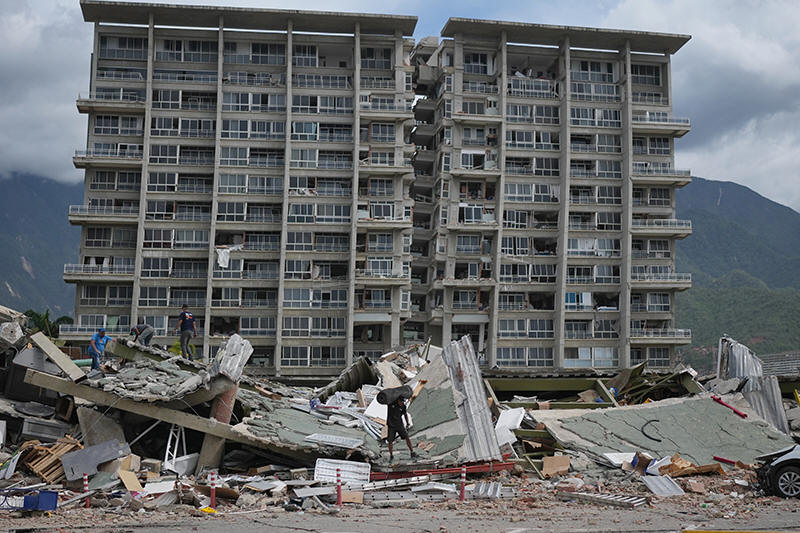
An earthquake-damaged building stands in La Guaira, Venezuela,
Sunday, June 28, 2026. (AP Photo/Matias Delacroix)

She felt a swell of hope when rescue teams from the U.S. had come to
inspect the building and confirmed to them that her dad was still alive
under the rubble. But they told the family that the building was too
unstable to enter and rescue him, she said.
They left the scene, but Guedez said would continue to try and rescue
their father without their assistance. She said they were now working
with civilian volunteers and local miners to get him out.
“We're not going to give up," said Guedez. “The rest of the team is
willing to continue. They know there's another way to get him out and
they said they're going to keep working until the very end.”
Despite the overwhelming demand for medical services and the shortage of
supplies in Venezuela’s public health system, Domingo Luciani Hospital
in the capital of Caracas coped with an influx of patients thanks to a
flood of donations.
“We have tons of patients, but thank god, people have responded by
bringing us a great deal of supplies,” said Leomery Pérez, an
anesthesiologist at the hospital.
Authorities said they had treated more than 3,100 wounded people,
including many with crush injuries.
A big challenge for Venezuela's acting president
The disaster poses a significant challenge for acting President
Rodríguez, the former vice president who took office in January after
the U.S. capture and removal of then-President Nicolás Maduro.
Since then, the U.S. government has played in increasingly powerful role
in dictating the future of the South American nation. Venezuela has
faced economic disarray for more than a decade, and many people reject
the legitimacy of the political movement Rodríguez represents.
The country now faces an even more difficult circumstances, said Ronal
Rodríguez, researcher for the Bogotá-based Venezuelan Observatory at the
University of Rosario.

“There is political interference by the United States, the operational
incompetence of a government that has driven the country into a complex
humanitarian crisis and, all of the sudden, an earthquake in a place
that lacks human capital and short-term resources to address the
situation,” he said.
Amy Pope, director general from International Organization for
Migration, warned that displacement from Venezuela – where crisis has
forced 8 million people to migrate over the past decade – was likely to
increase as people seek safety.
Rodríguez on Sunday said she was setting up a special commission to
assess the damage to homes to confirm whether it's safe for people
sleeping on the streets to return, adding that her government would also
examine infrastructure damage. The search for life in the destruction,
she said, would also continue.
“Today we recovered people who are still alive,” she said. “We always
maintain hope.”
___
Janetsky reported from Mexico City. Associated Press journalists Juan
Pablo Arraez, Matías Delacroix in La Guaira, Venezuela; Jorge Rueda in
Caracas, Venezuela; Clara Preve and Mayra Pertossi in Buenos Aires,
Argentina; and Elliot Spagat in San Diego, contributed to this report.
All contents © copyright 2026 Associated Press. All rights reserved |