US and Iran pause strikes but disagree over next steps on talks
[June 30, 2026]
By JON GAMBRELL and JOSH BOAK
DUBAI, United Arab Emirates (AP) — The United States and Iran on Monday
separately announced they will send delegations to Qatar this week,
though Tehran insisted it has not agreed to meet with the U.S. “at any
level” after attacks across the Persian Gulf over the weekend challenged
negotiations to end the war.
U.S. President Donald Trump said the Islamic Republic had requested a
meeting with U.S. counterparts and that they planned to convene Tuesday
in Doha, Qatar.
But one of Iran's senior negotiators denied talks had been scheduled.
And the spokesman for Iran's Foreign Ministry said Tehran was sending
its delegation to Qatar, a key mediator in the negotiations, to discuss
terms of the interim deal without involving the U.S.
Hostilities mounted in recent days in the Strait of Hormuz, through
which a fifth of the world's oil had been shipped before war began.
After four days of trading strikes, both sides appeared to pause their
attacks Monday.
The U.S. and Iran agreed to an interim deal earlier this month that
calls for Tehran to dilute its stockpile of enriched uranium. It also
waives U.S.-backed oil sanctions on the country, calls for free traffic
through the Strait of Hormuz and gives each side 60 days to hammer out
broader agreements.
Confusion mounts over next round of Iran-US talks
After Trump said Monday morning on social media that the U.S. and Iran
planned to meet, White House press secretary Karoline Leavitt told Fox
News’ “Fox & Friends” that special envoy Steve Witkoff and Jared
Kushner, the president’s son-in-law, were flying to Qatar.

Pakistan, also a key mediator, had said talks between Iran and the U.S.
would resume Tuesday.
But Kazem Gharibabadi, a senior negotiator for Iran, said in comments
published by Iranian state media that no talks had been confirmed. And
Esmail Baghaei, spokesman for Iran's Foreign Ministry, said that its
delegation was traveling to Qatar this week to discuss the planned
release of frozen Iranian assets and other issues related to the deal.
“There are no negotiation meetings with the U.S. side at any level
scheduled in the coming days,” Baghaei said.
However, that left open the possibility messages being passed to the
Qataris between the two sides.
Increased tension in waterway vital to world energy supplies
During the war that began Feb. 28, Iran’s attacks and threats stopped
cargo ships and tankers from moving through the Strait of Hormuz,
creating a global energy crisis.
In recent days, Iran has twice attacked vessels in the strait —
including a tanker filled with Qatari crude — following efforts to open
Oman’s territorial waters to both inbound and outbound traffic from the
Persian Gulf.
The attacks drew retaliatory American airstrikes and raised concerns
that negotiations to reach a formal end to the war could be disrupted.
Iran launched drone and missile attacks targeting Bahrain and Kuwait on
Sunday.
The strait has long been considered an international waterway despite
being in Iran and Oman’s territorial waters.
The Trump administration was operating Monday on the understanding that
the U.S. and Iran are standing down after the recent back-and-forth
strikes and that vessels can move freely through the Strait of Hormuz,
said a U.S. official who requested anonymity to discuss the sensitive
negotiations.
Iran's president, U.S. official say $6 billion coming to Iran
The U.S. official also said that Qatar planned to release $6 billion in
frozen Iranian assets that would be used to purchase U.S. food products
for the Iranian people.

[to top of second column]
|
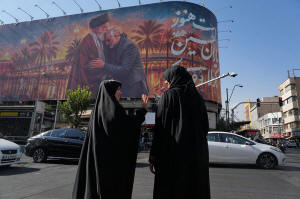
Women talk in front of a banner with graphic depicting the slain
Iranian Supreme Leader Ayatollah Ali Khamenei kissing head of the
late commander of Iran's Revolutionary Guard expeditionary Quds
Force, Gen. Qassem Soleimani, who was killed in a U.S. drone attack
in 2020 in Iraq, as they wait for the green light to cross an
intersection in downtown Tehran, Iran, Monday, June 29, 2026. (AP
Photo/Vahid Salemi)

Iranian President Masoud Pezeshkian had announced the expected
release of funds earlier Monday in comments published by the
state-run IRNA news agency.
Pezeshkian, a reformist within Iran's theocracy, is the
highest-ranking official within Iran to reference the release of the
funds held by Qatar.
Oman, Iran discuss possible fees for ships transiting the strait
Oman's foreign minister, Badr al-Busaidi, said Monday that Oman and
Iran are considering charging service-related fees for commercial
ships transiting the Strait of Hormuz.
Al-Busaidi said services could include water safety measures,
pollution prevention, navigational assistance and preparedness for
incidents such as fires. He told Radio Monte Carlo that Oman does
not support imposing transit fees on ships.
“This is internationally forbidden," he said, "and we are abiding by
these rules."
But there had never been any fees charged in the strait — and other
Gulf Arab states and the U.S. firmly oppose the imposition of any
costs for transit.
Iran and France clash over clearing mines from strait
An Iranian official warned France against “provocations” Monday
after French President Emmanuel Macron posted on X that France and
others were coordinating efforts to clear mines from the Strait of
Hormuz.
Kazem Gharibabadi, an Iranian deputy foreign minister, said on X
that under the interim deal “demining is carried out solely by Iran
and by no other country.”
Macron's post came after he greeted Sultan Haitham bin Tariq of Oman
ahead of high-level diplomatic talks in Paris.
Lebanon's president says it will deploy troops as part of deal
with Israel
Lebanese President Joseph Aoun separately said Monday that Lebanon
is determined to deploy troops along its entire southern border as
part of a framework agreement with Israel signed Friday. He made the
remark while meeting with Adm. Brad Cooper, the top U.S. military
commander in the Middle East.

The deal was rejected by the Iran-backed Hezbollah militant group,
which triggered the latest war with Israel on March 2 when it fired
rockets across Lebanon's southern border and into northern Israel.
The Israel-Lebanon deal calls for Hezbollah to be disarmed before
Israel will withdraw its troops from southern Lebanon. Israel agreed
to withdraw initially from a couple of “pilot zones” where the
Lebanese army would then deploy, but no details have been shared
about how that will work in practice.
Hezbollah officials have warned that attempts to implement the plan
could lead to civil war.
___
Boak reported from Washington. Associated Press writers Nasser
Karimi and Amir Vahdat in Tehran, Iran; Bassem Mroue and Sally Abou
AlJoud in Beirut; Sylvie Corbet in Paris and Russ Bynum in Savannah,
Georgia, contributed to this report.
All contents © copyright 2026 Associated Press. All rights reserved |