Supreme Court says Fed’s Cook can keep her job for now, but it upholds
other Trump firings
[June 30, 2026]
By MARK SHERMAN
WASHINGTON (AP) — The Supreme Court on Monday dramatically expanded
presidential power, upholding President Donald Trump’s firings of the
heads of independent federal agencies with one important exception: the
Federal Reserve.
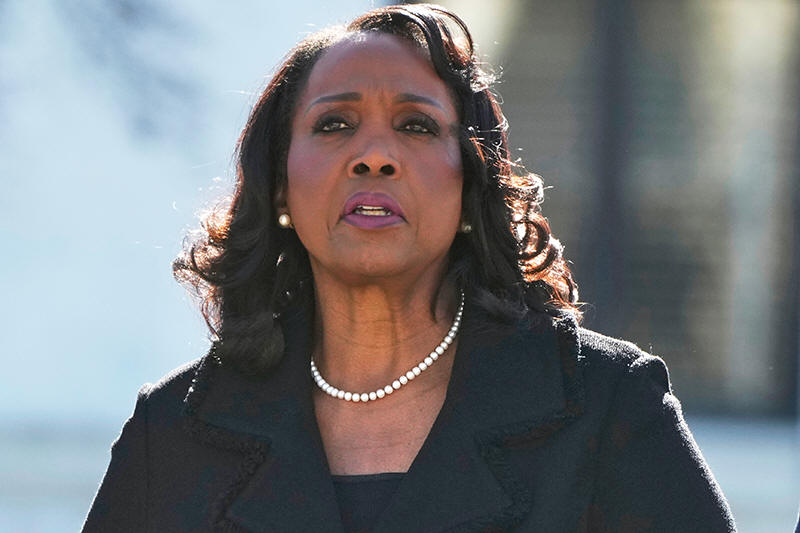
The justices allowed Fed governor Lisa Cook to stay in her job while she
fights the Republican president’s effort to fire her over allegations of
mortgage fraud, which she has denied.
But other than at the nation’s central bank, with its role of setting
interest rates, the court held that presidents have free rein to fire
agency heads at will, despite federal laws that require a cause for such
dismissals and a 91-year-old decision that had limited executive
authority.
With the six conservative justices in the majority, the nine-member
court jettisoned its unanimous decision in Humphrey’s Executor that had
limited when presidents can fire agencies’ board members — in part to
try to ensure decision-making free of political influence.
“We hold that such protection from removal is contrary to the separation
of powers enshrined in the Constitution,” Chief Justice John Roberts
wrote for the court.
Support for Trump’s position
The justices ruled in the case of former Federal Trade Commission member
Rebecca Slaughter, whom Trump fired without cause despite a provision of
federal law that requires a reason. The logic of the decision extends to
other agencies, including the National Labor Relations Board, the Merit
Systems Protection Board and the Consumer Product Safety Commission,
where Trump also has fired board members.

Trump voiced his approval in a Truth Social post. “It is such an Honor
to be the sitting President who won this Historic and Unprecedented
Ruling, one of the most important ever given with respect to
Presidential Powers,” he wrote.
The court already had signaled its support for the Trump
administration’s position, over the liberals’ objection, by allowing
Slaughter and the board members of other agencies to be removed from
their jobs even as their legal challenges continued.
No president before Trump had sought to wrest control of the agencies
that regulate wide swaths of American life, including nuclear energy,
product safety and labor relations. But at arguments in Slaughter's case
in December, the six conservatives, including three appointed by Trump,
seemed more concerned about issuing a ruling that would endure than
handing too much power to Trump.
Their rhetoric was reminiscent of the presidential immunity case in 2024
that allowed Trump to avoid prosecution for his efforts to undo his 2020
presidential election loss to Democrat Joe Biden. The court is writing a
decision “for the ages,” Justice Neil Gorsuch said then.
Justice Sonia Sotomayor, in a dissent she summarized aloud in the
courtroom, said the ruling could lead to “submission, instability, and
even oppression.”
“The president, to be sure, emerges with more power than ever before.
That power was given to him by six justices on this court, not the
people or the Constitution,” Sotomayor said.
Fed governor Cook's case
In Cook’s case, the court voted 5-4 to reject the Trump administration’s
effort to get Cook out of her job now. Roberts, Justice Brett Kavanaugh
and the three liberal justices were in the majority.
Allowing Cook to be ousted now, Roberts wrote, “would allow the
President to remove a member of the Federal Reserve at any time, for any
reason, without any notice before, and without any judicial check after.
That would turn for-cause protection into little more than at-will
employment.”
Roberts did include a footnote in his opinion noting that nothing
forbids Trump from “trying again” to fire her, provided she is given
proper notice and a chance to contest it.

[to top of second column]
|
Federal Reserve Board of Governors member Lisa Cook leaves the
Supreme Court in Washington, Jan. 21, 2026. (AP Photo/Mark
Schiefelbein, File)

Trump suggested he would take Roberts up on the offer, saying on
Truth Social that “we will take appropriate action immediately to
make sure that someone who has committed wrongdoing will not be
making vital decisions concerning the Welfare of the United States
of America!”
Cook, who was nominated to the Fed’s Board of Governors by Biden,
can continue in her post at least as long as her lawsuit challenging
her firing goes on, the court said. The Trump administration is
appealing a lower-court ruling in her favor.
Besides trying to fire Cook, Trump had threatened to fire former
Federal Reserve chairman Jerome Powell if he didn’t leave the board
when his term as chairman ended in mid-May. Powell has remained as a
governor, even as Kevin Warsh has replaced him as chairman.
Judges on lower courts have allowed Cook to remain in her post as
one of seven central bank governors.
The true motivation for trying to fire Cook, Trump’s critics say, is
the Republican president’s desire to exert control over U.S.
interest rate policy. If Trump succeeds in removing Cook, the first
Black woman to be a Federal Reserve governor, he could replace her
with his own appointee and gain a majority on the Fed’s board. The
case is being closely watched by Wall Street investors and could
have broad impacts on the financial markets and the U.S. economy.
Cook said her case was “never about mortgage documents signed years
before I became a Federal Reserve governor.”
"It was an attempt to remove me on a manufactured pretext because I
refused to bow to political pressure and continued to set interest
rates based only on what would best serve the American people. That
is the most fundamental obligation of a Federal Reserve governor,”
Cook said in a statement.
Trump's confrontation with the Fed
Trump has been dismissive of worries that cutting rates too quickly
could trigger higher inflation. He wants dramatic reductions so the
government can borrow more cheaply and Americans can pay lower
borrowing costs for new homes, cars or other large purchases, as
worries about high costs have soured some voters on his economic
management.

The Fed has left its key rate unchanged this year, but a growing
chorus of policymakers is expressing concern about persistently high
inflation and suggesting the central bank could raise its benchmark
rate by the end of this year or leave it unchanged.
While Cook’s case was under review at the high court, Trump
dramatically escalated his confrontation with the Fed. The Justice
Department opened a criminal investigation of Powell and served the
central bank with subpoenas.
The investigation ended in late April, the department said. The
announcement cleared a major roadblock to the confirmation of Warsh
as Powell’s successor.
The case against Cook stems from allegations she claimed two
properties, in Michigan and Georgia, as “primary residences” in June
and July 2021, before she joined the Fed board. Such claims can lead
to a lower mortgage rate and smaller down payment than if one of
them was declared as a rental property or second home.
Those applications, Solicitor General D. John Sauer said in January,
are evidence of “gross negligence at best” and give Trump reason to
fire her. In any event, he argued, courts shouldn’t be reviewing his
decision and Cook has no right to a hearing.
Cook has denied any wrongdoing and has not been charged with a
crime.
All contents © copyright 2026 Associated Press. All rights reserved |