Racial slur at BAFTA awards stirs complex feelings for Black people with
Tourette syndrome
[March 02, 2026]
By TERRY TANG
For Black people living with Tourette syndrome, the British Academy Film
and Television Arts Awards incident earlier this week where a vocal tic
manifested as a racial slur while two Black stars of the movie “Sinners”
were onstage has left them with complicated feelings.
“It’s been pretty difficult because I feel like there’s such a clash
between both sides,” said Chloe Winston, 24, who experiences coprolalia,
the same verbal tic as John Davidson, the BAFTA nominee and Tourette
syndrome advocate who yelled the slur. “A tic is not intentional, but it
still causes harm. And I think that does require accountability.”
Davidson's utterance just as Michael B. Jordan and Delroy Lindo were
presenting the first award of that night's ceremony ignited a firestorm
that overshadowed Sunday's BAFTAs. There was immediate outrage that the
actors and other Black attendees were subjected to the slur. Then there
was frustration from the disability community at a lack of understanding
about Tourette syndrome. But anger has been loud and widespread for
broadcaster BBC because of its decision to allow the racial slur to air
uncensored two hours after the live event. Most live awards shows like
the Oscars operate on a seconds-long tape delay.
The BAFTA and BBC apologies also were criticized as insufficient. The
BBC plans to edit it out of its iPlayer streaming service.
The ordeal has compelled Black people with Tourette syndrome, from
politicians to content creators, to speak out. They assert that showing
empathy for those dealing with the disorder doesn't minimize the pain
felt by the Black community. There needs to be acknowledgment of the
harm, some have said. Others also worry that misinformation or
stereotypes about Tourette syndrome could exacerbate racial profiling or
discrimination for Black people who live with it.
Now, advocacy groups are using the BAFTA moment to try to grow existing
support networks focused on Black people who feel isolated by Tourette
syndrome.

What is Tourette syndrome and coprolalia?
Tourette syndrome is a neurodevelopmental disorder characterized by
sudden, involuntary movements and/or sounds called tics, according to
the Tourette Association of America. These can be motor and vocal tics.
Tics can range from mild and inconsequential to moderate and severe and
can even be disabling in some cases.
“We know that there’s this sort of sensory and motor loop happening. And
again, similarly in the vocalizations, they typically start with things
like coughing, sniffing, or other just non-specific sounds, said Dr.
Jeremiah Scharf, a tic disorder specialist at Massachusetts General
Hospital.
In a majority of people, the symptoms begin to emerge during elementary
school age and peak between ages 10 and 14, according to Scharf. Roughly
1.4 million people in the U.S. live with Tourette syndrome or a
persistent tic disorder, according to the Centers for Disease Control
and Prevention.
Coprolalia is “the involuntary utterance of obscene and socially
unacceptable words and phrases.” The Tourette Association of America
estimates between 10%-15% of people with Tourette syndrome live with it.
The organization has cautioned against making assumptions about the
person based on the content of the tic.
These vocal outbursts — typically vulgarities and insults — are a
biological condition that can sometimes be triggered by stress such as
not enough sleep or being upset, Scharf said. The tics are hard to stop
and involuntary — almost like a sneeze.
“Unfortunately, for this subset of people, it is incredibly disabling
because they don’t want to say those things. It’s very distressing to
them,” said Scharf, who was talking in general terms and not about the
BAFTA awards incident specifically. “They feel significant remorse about
it.”
Treatment for severe tic disorders can range from medication to
behavioral therapies. Retraining the brain to handle tics is “takes an
enormous amount of practice in terms of recognizing when the tics are
coming,” Scharf said. But, there is no one-size-fits-all solution.

[to top of second column]
|
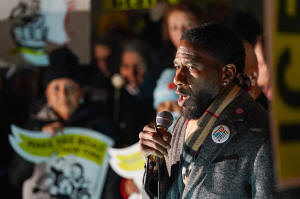
New York City Public Advocate Jumaane Williams delivers remarks
during a protest in response to the fatal shooting of Renee Nicole
Good by a federal immigration officer this morning in Minneapolis,
Wednesday, Jan. 7, 2026, in New York. (AP Photo/Ryan Murphy, File)
 Incident stirs up struggles
against racism and ableism
Jhónelle Bean, an American Sign Language interpreter who is Black
and has Tourette syndrome, took to TikTok after seeing so much
“all-or-nothing” discourse around the BAFTA awards. Her video about
the “complexity and duality of the situation” has garnered over 3
million views.
“Two things can be true at the same time,” Bean said. “Just because
he ticced that does not mean it was intentional. But then also that
still caused hurt or harm for people that heard it, which again is
why I’m mad at the BAFTAs and the BBC for keeping it in the
broadcast in the first place because they had the power to take it
out.”
The incident also brought up “ableism” comments that were flat-out
discriminatory. They included that Davidson, the man who shouted the
racial slur, “should have been locked away, he should’ve had a
muzzle, things like that,” Bean said.
At the same time, Bean disagreed with some engaged in the social
media discourse who said those who took offense over the N-word
needed to “get over it.”
Jumaane Williams, New York City's public advocate who is Black and
has Tourette syndrome, said it can be “painful both physically and
mentally” to hold in a tic. As someone who has coprolalia too,
Williams gives Davidson some credit for removing himself from the
situation though “maybe he could have moved a little sooner.”
“For me, it was all about making sure we’re practicing care. And I
don’t think that happened for the two actors that were there or the
Black folks who were there or people who didn’t want to hear the
word,” Williams said.
A demand for support groups for Black people with Tourette
syndrome
There's always going to be inherent concern if you are Black with
Tourette syndrome or any tic disorder, said Reice Griffin, 20, who
is a Tourette Association of America rising leader and ambassador.
She has had people witness her tics and assume she uses drugs or is
typically belligerent. And interacting with police can be even more
stressful.
“Law enforcement is not well equipped to deal with Tourette
syndrome, but also historically, as a Black person, you never really
want to be around law enforcement,” Griffin said.
The association, which offers printable “I Have TS” cards, is
actively trying to offer more support for people of color.
Griffin recently attended a virtual support group meeting for Black
young adults, and she has been speaking at schools and to groups to
become more comfortable with herself.

“I thought that because I had Tourette syndrome that, like, public
speaking was out the window,” Griffin said. “If I could help another
young Black girl with Tourette syndrome not feel as alone or help
people get diagnosed — that’s the dream.”
Williams, the New York City public advocate, agrees there is not
enough support for Black people with Tourette syndrome. He tries to
help by speaking about his own life. That has led to him hearing
directly from New Yorkers.
“Sometimes in the street or an event people will bring their family
member up which is always a pretty emotional space for me because
when I see the kid, I know what they’re going through,” Williams
said.
—-
Tang reported from Phoenix.
All contents © copyright 2026 Associated Press. All rights reserved |