Gaza's ceasefire had some momentum. Now, some fear a new war will
distract the world
[March 02, 2026]
By WAFAA SHURAFA, TOQA EZZIDIN and CARA ANNA
DEIR AL-BALAH, Gaza Strip (AP) — Some Palestinians say they fear the
widening war sparked by U.S. and Israeli attacks against Iran could
overshadow the fragile situation in Gaza, just over a week after U.S.
President Donald Trump rallied billions of dollars in pledges for the
territory's reconstruction and tried to nudge a ceasefire forward.
Residents say they are scared of neglect and deprivation, with Israel in
the wake of the weekend strikes closing all crossings into their
shattered territory of over 2 million people.
COGAT, the Israeli military body overseeing civilian affairs in Gaza,
asserted in its announcement of the closings that the food supply inside
the territory “is expected to suffice for an extended period.” It added
that the rotation of humanitarian workers in and out of Gaza is
postponed.
COGAT did not respond to a request for comment Sunday.
Palestinians told The Associated Press they were rushing to markets,
haunted by memories of painful food scarcity last year under months of
Israel's blockade. Part of Gaza, around Gaza City, was found to be in
famine.
“When the crossings shut down, everything was suspended from the
market," said Osamda Hanoda from Khan Younis. "The prices go up, and
people live in misery."
Reports show prices of goods rising sharply
The shaky Israel-Hamas ceasefire had led to more humanitarian aid and
other supplies entering Gaza, even as the United Nations and aid
partners say more of everything from basic medical supplies to fuel is
needed.
Now, Palestinians are hoarding again, with reports of prices rising
sharply for basic goods such as bags of flour.
“We are afraid of not finding milk" and diapers for the kids, or food
and water, said Hassan Zanoun, who was displaced from Rafah.
It was not clear when any crossing might reopen. Israeli authorities
focused on Iran, and citizens dashed repeatedly for shelter as sirens
wailed.

Ramadan is disrupted
The war in Gaza began with the Hamas-led attack on Israel on Oct. 7,
2023, and it's been marked from the start by restrictions on people and
supplies being allowed into the territory — and terrified people,
including medical evacuees in need of treatment, getting out.
A month ago, Gaza's main Rafah border crossing with the outside world —
its only crossing not with Israel — reopened, allowing a small and
tightly controlled flow of Palestinian traffic in both directions. No
cargo was allowed through.
Now all crossings are closed again in the middle of the holy Muslim
fasting month of Ramadan, a time of chosen deprivation, evening feasts
and prayer. Images have shown Palestinians lined up at long tables in
the middle of bombed-out debris.
The strikes on Iran shook that routine.
“All the people rushed to markets, and they all wanted to shop and
hide,” said Abeer Awwad, who was displaced from Gaza City, as word of
the explosions in Tehran began to spread.
Under the Oct. 10 U.S.-brokered ceasefire, the heaviest fighting has
subsided, though regular Israeli fire continues in Gaza. The U.N. World
Food Program has noted progress in the enclave but said in its latest
food security analysis last week that hunger remains.
[to top of second column]
|
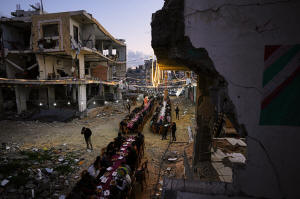
Palestinians gather for iftar, the fast-breaking meal, during the
Muslim holy month of Ramadan amid the rubble of destroyed buildings
in Gaza City, Thursday, Feb. 26, 2026. (AP Photo/Abdel Kareem Hana)

“Households reported an average of two meals per day in February
2026, compared to one meal in July," it said. "Still, one in five
households consumed only one meal daily.”
The World Central Kitchen, meanwhile, warned that it would run out
of supplies this week if Israel kept the strip’s crossings closed.
“We need food deliveries every single day to feed hungry families
who are not part of this war,” José Andrés, the celebrity chef who
founded the organization, said in a social media post.
He said WCK provides 1 million meals a day in Gaza, and that the
group and others working in war-torn Gaza need food and other
supplies every day
“We cannot wait...let the humanitarian trucks go through today!” he
said.
A challenge for aid groups and others
Refocusing the world's attention on Gaza is a challenge for aid
groups and others as Iran scrambles for new leadership and
explosions continue in Tehran, Israel and around the Middle East.
Trump has said bombing in Iran could continue through the week or
longer, and warned Tehran of “A FORCE THAT HAS NEVER BEEN SEEN
BEFORE!” if it escalates attacks.
It's a dramatic turn from Trump's launch less than two weeks ago of
his new Board of Peace, a gathering of world leaders that is aimed
at ending the war in Gaza but has ambitions of resolving conflicts
elsewhere.
Even with that bump in momentum on Gaza, major challenges remain for
the ceasefire. They include disarming Hamas, assembling and
deploying an international stabilization force, and getting a newly
appointed Palestinian committee meant to govern Gaza into the
territory.
As the Middle East turns to another war, some Palestinians see a
benefit: Israel's military is distracted.
“The good thing is that the sound of booms and demolitions is rare
now near the yellow line,” said Ahmed Abu Jahl, of Gaza City,
speaking about the line dividing Gaza and marking out roughly half
the territory controlled by Israeli forces.
"Even the drones, they are still flying overhead, but their number
has gone down.”
___
Ezzidin reported from Cairo and Anna from Lowville, New York.
All contents © copyright 2026 Associated Press. All rights reserved
 |