Energy prices surge as tanker disruptions and facility shutdowns rattle
global supply
[March 03, 2026] By
DAVID McHUGH and CATHY BUSSEWITZ
FRANKFURT, Germany (AP) — Energy prices rose sharply Monday as
disruptions to tanker traffic through the Strait of Hormuz and damage to
production facilities raised uncertainty about how U.S. and Israeli
attacks on Iran would affect supply to the world economy.
The biggest shock was to natural gas prices, which rose more than 40% in
Europe when QatarEnergy, a major supplier, halted production of
liquefied natural gas after its facilities were attacked.
“Infrastructure is at risk throughout the region, and it’s not just at
risk because of deliberate attacks, but also inadvertent attacks," said
Kevin Book, managing director at Clearview Energy Partners. “Shrapnel
and debris from missile interceptions can fall onto facilities and
disable them too, and so there are a number of challenges that come from
this kind of conflict in an area with so much energy production.”
U.S. oil rose 6.3% to $71.23 per barrel, while international standard
Brent was up 6.7% to settle at $77.74 per barrel.
Higher oil prices raise the prospect of costlier gasoline for U.S.
drivers as well as increased prices for other goods at a time when
people in many countries have been stung by inflation.
A key focus was the Strait of Hormuz at the southern end of the Persian
Gulf, through which 20% of the world's oil supply passes. Tanker traffic
dropped sharply as satellite navigation systems were disrupted, data and
analytics firm Kpler said on X. The U.K. Maritime Trade Operations
Center reported attacks on several vessels in the area on either side of
the strait and warned of elevated electronic interference to systems
that show where ships are.
A bomb-carrying drone boat struck a Marshall Islands-flagged oil tanker
in the Gulf of Oman, killing one mariner, Oman said.

Iran has been threatening vessels approaching the Strait of Hormuz and
is believed to have launched multiple attacks.
That's resulting in a “de facto closure” of the strait, defined by the
risk tolerance of ship operators and sea captains, with traffic slowing
to a trickle, Book said. “The reality though is the insurance companies
are raising prices or, in some cases, canceling policies and sea
captains have risk concerns. So too do ship owners and shippers,” he
added.
Saudi Arabia intercepted Iranian drones that attacked the Ras Tanura oil
refinery near Dammam and the refinery was shut down as a precaution,
Saudi state television reported. Market attention has focused on whether
the conflict will widen to other oil-producing countries in the region.
Oil price shock comes as US gas prices were already rising
The price of crude is the single largest factor in how much U.S. drivers
pay for fuel — a highly political issue ahead of midterm Congressional
elections. And higher oil prices are usually felt at the pump within a
couple of weeks at most.
Gas prices are already rising ahead of the summer driving season as
people travel more. The national average for a gallon (3.7 liters) of
regular went up by 6 cents Monday to $2.99, according to motoring club
AAA.
Crude price increases are substantially reflected in pump prices in 20
days and a $10 per barrel increase typically results in around a 25 cent
rise per gallon, according to 2019 research by the Federal Reserve Bank
of Dallas.
The price of crude has less impact in Europe, where taxes make up most
of the price of fuel, but higher energy costs can affect prices across
the economy. A sustained rise of $15 per barrel could add 0.5 percentage
points to consumer prices in Europe, according to Holger Schmieding,
chief economist at Berenberg bank.
No way around the Strait of Hormuz for much of the oil
There are pipelines that circumvent the strait, but they don't have
enough capacity to move all the oil that passes through the waterway.
Saudi Arabia, Iraq and the United Arab Emirates all depend on tankers to
get the bulk of their oil to global markets.
Analysts say completely blocking the strait would hurt Iran too since
all of its 1.6 million barrels per day pass through the strait. Most of
that goes to China, where refineries are less concerned about U.S.
sanctions that prevent Iran from selling its oil elsewhere.
[to top of second column] |
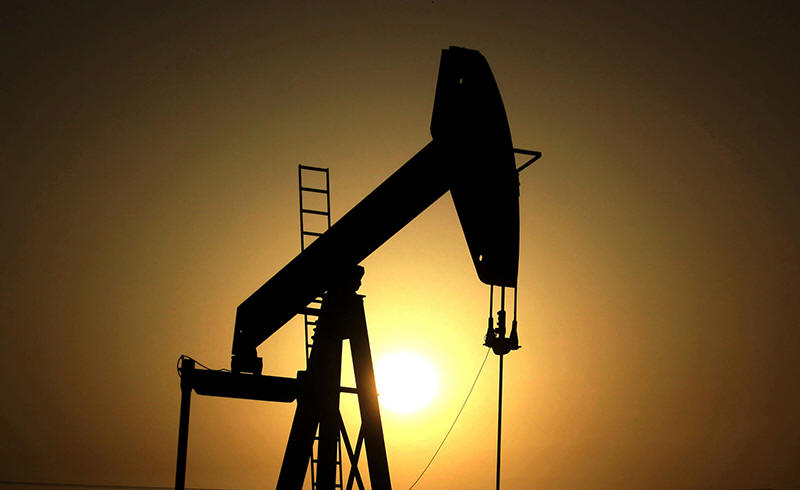
In this Wednesday, June 8, 2011 file photo, sun sets behind an oil
pump in the desert oil fields of Sakhir, Bahrain. (AP Photo/Hasan
Jamali, File)
 “Iran has essentially two ways to
close the strait. One is to harass or attack ships, and the other is
to lay down mines," Book said. "And without a Navy, both of those
things would be difficult. So, if the president succeeds in
‘annihilating,’ in his words, the Iranian Navy, then long-term
prospects of closure should decline, and that should increase the
likelihood that ships will start sailing again.”
The strait is also a key route for liquefied natural gas. European
futures contracts for April delivery shot up to 45.46 euros ($53.26)
on the ICE commodities exchange after QatarEnergy said it would stop
its production of liquefied natural gas. The state-owned firm blamed
the war for the decision.
Qatar is a major gas supplier for Europe, which relies on shipments
of liquefied gas, or LNG, to replace supplies of Russian pipeline
gas lost due to the invasion of Ukraine.
Long-term disruption could send prices higher
Monday’s price increase was within the $5-$10 per barrel range
expected by analysts based simply on the fear factor associated with
the outbreak of war. And some war concerns were already reflected in
the price before the conflict started.
However, long-term disruption to ship traffic in the Strait of
Hormuz could send prices even higher, and so could damage to oil
infrastructure in other Gulf countries. Meanwhile, a shorter
conflict in which disruptions are easily reversible could mean the
current price spike won’t last.
On Monday, U.S. President Donald Trump said that the U.S. expected
its military operations against Iran to last four to five weeks but
has “ the capability to go far longer.”
“The key question for the global economy is obvious: Will the Strait
of Hormuz be effectively closed for oil and gas exports for more
than a few weeks?” Schmieding said. “If so, it would hurt global
growth and raise global inflation noticeably. But I would expect
Trump to go to great lengths to prevent a lasting surge in energy
prices that could hurt him at home ahead of the U.S. midterm
elections in November.”
He forecast oil prices would return to $65-$70 per barrel after a
near-term spike.
Uncertainty and volatility are likely to continue
Iran’s attack on the Ras Tanura refinery represents a major
escalation, a Middle East analyst said, with Iran demonstrating that
key Gulf energy infrastructure is within its reach, and investor
sentiment likely to worsen.

Torbjorn Soltvedt, principal Middle East analyst at risk
intelligence company Verisk Maplecroft, said Iran's goal is to raise
the economic costs of the conflict for Gulf states like Saudi Arabia
and the United Arab Emirates, hoping that these countries will
pressure the U.S. and Israel to de‑escalate.
He said that the coming days and weeks will be marked by uncertainty
and volatility in global markets, with oil prices likely to push
past $80 per barrel.
“If we start to see additional direct attacks against energy
infrastructure, not just in Saudi Arabia and Kuwait, but in other
countries in the region, then that’s when the market will start to
think about a push toward $90 and perhaps even beyond.”
___
Associated Press writers Suzan Fraser in Ankara, Turkey, and Jon
Gambrell in Dubai, United Arab Emirates, contributed to this report.
Bussewitz reported from New York.
All contents © copyright 2026 Associated Press. All rights reserved |