Trump pushes back on mounting criticism about his Iran war battle plan
as conflict spreads
[March 03, 2026]
By AAMER MADHANI
WASHINGTON (AP) — President Donald Trump on Monday pushed back against
mounting criticism that he hasn't done enough to explain why it was
necessary to start a war with Iran now or to articulate his vision for
an endgame to the escalating conflict.
The frustration is coming not just from the political left but also from
his “Make America Great Again” base, as the conflict expands, energy
prices surge, and the death toll in the Middle East rises in a war that
the administration suggests may only be in the opening stages.
Trump also seemed to leave open the possibility for a more extensive
U.S. military involvement, telling the New York Post on Monday that he
was not ruling out the possibility of boots on the ground. It came as
Defense Secretary Pete Hegseth told reporters that the administration
would not get into the “foolish” exercise of telegraphing “what we will
or will not do.”
“I don’t have the yips with respect to boots on the ground — like every
president says, ‘There will be no boots on the ground.’ I don’t say it,”
Trump said. “I say ‘probably don’t need them,’ (or) ‘if they were
necessary.’”
The president, and top aides, sought to defend his approach as Iran
continues to retaliate by firing drones and missiles at Israel, American
bases in the region, and at Persian Gulf neighbors. Israel and
Hezbollah, the Iran-backed militia in Lebanon, also traded strikes on
Monday, opening another front in the conflict.
Some in MAGA world are fuming
Trump strode back into office last year on an “America First” pledge to
keep the U.S. out of the sort of “forever wars” that bogged down some of
his recent White House predecessors. Central to his foreign policy
outlook dating to his first campaign has been his call to “abandon the
failed policy of nation building and regime change.”

He echoed this call during a visit to Saudi Arabia last year, saying
that “so-called ‘nation-builders’ wrecked far more nations than they
built — and the interventionists were intervening in complex societies
that they did not even understand themselves.”
But now Trump finds himself in a war of his own choosing that's spurring
concern the U.S. could be dragged into another prolonged conflict in the
Middle East.
“I’m not happy about the whole thing. I don’t think this was in
America’s interests,” Erik Prince, a longtime Trump ally and a prominent
private security contractor said Sunday in an appearance on former Trump
adviser Steve Bannon's “War Room” podcast. “It’s gonna uncork a
significant can of worms and chaos, and destruction in Iran now.”
Prince added, “I don't see how this is in keeping with the president's
MAGA commitment. I am disappointed.”
Other prominent allies questioning the decision to strike Iran include
YouTube host Benny Johnson, influencer Andrew Tate, and conservative
commentator Tucker Carlson.
Trump, in an interview with journalist Rachael Bade published Monday
evening, dismissed some of the concerns as being out of step with the
MAGA movement writ large.
“MAGA wants to see our country thrive and be safe. And MAGA loves what
I’m doing — every aspect of it,” Trump said. He added that Iran “is a
detour that we have to take in order to keep our country safe and keep
other countries safe, frankly.”
To be certain, many of Trump's staunch allies say they back Trump's
decision, and see no signs of schism in their movement.
“No, ma’am, I think Iran, they’re bad actors,” Rep. Tim Burchett, R-Tenn.,
told a reporter who asked about the divide. “They’ve killed Americans.
In Iraq, they supply armaments. Hezbollah is part of their pact and
they’ve supplied them with armaments and funds. And they do business
with Chinese, so absolutely not. I think we’re good.”

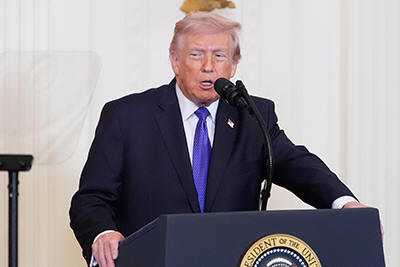
Trump, speaking at a White House event on Monday, said the joint U.S.
and Israel military operation was “substantially ahead of schedule” and
estimated that it would take four to five weeks to meet the
administration's objectives — although he said it could take longer.
“We have capability to go far longer than that,” Trump said.
Hegseth was even more vague about the time frame.
“President Trump has all the latitude in the world to talk about how
long it may or may not take. Four weeks, two weeks, six weeks,” Hegseth
said. “It could move up. It could move back.”
[to top of second column]
|
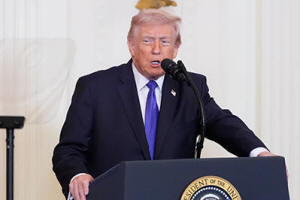
President Donald Trump speaks about Iran before a Medal of Honor
ceremony in the East Room of the White House, Monday, March 2, 2026,
in Washington. (AP Photo/Alex Brandon)

The U.S. military expects to endure additional casualties in its
operation against Iran, Joint Chiefs Chairman Dan Caine told
reporters. As of Monday, six U.S. service members had been killed in
action and others badly injured as Iran carried out a barrage of
retaliatory strikes around the region.
Regime change or regime collapse?
The administration has not detailed who it wants to see take control
of Iran following the killing of Iranian Supreme Leader Ayatollah
Ali Khamenei and dozens of other top leaders in the opening salvos
of the conflict.
Trump in announcing the start of the major combat operations called
on the Iranian Revolutionary Guard Corps to put down their arms. But
history suggests that air power alone is unlikely to bring about the
kind of regime change that Trump says he wants to see in Iran.
The president also hasn't committed to assisting members of the
Iranian opposition who he has called on to rise up against the
ruling Islamic theocracy once the bombing campaign is done.
Trita Parsi, executive vice president of the Quincy Institute for
Responsible Statecraft, a Washington think tank, said that Trump may
ultimately be willing to settle for a “regime collapse” or “regime
implosion.”
“That is very different (than regime change), not only because
potentially it could be achieved, but it’s also something that
enables the Trump administration to wash their hands of the
consequences of this,” Parsi said.
Still, Israel is pressing Trump for a sustained operation that could
deliver a decisive blow to Iran's clerical rule.
“I think the Israelis' biggest concern may be that President Trump
would take … sort of the early offering, declaring victory,” said
Daniel Shapiro, a former U.S. ambassador to Israel during the Obama
administration who is now a distinguished fellow at the Atlantic
Council. “I think they’d like to see this go longer, with the
president’s support.”
Questions about Trump's rationale
Trump administration officials told congressional staff in private
briefings Sunday that U.S. intelligence did not suggest Iran was
preparing to launch a pre-emptive strike against the U.S. The
administration officials instead acknowledged there was a more
general threat in the region from Iran’s missiles and proxy forces.

Yet Trump on Monday repeated his assertion that the U.S. needed to
take action because of concerns that Iran was aiming to build
ballistic missiles that could reach the United States.
Iran hasn’t acknowledged it is building or seeking to build
intercontinental ballistic missiles. The U.S. Defense Intelligence
Agency, however, said in an unclassified report last year that Iran
could develop a militarily viable intercontinental ballistic missile
by 2035 “should Tehran decide to pursue the capability.”
The president also repeated his claim that Iran was seeking to
rebuild its nuclear program even after U.S. strikes carried out last
June during the 12-day Israel-Iran war had in his words
“obliterated” three key nuclear facilities.
Rafael Grossi, head of the International Atomic Energy Agency, on
Monday reaffirmed that Iran has an “ambitious” nuclear program but
doesn’t have a program for building nuclear weapons currently. Iran
has refused to let IAEA inspectors visit its damaged nuclear sites.
Kelsey Davenport, the director for nonproliferation policy at the
Arms Control Association, said “regime change is not a viable
nonproliferation strategy.”
“Iran’s nuclear program cannot be bombed away. Iran’s nuclear
knowledge cannot be bombed away,” she said. “Even if there’s regime
change, Iran’s program will still pose a proliferation risk.”
___
AP journalists Seung Min Kim, Nathan Ellgren, and Didi Tang
contributed reporting.
All contents © copyright 2026 Associated Press. All rights reserved |