Lebanon’s leaders turn on Hezbollah as airstrikes hit Beirut and
thousands seek shelter
[March 03, 2026]
By FADI TAWIL and BASSEM MROUE
BEIRUT (AP) — The Israeli military on Tuesday struck a building housing
Hezbollah-aligned Al-Manar channel studios in Beirut’s southern suburbs
following an evacuation warning, the channel said. In a statement, the
Israeli military said it targeted “Hezbollah command centers and weapons
storage facilities in Beirut.”
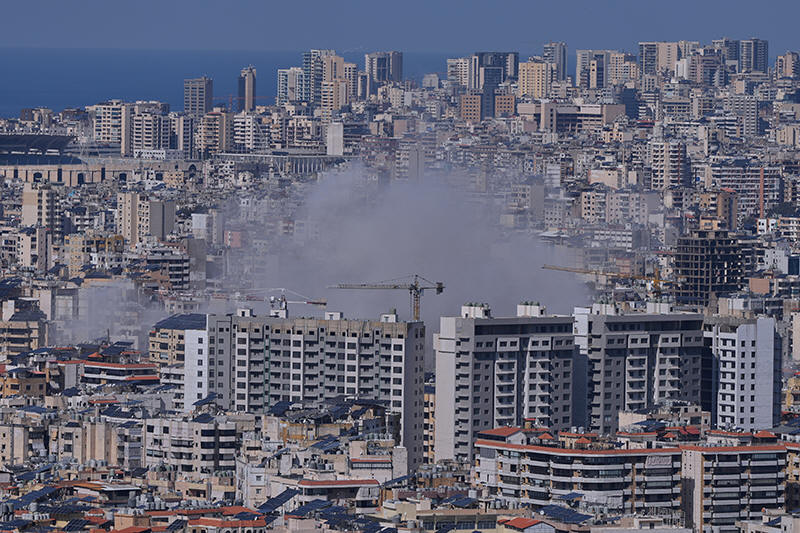
Following the strike, plumes of smoke were seen billowing over the
skyline. No immediate details on casualties were available.
Al-Manar’s headquarters and transmission facilities in Beirut were last
struck by Israel during the 2006 war between Israel and Hezbollah.
The renewed airstrikes that began Sunday prompted Lebanese civilians to
flee the country's south and Beirut’s southern suburbs Monday, seeking
refuge in Lebanon's capital following a new and deadly escalation
between Israel and the Iran-allied Lebanese militant group Hezbollah
that left more than 50 people dead.
The Hezbollah missile and drone attacks on northern Israel after
midnight Sunday triggered waves of Israeli airstrikes and also brought
the harshest criticism yet to the Iran-backed group from the country's
leaders.
Lebanon’s Health Ministry reported at least 52 people were killed and
154 wounded in overnight strikes in the Beirut suburbs and southern
Lebanon. The Ministry of Education said that schools will also be closed
Tuesday because of the situation.
During the day, Israel's military carried out dozens of airstrikes on
Beirut's southern suburbs as well as southern and eastern Lebanon.
Shortly after sunset, an Israeli airstrike in a Beirut neighborhood
caused widespread damage and the Israeli military said it targeted a
senior Hezbollah official.

The Israeli military earlier said it struck more than 70 weapons storage
facilities, launch sites and missile launchers belonging to Hezbollah.
The military also said it killed senior Hezbollah intelligence official
Hussein Mokaled.
Also on Monday, the Israeli military launched a wave of strikes on
branches of al-Qard al-Hasan, a Hezbollah-linked microfinance
institution, that Israel said is being used to fund the group's military
wing.
The government heavily criticizes Hezbollah's actions
The Palestinian Islamic Jihad group said the commander of its military
wing in Lebanon was also killed in an airstrike south of Beirut
overnight.
The Israeli military said that Hezbollah fired a drone toward northern
Israel on Monday evening adding that it was successfully intercepted.
Earlier on Monday, the Lebanese government slammed Hezbollah’s decision
to enter Iran’s war with Israel and the United States, calling the
militant group’s actions illegal and demanding it hand over its weapons.
“There is a side that wants to drag the country to matters that we have
nothing to do with,” the Lebanese information minister quoted President
Joseph Aoun as saying during an emergency meeting of the Cabinet that
discussed the escalation. Aoun was referring to Hezbollah.
In a statement early Tuesday, Hezbollah said “confrontation is a
legitimate right,” describing its firing of rockets toward Israel as “a
reaction to the aggression," and adding that it had repeatedly warned
that Israeli attacks “could not continue without a response.” Israel has
continued near-daily strikes, primarily in southern Lebanon, since a
ceasefire was reached with Beirut in late 2024.
Highways were jammed overnight and into Monday with people fleeing after
what was Israel's deadliest barrage on Lebanon in more than a year,
striking hours after Hezbollah fired missiles across the border for the
first time in more than a year.

Ali Hamdan was stuck in gridlock on the road between his village in
southern Lebanon, Deir al-Zahrani, and the port city of Sidon. What
should have been a half-hour’s drive had taken seven hours, he said.
“I don’t know how long it will take us to reach Beirut," he said. "I’m
headed toward Beirut, but I don’t know where yet. We don’t have a place
to stay.”
Seeking refuge in a school
At a public school in Beirut, hastily converted into a temporary
shelter, families arrived carrying mattresses, plastic bags and bundles
of clothing. Other families sat on sidewalks beside their belongings,
some men smoking as they waited for space to become available inside.
[to top of second column]
|
Smoke rises from Israeli airstrikes on Dahiyeh, a southern suburb of
Beirut, Lebanon, Monday, March 2, 2026. (AP Photo/Hassan Ammar)

Volunteers moved through the crowd, registering names as families
filled classrooms and gathered in the school courtyard.
Hussein Abu Ali, who fled a southern Beirut suburb with his wife and
children, described the moment the strikes hit.
“My son began shaking and crying," he said. "Where are you supposed
to go? I stepped outside, then back in because I was afraid of
shooting in the air. I gathered my children and went down to the
street.”
Nadia Al‑Salman, displaced from the southern town of Majdal Zoun,
said they left their homes "not out of fear or terror of the United
States, but to fulfill our religious and legal duty to protect
ourselves.”
“They do not intimidate or frighten us, and they will not make us
retreat even an inch from the path of resistance,” she added.
Lebanon's Minister of Social Affairs Hanin al-Sayed told reporters
that 171 shelters have been opened throughout the country, adding
that they are housing 29,000 displaced persons.
During the latest Israel-Hezbollah war in 2024, at one point, more
than a million people were displaced in Lebanon. Many have been
unable to return to their homes in the south, where villages along
the border remain in ruins.
Hezbollah's attack on Israel expands the war in the region
Hezbollah launched rockets into Israel a day after the militant
Palestinian group Hamas attacked southern Israel on Oct. 7, 2023,
triggering the war in Gaza. After months of low-level fighting, the
conflict escalated into a full-scale war in September 2024 before a
U.S. brokered ceasefire nominally halted the fighting two months
later.
Since that ceasefire, Israel has continued to launch near-daily
strikes in Lebanon, saying it aims to stop Hezbollah from
rebuilding.
Monday’s escalation also marked the first time in more than a year
that Hezbollah has claimed responsibility for firing into Israel,
saying the attacks were in retaliation for the killing of Iran’s
Supreme Leader Ali Khamenei.

But Lebanon’s government said it considers Hezbollah’s military
activities illegal and that the group should hand over its weapons.
Prime Minister Nawaf Salam said after the emergency Cabinet meeting
Monday that only the state should decide on matters of war and
peace.
He added that Hezbollah’s military activities were banned going
forward and called on security agencies to prevent the firing of
missiles or drones from Lebanon and detain those behind the launch.
It was the harshest stance the Lebanese government has taken yet
toward Hezbollah, which also has a political party with a
parliamentary bloc in addition to its armed militants.
Salam also called on the international community to work on getting
a “clear and final commitment” from Israel to stop its strikes on
Lebanon.
The Israeli military overnight issued a warning for residents of
around 50 communities across southern and eastern Lebanon to
evacuate. Military spokesman Brig. Gen. Effie Defrin said Israel is
keeping “all options on the table,” including a potential ground
invasion of Lebanon and threatened that “Hezbollah will pay a very
heavy price."
He said Israel has called up more than 100,000 reservists since the
war with Iran began on Saturday.
___
Associated Press writers Abby Sewell in Beirut, Natalie Melzer in
Nahariya, Israel, Sally Abou AlJoud in Dahab, Egypt, and Melanie
Lidman in Tel Aviv, Israel, contributed to this report.
All contents © copyright 2026 Associated Press. All rights reserved
 |