Democratic moderates warn that leaning too far left in midterms sets up
presidential loss in 2028
[March 03, 2026]
By MEG KINNARD
CHARLESTON, S.C. (AP) — Across the country, progressives are lighting a
fire that they hope will catapult Democrats back to power in Congress
this year. But here in a hotel ballroom, the party’s beleaguered
moderates have another message — not so fast.
Leaders at Third Way's conference talked over and over about how
Democrats can’t swing too far left in the midterms, or when picking
their next presidential nominee, if they have any hope of winning back
the White House.
The title of the two-day, invite-only conference: “Winning the Middle.”
And there was plenty of advice on how to do that.
Be plainspoken, not lofty or academic. Don’t live online, but be
authentic on social media. Loosen up, and be patriotic without fear that
something like the American flag or Pledge of Allegiance has been
co-opted by conservatives.
Matt Bennett, co-founder of Third Way, said the organization of moderate
Democrats plans to meet repeatedly as the next presidential campaign
approaches, convening people who will be influencing and working for
Democratic candidates.
“We’re doing it early, and we’re doing it much, much more aggressively
than we did last time,” Bennett said. “We’ve got a team in place that is
talking every day to the 2028ers.”
Jim Messina, who managed Barack Obama's reelection campaign in 2012,
said Democrats still need to find their footing with voters.

“In 2026, we’re going to win, because we have one great nominee, and his
name is Donald Trump,” he said, meaning Trump's unpopularity sets the
stage for Democratic wins in his view. “But we’re going to lose the
presidential election in 2028 if we can’t find an economic message that
identifies with most people.”
Asked to give Democrats the “brutal truth,” Messina said, "We have no
economic message, and if we don’t get one, we’re not going to win.”
The location of the conference was no accident. South Carolina has been
pivotal in Democratic presidential primaries, including boosting Joe
Biden to victory in 2020. Although a new calendar from the Democratic
National Committee won't be ready for several months, Bennett said
Democrats expect the state to remain influential.
[to top of second column]
|

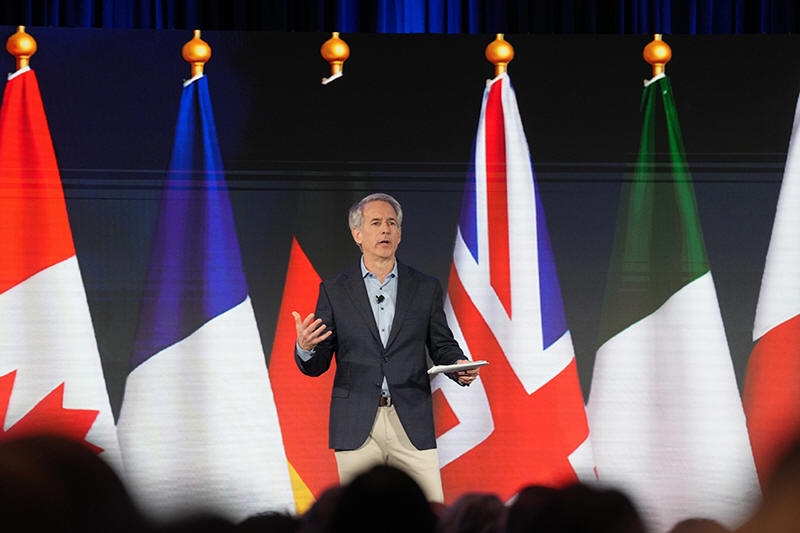
Matt Bennett of Third Way speaks during the "Winning the Middle"
conference Monday, March 2, 2026, in Charleston, S.C. (AP Photo/Meg
Kinnard)

“We need to socialize these ideas immediately, so that they can
begin to take hold and be widely shared by the time we get to the
main part of their primary cycle,” Bennett said.
There was no shortage of stylistic tips at the conference.
“Democrats come across as like professors, academics, elites — I
mean, my God, rip off your freaking sport coat and talk to me," said
Joe Walsh, who was a tea party Republican when he represented
Illinois in the U.S. House but became a Democrat last year. “Voters
in general are just crying out for authenticity."
But to Walsh, that doesn't mean taking a cue from those like
California Gov. Gavin Newsom, who has begun visiting early
presidential primary states, including South Carolina. In critiquing
Trump on social media, Newsom has taken to imitating the president's
tone, trolling Trump in his all-caps style.
“I think the mimicking and the copying a lot of the Trumpism isn't
the way you're actually going to reach a lot of folks,” Walsh said.
“Voters in general are just crying out for authenticity."
There were recommendations on the issues, too. A smattering of the
more than 100 people in the audience raised hands when asked how
many had worked the word “affordability” — the buzziest of campaign
buzzwords — into messaging materials.
“I think some of you are lying,” joked Gabe Horwitz, who leads Third
Way's economic program, intimating that the actual number was much
higher.
Melissa Morales of Somos Votantes, a Latino voter and civic
engagement organization, said Democrats should cut the word out of
their campaign vocabulary.
“It barely makes sense in English, and it is a nightmare to
translate into Spanish, so can we please call it something else?”
she asked.
“They’re not asking us for economic theory, they’re asking us for a
set of everyday solutions," Morales added. "And if we want to
connect with them, that’s how we’re going to have to do it.”
All contents © copyright 2026 Associated Press. All rights reserved |