Iran war taxes US diplomatic work and leaves Americans in the Mideast in
limbo
[March 04, 2026]
By MATTHEW LEE
WASHINGTON (AP) — The largest U.S. diplomatic drawdown in the Middle
East since the Iraq War began more than two decades ago is creating an
apparently unplanned-for crisis for the Trump administration as the
United States and Israel strike Iran in a widening conflict.
The State Department has been forced to close several embassies to the
public, shut down at least one consulate, order the departure of embassy
staff and families from at least six nations, and advise Americans in 14
countries to leave the region immediately despite the war closing major
airports and causing widespread flight cancellations.
Nonetheless, the department said Tuesday that more than 9,000 Americans
had safely returned from the Middle East since the weekend, many of them
without government assistance, and that it was actively assisting those
who have reached out for help, including by securing military aircraft
and charter flights.
“We’ve had a couple instances in which we have planes in the air, and on
the way, and unfortunately, the airspace gets closed, and they have to
turn back around,” Secretary of State Marco Rubio told reporters.
The department has been in contact with nearly 3,000 Americans wanting
to leave the region or seeking information about how to depart, Dylan
Johnson, assistant secretary of state for public affairs, said on X.
Rubio, who spoke on Capitol Hill before briefing lawmakers on the latest
developments, said 1,500 people had actually requested help in leaving.
Charter flights were being arranged from Jordan, Saudi Arabia and the
United Arab Emirates. In countries where airports or airspace was
closed, the department said, it is organizing land travel to countries
where flights are available, including Egypt and Oman.
Still, emergency reductions in embassy staffing and post closures since
the strikes on Iran began on the weekend have put a severe strain on the
ability to help U.S. citizens in need of assistance that might usually
be considered routine. Consular services are unavailable in many places
and the personnel reductions have limited crucial official engagements
with allied and partner governments during the war, including in
Bahrain, Jordan, Kuwait, Lebanon, Pakistan, Qatar and Saudi Arabia.

Biggest US drawdown in region since Iraq War
The scale of the American drawdown in the region rivals if not exceeds
what was done in the run up to and the immediate aftermath of the Iraq
invasion in 2003. Back then, the State Department reduced its staffing
in more than a dozen countries and advised U.S. citizens to leave or
seriously consider leaving countries throughout the Middle East, North
Africa and South Asia from Morocco to Pakistan.
On Monday, Americans were told in a hastily drafted announcement posted
on X to leave Bahrain, Egypt, Iran, Iraq, Israel, Jordan, Kuwait,
Lebanon, Oman, Qatar, Saudi Arabia, Syria, the United Arab Emirates and
Yemen even though commercial flights and other transportation have been
disrupted.
Americans had been advised early Tuesday that the State Department had
ordered nonessential diplomats and embassy families to leave Bahrain,
Iraq, Jordan, Kuwait, Qatar and the UAE.
[to top of second column]
|
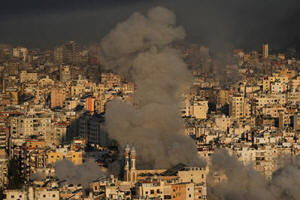
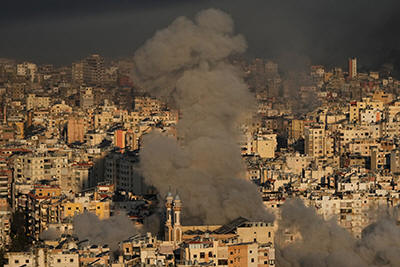
Smoke rises from Israeli airstrikes in Dahiyeh, a southern suburb of
Beirut, Lebanon, Tuesday, March 3, 2026. (AP Photo/Hussein Malla)

The embassies in Jordan, Kuwait, Lebanon and Saudi Arabia also were
closed to the public Tuesday. But only one diplomatic mission — the
U.S. consulate in Karachi, Pakistan — had completely suspended
operations.
A drone attack on the U.S. Embassy in Riyadh caused a “limited
fire,” Saudi Arabia’s Defense Ministry said.
The strike in Riyadh caused part of the embassy's roof to collapse,
although there were no reported deaths or injuries to staff,
according to an internal State Department memo. It said there were
no deaths or injuries after two drones hit the vicinity of the
embassy in Kuwait City.
Confusion leads to questions about preparations
Confusion was playing out around the region, raising questions about
the preparations for possible military action and its impact on
travel and the safety of Americans overseas, which is the State
Department's primary responsibility.
“If Americans are being instructed to leave but are given no viable
pathway, that suggests one of two things: The system is not being
activated, or the system has atrophied,” said Shawn VanDiver,
president of AfghanEvac, a group that supports Afghan nationals
seeking to come to the United States after having served with U.S.
forces in Afghanistan.
He noted that during the U.S. withdrawal from Afghanistan in 2021,
the Biden administration had organized the evacuation of 121,000
people in a matter of days.
“Crisis response cannot be partisan,” he said. “It has to survive
transitions. It has to be staffed, exercised, and protected. The
oversight question is straightforward: Was the post-Afghanistan
crisis response architecture sustained, or has it been weakened?”
The State Department did not immediately respond to a query about
its planning for embassy and consulate staffing or providing
assistance to American citizens in the event of a conflict with
Iran.
The U.S. government cannot compel American citizens to leave any
country. In rare circumstances, it can make it illegal for U.S.
passports to be used for travel to a specific destination. The only
such restriction is on North Korea. But before the strikes began,
Rubio said Friday that the restriction might also be applied to
Iran.
Travel advice from the State Department, including admonitions not
to visit a country or to leave it, often is not respected. Many
people reside in or have close family living there and either ignore
or decline to heed the advice.
There are large numbers of U.S. citizens living in or traveling
throughout the Middle East. The State Department, however, refuses
to offer an estimate because Americans are not required to report
their presence in any country abroad. It says any estimate would be
inaccurate.
Tens of thousands of U.S. citizens, many of them dual nationals, are
believed to live in Israel, Lebanon, Egypt and Iran.
All contents © copyright 2026 Associated Press. All rights reserved |