Israel sends troops into southern Lebanon as Hezbollah says it is ready
for 'open war'
[March 04, 2026]
By ABBY SEWELL and BASSEM MROUE
BEIRUT (AP) — Israel sent troops into southern Lebanon on Tuesday and
warned residents of more than 80 villages to evacuate as the Iran-backed
militant Hezbollah group said it was ready for an “open war” with Israel
in the wake of the U.S.-Israeli war on Iran.
The development came after Hezbollah fired rockets and launched drones
early Monday toward northern Israel. Israel retaliated with a wave of
airstrikes that killed 50 people in Lebanon, including seven children as
well as a Palestinian militant and a Hezbollah intelligence official in
Beirut’s southern suburbs.
That death toll is a revised figure from an earlier one reported by the
Health Ministry, which originally said Monday that 52 people died in the
strikes. Lebanese Health Minister Rakan Nassereddine then on Tuesday
reduced that number to 40, then later raised the toll to 50.
Lebanon also said 335 people were wounded and that tens of thousands
were displaced.
The U.N. refugee agency said Tuesday that 30,000 displaced people were
staying in collective shelters in Lebanon, “while many others slept in
their cars, on sides of the roads as they could not yet find safe
shelter.”
Hezbollah says it has no option but to fight Israel
Hezbollah fired two salvos of rockets toward northern Israel, the
militant group said while Israeli airstrikes overnight damaged a
building housing Hezbollah’s television and radio stations. Beirut’s
southern suburbs also saw a series of strikes on Tuesday afternoon that
came without warning. The Israeli military later said it targeted
Hezbollah officials.

The Israeli military’s Arabic spokesman, Avichay Adraee, warned
residents of more than 80 villages and towns in southern Lebanon to
leave, adding that people should not return to these areas until further
notice.
A senior Hezbollah official said that after more than a year of abiding
by a ceasefire as Israel’s strikes continued on Lebanon, the group’s
patience has ended, leaving it with no option but to fight Israel. “The
Zionist enemy wanted an open war, which it has not stopped since the
ceasefire agreement,” Mohamoud Komati said.
“So let it be an open war,” added the Hezbollah official.
Lebanese President Joseph Aoun told the ambassadors of Saudi Arabia,
Qatar, the United States, France and Egypt on Tuesday that Hezbollah has
been firing rockets from areas north of the Litani River. That's outside
an area south of the river and along the border with Israel, where
Lebanese troops have earlier said they are in full control.
More Israeli troops enter Lebanon
The Israeli military said Tuesday it sent additional troops into
southern Lebanon and took new positions on several strategic points
close to the border. Lebanon’s state-run National News Agency said the
Lebanese army was evacuating some of its positions along the border.
Adraee, the Israeli spokesman, said on X that the troops’ movements
inside Lebanon are meant to bolster Israel's forward defense system and
create an addition layer of security.
[to top of second column]
|
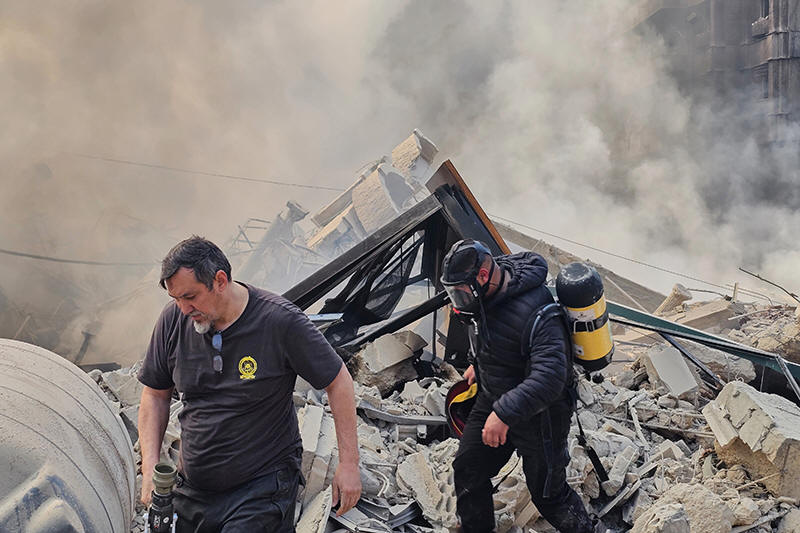
Firefighters inspect the rubble as smoke rises from a building hit
by an Israeli airstrike in Dahiyeh, a southern suburb of Beirut,
Lebanon, Tuesday, March 3, 2026. (AP Photo/Hassan Ammar)

Lebanon’s state-run National News Agency said the Lebanese army was
evacuating some of its border positions.
A Lebanese military official confirmed to The Associated Press that
Israeli troops had moved into several areas in southern Lebanon on
Tuesday and that the Lebanese army was “repositioning” in the area.
The official spoke on condition of anonymity to discuss military
movements.
The U.N. peacekeeping force in southern Lebanon, known as UNIFIL,
later Tuesday said its peacekeepers saw Israeli troops making forays
across the border and then returning to Israel. Israel’s army said
its troops are still operating in Lebanon, but it wasn't clear how
many soldiers remained inside Lebanon.
Hezbollah began firing into Israel a day after the Oct. 7, 2023
Hamas-led attack on southern Israel triggered the war in Gaza. After
months of low-level fighting, a full-scale war erupted in September
2024 and Israel later launched a ground invasion of Lebanon.
Israeli forces withdrew from most of southern Lebanon after a
U.S.-brokered ceasefire halted the fighting in November 2024 but
continued to occupy five points on the Lebanese side of the border.
Israel also continued with near-daily strikes, primarily in southern
Lebanon, saying that Hezbollah has been trying to rebuild its
positions there.
Lebanon's Health Ministry also said Tuesday that 397 people had been
killed in Israeli strikes in Lebanon after the ceasefire took effect
and before Hezbollah launched its latest attacks.
Syrians flee across the border
Thousands of Syrians living in Lebanon crossed back into Syria,
fleeing Israeli strikes over the past two days.
UNHCR said the number of people crossing from Lebanon into Syria
jumped on Monday to 10,629 from typically between 3,900 and 4,400 a
day since the holy Islamic month of Ramadan began in February. The
vast majority were Syrian, but a small number of Lebanese citizens
also crossed.
Azzam Sweiri, a Syrian farm laborer working in southern Lebanon,
said he saw streets "packed with cars and people” as he fled the
bombardment.

“It took us 10 or 12 hours just to make it 30 or 40 kilometers,” he
said after crossing in to Syria Tuesday, adding that after he left,
he heard that the house next to the one where he lived was hit by an
Israeli airstrike.
___
Associated Press journalists Ghaith AlSayed and Omar Sanadiki in
Jdeidet Yabous, Syria, contributed to this report.
All contents © copyright 2026 Associated Press. All rights reserved |