China to unveil priorities for coming 5 years at major annual political
meeting
[March 04, 2026]
By HUIZHONG WU
BEIJING (AP) — China's ceremonial legislature is set to meet Thursday,
where it will unveil the country's policy direction and economic goals
for the coming years.
The meeting is held in Beijing, where the National People's Congress and
its advisory body gather. The National People's Congress will ratify new
laws decided by China's Communist Party leadership. While the
near-3,000-member body technically votes, the vote is always almost
unanimous.
Also meeting is the Chinese People’s Political Consultative Conference,
an advisory body composed of elite members of Chinese society, from
business people to athletes. They also include representatives from
China's minority groups, but the body has little power on issues of
public policy.
The gathering is called the Two Sessions. The political meetings have
changed under President Xi Jinping, with tighter scripts and less scope
for debate.
“A long, long time ago, it was a venue for policy deliberation,” and
even controversial things, said Alfred Wu, a professor of public policy
at the National University of Singapore. “Now it's very much become a
showcase, propaganda."
Economy is front and center
The National People's Congress is when the Chinese premier announces the
country's GDP target and other economic targets for the year.
This year, observers are also waiting for details for the 15th five-year
plan, of which the government had revealed a draft in October. It is
expected to be focused on building tech prowess and self-sufficiency.
China issues five-year plans to direct its economy, a legacy of its
historical approach when it had a planned economy.

The Chinese economy remains sluggish, with high youth unemployment, weak
housing prices and sagging domestic consumption. It also faces a trade
war with the U.S., which has leveraged tariffs on all Chinese goods.
Lou Qinjian, the spokesperson for this year's National People's
Congress, said Wednesday that the government would maintain its efforts
to improve living standards and boost consumption. Those would include
raising incomes and improving the education, child care, elderly care
and health care systems so “consumers will feel freer to spend,” he said
at press conference.
Experts have said China will have to strike a tough balance between its
goals of boosting its tech manufacturing, such as in robotics, renewable
energy and AI, and boosting domestic consumption as many ordinary people
are feeling the pinch. Tech supply chains are narrow and the
trickle-down effect is less pronounced.
China is likely to drop its headline growth target to a record low,
predicted Neil Thomas and Lobsang Tsering, policy experts at the Asia
Society. It will be significant as a step in a “shift from high-speed to
high-quality growth,” they wrote.
[to top of second column]
|
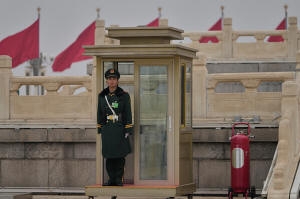
A Chinese paramilitary policeman stands guard on Tiananmen Square
near the Great Hall of the People, in Beijing, China, Wednesday,
March 4, 2026. (AP Photo/Ng Han Guan)

A push for ethnic assimilation
The National People's Congress is also expected to ratify a new law
governing China’s ethnic minorities. While a final draft has not
been released, experts say the latest public draft focused on
assimilation, reducing autonomy for the country's minority groups.
Lou said the legislation fosters “a stronger sense of community
among all ethnic groups in the Chinese nation” and outlines steps to
promote interaction, exchange and integration.
“Once enacted, we will work to implement it thoroughly and advance
Chinese-style modernization through the great unity of the Chinese
nation,” he said.
Lou highlighted the Communist Party's push for unity several times
during the press conference and credited past five-year plans with
delivering not only rapid economic growth but also long-term
stability, a major concern of party leaders.
Personnel movements are not expected
China's legislature dismissed 19 members last week, after a highly
publicized removal of two of the country's most senior generals in
January.
Now, only one member remains of the powerful Central Military
Commission, which controls the military, but policy experts say they
do not expect any personnel announcements in the upcoming Two
Sessions. Observers like to closely watch attendance for any signs
of possible purges, however.
Xi Jinping has removed possibly up to 100 senior officials in the
People’s Liberation Army in the past four years, according to the
Center for Strategic Studies, with the most prominent being General
Zhang Youxia in January.
Yet, there is likely no great rush from the leadership to find a
replacement.
“I don’t think they’re particularly worried about this,” said Wu of
National University Singapore. For example, he said, Wang Yi became
foreign minister again after stepping down from the job initially
because of the high-profile removal of Qin Gang, previously his
replacement.
___
Associated Press writer Ken Moritsugu contributed to this report.
All contents © copyright 2026 Associated Press. All rights reserved
 |