More than 20 states sue over new global tariffs Trump imposed after his
stinging Supreme Court loss
[March 06, 2026] By
LINDSAY WHITEHURST and PAUL WISEMAN
WASHINGTON (AP) — Some two dozen states challenged President Donald
Trump’s new global tariffs on Thursday, filing a lawsuit over import
taxes he imposed after a stinging loss at the Supreme Court.
The Democratic attorneys general and governors in the lawsuit argue that
Trump is overstepping his power with planned 15% tariffs on much of the
world.
Trump has said the tariffs are essential to reduce America's
longstanding trade deficits. He imposed duties under Section 122 of the
Trade Act of 1974 after the Supreme Court struck down tariffs he imposed
last year under an emergency powers law.
Section 122, which has never been invoked, allows the president to
impose tariffs of up to 15%. They are limited to five months unless
extended by Congress.
The lawsuit is led by attorneys general from Oregon, Arizona, California
and New York.
“The focus right now should be on paying people back, not doubling down
on illegal tariffs,” said Oregon Attorney General Dan Rayfield. The suit
comes a day after a judge ruled t hat companies who paid tariffs under
Trump's old framework should get refunds.
White House vows vigorous defense
The White House said Trump is acting within his power. “The President is
using his authority granted by Congress to address fundamental
international payments problems and to deal with our country’s large and
serious balance-of-payments deficits," said spokesman Kush Desai. "The
Administration will vigorously defend the President’s action in court.”

The new suit argues that Trump can't pivot to Section 122 because it was
intended to be used only in specific, limited circumstances — not for
sweeping import taxes. It also contends the tariffs will drive up costs
for states, businesses and consumers.
Arizona Attorney General Kris Mayes pointed to a New York Federal
Reserve Bank study that found Americans largely bear the cost of the
tariffs, which has been estimated at $1,200 a year per household. “That
is money out of the pockets of American families trying to buy
groceries, pay rent and keep their small businesses afloat,” Mayes said.
Many of the plaintiff states also successfully sued over Trump’s tariffs
imposed under a different law: the International Emergency Economic
Powers Act (IEEPA).
Four days after the Supreme Court struck down his sweeping IEEPA tariffs
Feb. 20, Trump invoked Section 122 to slap 10% tariffs on foreign goods.
Treasury Secretary Scott Bessent told CNBC on Wednesday that the
administration would raise the levies to the 15% limit this week.
[to top of second column] |
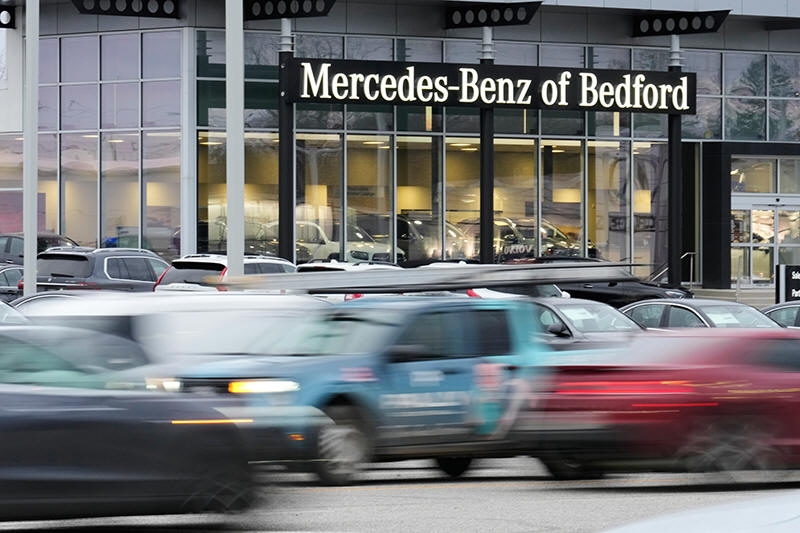
Cars drive by a Mercedes-Benz dealership on the Bedford Automile in
Bedford, Ohio, Friday, Feb. 20, 2026. (AP Photo/Sue Ogrocki)
 The Democratic states and other
critics say the president can’t use Section 122 as a replacement for
the defunct tariffs to combat the trade deficit.
The Section 122 provision is aimed at what it calls “fundamental
international payments problems.’’ At issue is whether that wording
covers trade deficits, the gap between what the U.S. sells other
countries and what it buys from them.
Section 122 arose from the financial crises that emerged in the
1960s and 1970s when the U.S. dollar was tied to gold. Other
countries were dumping dollars in exchange for gold at a set rate,
risking a collapse of the U.S. currency and chaos in financial
markets. But the dollar is no longer linked to gold, so critics say
Section 122 is obsolete.
Awkwardly for Trump, his own Justice Department argued in a court
filing last year that the president needed to invoke the emergency
powers act because Section 122 did “not have any obvious
application’’ in fighting trade deficits, which it called
“conceptually distinct’’ from balance-of-payment issues.
Still, some legal analysts say the Trump administration has a
stronger case this time.
“The legal reality is that courts will likely provide President
Trump substantially more deference regarding Section 122 than they
did to his previous tariffs under IEEPA,’’ Peter Harrell, visiting
scholar at Georgetown University’s Institute of International
Economic Law, wrote in a commentary Wednesday.
The specialized Court of International Trade in New York, which will
hear the states' lawsuit, wrote last year in its own decision
striking down the emergency-powers tariffs that Trump didn't need
them because Section 122 was available to combat trade deficits.
Trump does have other legal authorities he can use to impose
tariffs, and some have already survived court tests. Duties that
Trump imposed on Chinese imports during his first term under Section
301 of the same 1974 trade act are still in place.
Also joining the lawsuit are the attorneys general of Colorado,
Connecticut, Delaware, Illinois, Maine, Maryland, Massachusetts,
Michigan, Minnesota, Nevada, New Jersey, New Mexico, North Carolina,
Rhode Island, Vermont, Virginia, Washington, Wisconsin, and the
governors of Kentucky and Pennsylvania.
All contents © copyright 2026 Associated Press. All rights reserved |