As citizen voting bill stalls in US Senate, some states forge ahead
[March 07, 2026]
By DAVID A. LIEB
JEFFERSON CITY, Mo. (AP) — While the U.S. Senate remains deadlocked over
President Donald Trump's call for strict citizenship voting
requirements, Republicans in some states are pressing ahead with their
own measures that could require documentary proof of citizenship to join
or remain on the voter rolls.
Proof-of-citizenship legislation won final approval this week in South
Dakota and Utah, already has passed one chamber in Florida and received
a committee hearing in Missouri. In Michigan, supporters of voter
citizenship documentation submitted 750,000 petition signatures this
week in a bid to get a constitutional amendment on the November ballot.
Federal law already prohibits noncitizens from voting in U.S. elections,
with violators subject to fines, imprisonment and potential deportation.
When people register to vote, they affirm under penalty of perjury that
they are U.S. citizens. But Trump contends that's not enough. He wants
prospective voters to show proof of their citizenship.
What would the federal legislation do?
The federal Safeguard American Voter Eligibility Act, or SAVE America
Act, would require documentary proof of U.S. citizenship to register to
vote. That could be satisfied with such things as a U.S. passport,
citizen naturalization certificate or a combination of a birth
certificate and government-issued photo identification.
The federal bill also would require a photo identification to cast a
ballot, which some states already mandate. The Republican-led U.S. House
approved the legislation last month on a mostly party-line vote, but it
has stalled in the Senate under a filibuster threat from Democrats.
What would the new state measures do?
Legislation passed in South Dakota and Utah would create a two-tier
voting system. People who provide documentation of their citizenship
could vote in all elections. Those who don't could vote only in federal
elections for president, U.S. Senate and U.S. House.
The bifurcated voting system is modeled after Arizona, where tens of
thousands of voters who have not provided proof of citizenship can cast
ballots only in federal elections. Arizona implemented its system after
the U.S. Supreme Court ruled in 2013 that the state could not require
citizenship documentation for federal elections.

The bills in South Dakota and Utah would take effect upon a governor's
signature, meaning they could be in place for newly registered voters
ahead of the November elections.
Utah's bill also directs election officials to use an online service
from U.S. Immigration and Customs Enforcement to check the citizenship
status of existing voters. Those flagged would be sent notices asking
for proof of citizenship to remain eligible to vote in all elections.
How are the Florida and Michigan measures different?
Neither the Michigan initiative nor legislation passed by the Florida
House would require people to submit proof of citizenship when
registering to vote. Instead, the measures would create a
behind-the-scenes review that could result in some people being asked
for citizenship documentation.
Under the Michigan measure, the secretary of state would review driver's
license records, juror records and federal Homeland Security and Social
Security data to determine if registered voters are citizens. Those
flagged would be removed from the voter rolls if they cannot provide
proof of citizenship.
The Florida legislation would require election officials to verify the
citizenship of all registered voters using the state's driver's license
database. Anyone whose citizenship could not be verified would be
required to submit documentary proof.

[to top of second column]
|
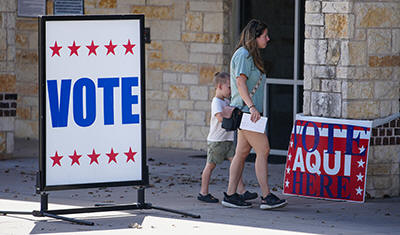
Voters in central Texas make their way to an active polling station
to vote in Pflugerville, Texas, Tuesday, March 3, 2026. (Ricardo B.
Brazziell/Austin American-Statesman via AP)

Why are some pushing for proof of citizenship?
Trump and some fellow Republicans have raised alarms for several
years about noncitizens voting in U.S. elections. Though evidence of
people doing so is rare, there are some cases.
In 2024, a student from China was charged with perjury and attempted
illegal voting after registering to vote by showing a University of
Michigan student ID and signing a document asserting he was a U.S.
citizen. He later contacted a local clerk's office requesting to get
his ballot back, and ultimately fled the country.
The case provided part of the impetus for the Michigan ballot
initiative, said Paul Jacob, chairman of Americans for Citizen
Voting, which is backing the measure.
“We want a system we can have confidence in," Jacob said. "The way
you avoid big problems in elections is to fix the small problems
when they rise up and present themselves.”
What are the concerns about documenting citizenship?
Constitutional amendments limiting voting to “only citizens” have
won widespread support when placed on state ballots. But voting
rights advocates say that requiring documentary proof can get
complicated.
During a recent debate in the Florida House, Democratic state Rep.
Ashley Gantt recounted how her aunt was born in a South Carolina
home at a time when some hospitals didn't accept Black patients. As
a result, she has no birth certificate and has had difficulty tying
to demonstrate her citizenship, Gantt said.
A proof-of-citizenship law “would stop many thousands — if not more
— U.S. citizens from voting in Florida,” said Michelle Kanter Cohen,
policy director and senior counsel at the nonprofit Fair Elections
Center. “It requires documentation that a lot of eligible citizens
don’t have, or don’t have access to.”
Nationwide, about 21 million people — 9% of voting-age citizens —
lack documentary proof of citizenship or cannot easily obtain it,
according to a 2024 report by the Center for Democracy and Civic
Engagement at the University of Maryland.
What's happened in other states that passed similar laws?
Legal challenges are common when states pass proof-of-citizenship
requirements for voters.
After Kansas adopted a proof-of-citizenship law 15 years ago, more
than 31,000 U.S. citizens ended up getting blocked from registering
to vote. Federal courts declared the Kansas law an unconstitutional
burden on voting rights, and it hasn’t been enforced since 2018.
Two years ago, New Hampshire and Louisiana both passed
proof-of-citizenship laws, prompting lawsuits. New Hampshire's law
went to trial last month and is awaiting a ruling. Louisiana's
election commissioner acknowledged in a December court filing that
the requirement has not been enforced.
A nonprofit group also filed a legal challenge to a Wyoming
proof-of-citizenship law passed last year. But a federal court
dismissed that case while ruling the group lacked standing to sue.
All contents © copyright 2026 Associated Press. All rights reserved |