China's exports surge in Jan-Feb despite waning trade with the US
[March 10, 2026] By
CHAN HO-HIM
HONG KONG (AP) — China's exports jumped nearly 22% in the first two
months of the year from a year earlier, powered by a surge in shipments
of computer chips, autos and electronics.
The export figures released by China’s customs agency on Tuesday were
much better than economists had forecast. They far exceeded the 6.6%
annual pace of growth recorded in December.
Shipments to the U.S. fell 11% in January and February, narrowing from a
30% drop in December. Exports to the European Union increased almost 28%
while those to Latin America climbed 16%.
Exports to the rest of Asia, including Japan and India, also were
sharply higher.
China’s exports have been a bright spot for its economy despite tensions
with the U.S. Chinese exports climbed 5.5% for 2025 as its trade surplus
surged to a record of nearly $1.2 trillion. Higher shipments to other
regions have helped offset weaker exports to the U.S. after U.S.
President Donald Trump imposed a variety of higher tariffs on imports
from many countries.
The boom in use of artificial intelligence is driving strong demand for
computer chips of all kinds. China's exports of semiconductors by value
soared nearly 73% in the first two months of the year, partly also
lifted by higher prices as the world faces a memory chip shortage. Its
exports of autos rose 67% and mechanical and electrical items rose 27%.
Trump’s planned visit to Beijing at the end of March is being closely
watched for a possible extension of a trade truce between the two
countries reached in October last year, which could be positive news for
Chinese exports to the U.S.
A recent U.S. Supreme Court ruling against Trump’s sweeping tariffs has
already resulted in lower tariffs for countries including China.
“While the recent pace of gains is unlikely to be sustained, exports are
likely to remain robust given the recent decline in U.S. tariffs and
strong demand for semiconductors,” Zichun Huang, a China economist at
Capital Economics, wrote in a note.
China's total imports in January and February rose almost 20%, up from
December’s 5.7% year-on-year increase. However, its imports from the
United States dropped nearly 27% from a year earlier.
China's global trade surplus in January-February was $213.6 billion.
Trade data is typically combined for January to February each year to
help even out seasonal impacts from the Lunar New Year festival, the
biggest holiday of the year.
[to top of second column] |
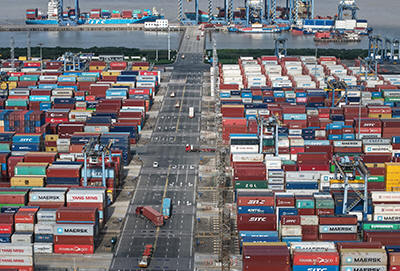
An aerial view of a container terminal in seen in Shanghai, Tuesday,
March 10, 2026. (Chinatopix via AP)
 A slowing domestic economy fueled by a yearslong property sector
downturn has been weighing on the world's second largest economy. Last
week, Chinese leaders announced an economic growth target of 4.5% to 5%
for 2026, the lowest since 1991.
The war in the Middle East has raised uncertainty over the outlook for
trade and for China's own energy security. An effective blockade of the
Strait of Hormuz, a transit point for much of the world's trade in oil
and gas, may restrict China’s access to relatively cheap Iranian oil and
also impede its broader commerce with the region.
For China, export competitiveness is paramount, said Han Lin, China
Country Director at consultancy The Asia Group. “Energy inflation is the
last thing Beijing policymakers need," he said.
If the war drags on, a surge in oil prices fueling global inflation
could also weaken consumption abroad, potentially hurting overseas
demand for Chinese goods, said Daniel Russel, a distinguished fellow at
the Asia Society Policy Institute.
All contents © copyright 2026 Associated Press. All rights reserved
 |