Once a beacon of cheap homes, Nevada has become a symbol of America's
struggle with high costs
[March 10, 2026] By
JONATHAN J. COOPER
LAS VEGAS (AP) — When his parents were about his age, they bought their
first home. But for 27-year-old Brian Torres Suazo, that milestone feels
like a distant dream, despite a secure job with union wages and down
payment assistance.
Torres Suazo expects to continue sharing an apartment with roommates for
the foreseeable future, kept on the sidelines of homeownership by
stubbornly high costs, even in cities once known for their
affordability, such as his native Las Vegas.
He’s not alone. In a restless electorate frustrated by high prices, the
cost of housing stands out. Democrats are pushing to channel this anger
into support for their quest to chip away at Republicans’ unified
control of Washington, maintaining their focus on economic concerns even
when war with Iran dominates the news.
Their path cuts through Nevada, a perennial swing state won by
Republican Donald Trump in the 2024 presidential election and now home
to closely contested U.S. House races.
“I would be paying more — a lot more — in mortgage than I am for rent
right now,” said Torres Suazo, a food runner on the Las Vegas Strip.
Sometimes he feels like politicians aren't listening to people like him.
“It’d be nice if more people that knew what it’s like to work for a
living could be in those rooms to make decisions,” he added.

Housing affordability isn't just a coastal concern
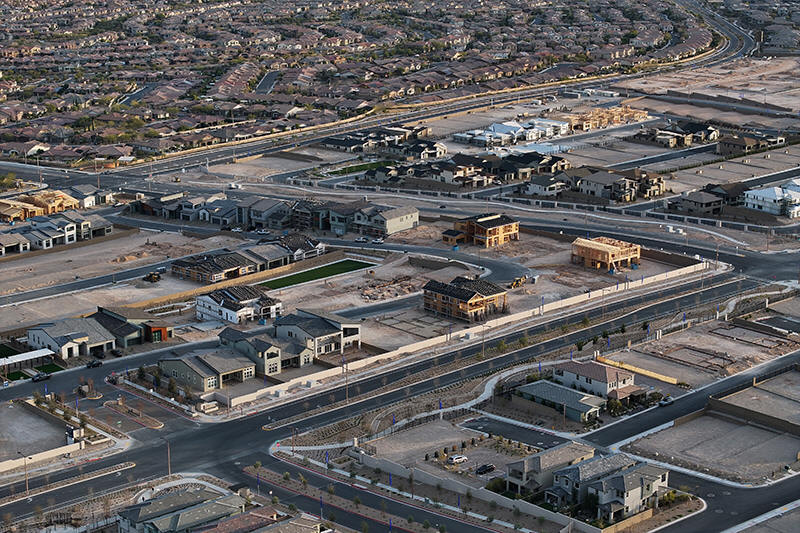
In all directions from the Strip, tract homes with sharp-angled roofs
and earthy paint schemes sprout from the desert by the dozen. Streets to
nowhere snake through the dirt, ready for future homes. Wooden signs dot
roadsides advertising homes from the $300,000s for a townhome to over $1
million for big houses in the most desirable suburban neighborhoods.
Housing costs have long been a potent political issue in pricey
metropolitan areas like New York and San Francisco, but now the issue is
popping up virtually everywhere.
During the coronavirus pandemic, white-collar workers newly empowered to
work remotely cashed out their equity in high-priced cities and bid up
prices across Sun Belt cities like Las Vegas, Phoenix, Dallas, and
Charlotte, North Carolina. At the same time, near-zero interest rates
drove a wave of refinancing that gave existing homeowners mortgage
payments that now seem impossibly low.
Almost 40 million people visited Las Vegas last year, and gamblers
wagered $14 billion at Clark County casinos, according to the Las Vegas
Convention and Visitors Authority. The steady flow of people and cash
attracts dreamers and strivers with the promise of a good job and an
affordable home.
The population of Clark County, which includes Las Vegas, grew 17% to
2.4 million between 2014 and 2024. The country as a whole grew 6% over
that period.
“If you ask locals who grew up here, some of them feel that housing is
out of reach for them,” said Las Vegas real estate agent Tony Clifford.
“You talk to somebody from out of state – Northwest, West, California –
we’re still so cheap compared to them.”

Home prices and mortgage rates have ticked down from historic highs in
much of the country, and real estate agents say Las Vegas is now
considered a buyer’s market. Houses are staying on the market longer,
and more sellers are accepting discounted offers or offering
concessions, such as covering closing costs. But monthly mortgage
payments are still much higher than they were before the pandemic.
In Las Vegas, resale home prices rose 53% between December 2019 and the
same month last year, according to the Case-Shiller index. The index
tracks homes that have previously sold, excluding new construction,
which makes up more than a quarter of the Las Vegas market.
In Las Vegas, the median home sale price rose 65% between the first
quarter of 2020 and the same period last year, reaching $393,000,
according to Federal Reserve data. It ticked down to $379,000 during the
fourth quarter last year.
Nationally, 30-year mortgage rates followed a similar trend, bottoming
out at 2.65% nationally in 2021 before peaking in 2023 at nearly 8%.
They’ve settled around 6% this quarter.
Still, even with rates and prices stabilizing, they remain higher than
they were before the pandemic. The median resale house at the prevailing
interest rates with 20% down would cost $2,300 per month in December
2025, double the figure from December 2019.

[to top of second column] |
Homes are seen under construction Monday, Feb. 2, 2026, in Las
Vegas. (AP Photo/John Locher)
 Big investors are buying up
houses
Large investors own about 11% of single-family home rentals in Las
Vegas, according to the Hamilton Project at the Brookings
Institution, compared with about 3% nationally.
They're increasingly becoming bipartisan targets as they buy and
rent out single-family homes, though economists generally discount
the benefits of constraining them. Trump and Nevada Attorney General
Aaron Ford, the leading Democratic candidate for governor, are both
among a growing cadre of officials calling for limits on corporate
homeownership.
“People live in homes, not corporations,” Trump said in a social
media post in January, calling for Congress to ban large
institutional investors from buying houses. He’s also pressured the
Federal Reserve to lower interest rates and proposed extending
mortgage terms to 50 years, privatizing Fannie Mae and Freddie Mac,
and allowing homebuyers to tap retirement or Education Savings
Accounts for a down payment.
Ford's housing plan, released last month, also calls for banning
algorithmic pricing of rents, tackling regulatory barriers that
block or slow new construction and seeking to unlock federal land
for homebuilding. The federal government owns 84% of the land in
Nevada.
Nevada's Republican Gov. Joe Lombardo, who is one of the most
vulnerable incumbent state leaders in the country, has tried to
address the problem, announcing last month that his administration
has approved $64 million to boost a dozen housing development
projects, mostly in the Las Vegas and Reno areas, along with
assistance for homebuyers.

The midterms may hinge on affordability
Democrats are making affordability the central plank of their pitch
to voters in November, arguing that Trump has failed in his campaign
promise to bring prices back down despite Republican control of
Congress. They believe anxiety over the cost of living has been a
major factor in their victories in a series of off-year elections,
including the races for governor of New Jersey and Virginia as well
as special elections down the ballot.
Many Americans say Trump is focusing on the wrong priorities,
according to multiple surveys, including a January AP-NORC poll, and
they largely think Trump is neglecting the issue of costs at home.
Trump was reelected in large part because of economic concerns, but
recent polling shows that the bulk of Americans aren’t seeing
benefits from his policies yet, and most don’t think he’s paying
enough attention to the issue.
A large share of registered voters see the economy as one of the top
issues facing the country, and a recent New York Times poll found
that about half of registered voters say Trump’s policies have made
life for most Americans “less affordable.”
The issue will remain salient in November even as the Iran war
raises interest in foreign policy, said Democratic strategist Paul
Begala, one of the architects of Bill Clinton's 1992 strategy that
emphasized domestic economic concerns during a time of global
upheaval from the first Gulf War and the fall of the Soviet Union.
“Trump’s refusal to raise the minimum wage, and his willingness to
raise the cost of health care, electricity, hamburger, and now gas,
is a two-edged sword that will cut down a large number of
congressional Republicans,” Begala said.

Housing is a thorny political issue. Rooted homeowners like high
prices that inflate their net worth, at least on paper, a reality
that Trump has nodded to repeatedly this year, assuring homeowners
he wants to keep their values high.
But those prices become handcuffs if they want to move on but are
priced out of the bigger homes or better neighborhoods they’re
eying.
Michele Niemeyer feels trapped in the condo she bought for more than
$500,000 just off the Strip. The homeowners association fee just
went up to $686 a month, straining her budget, and the value of her
unit has plummeted. But the neighborhoods that were in her budget
when she bought the condo are now out of reach.
“I want to move,” Niemeyer said. “I just don't know where.”
All contents © copyright 2026 Associated Press. All rights reserved |