Australia grants asylum to 5 members of the Iranian women's soccer team
[March 10, 2026]
By CHARLOTTE GRAHAM-McLAY, JOHN PYE and R.J. RICO
GOLD COAST, Australia (AP) — Australia granted asylum to five members of
the Iranian women’s soccer team who were visiting the country for a
tournament when the Iran war began, a government minister said Tuesday.
The announcement followed days of urging by Iranian groups in Australia
and by U.S. President Donald Trump for the Australian government to help
the women, who had not spoken publicly about a wish to claim asylum. The
team drew speculation and news coverage in Australia when players didn't
sing the Iranian anthem before their first match.
Early Tuesday, police officers transported five of the women from their
hotel in Gold Coast, Australia, “to a safe location” after they made
asylum requests. There, they met with Home Affairs Minister Tony Burke
and the processing of their humanitarian visas was finalized, the
minister told reporters in Brisbane.
“I don't want to begin to imagine how difficult that decision is for
each of the individual women, but certainly last night it was joy, it
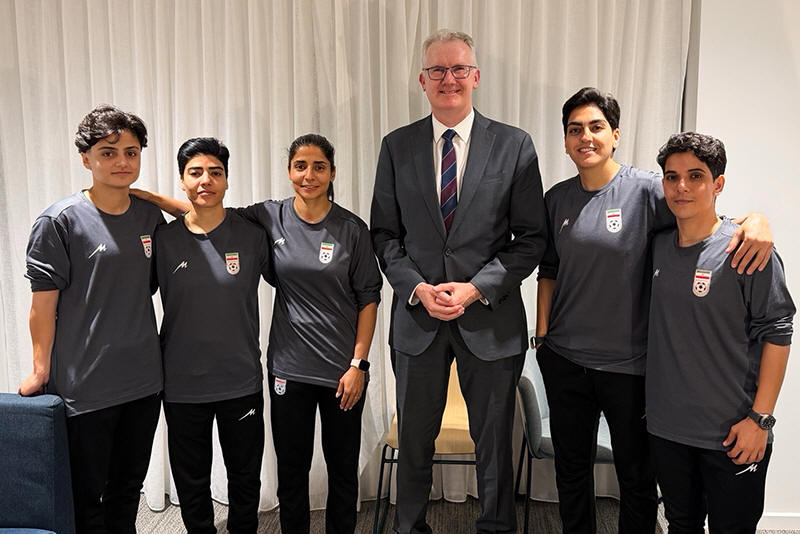
was relief,” said Burke, who posted photos to social media of the women
smiling and clapping as he signed documents. “People were very excited
about embarking on a life in Australia.”
The women granted asylum were happy for their names and pictures to be
published, he said. Burke added that the players wanted to make clear
that they were "not political activists.”
Iranian state TV said the country’s football federation asked
international soccer bodies to review what it called Trump’s “direct
political interference in football,” warning such remarks could disrupt
the 2026 World Cup, which begins in North America in June.

Naghmeh Danai said she was invited as a migration agent and member of
the Iranian-Australian community to visit the women at a hotel Monday
night and to reassure them about what was available to them in
Australia.
“I told them that if you accept this offer, you will have a great future
here. You will have more respect. You won’t be under a lot of
suppression that you have been in your country. And they were thrilled,”
Danai said.
“At the same time, it’s understandable that it was a very hard decision
for them to make when they have family back home and when they just came
here compete,” Danai added.
Future remains unknown for 21 in squad and others
The Iranian team arrived in Australia for the Women’s Asian Cup last
month, before the Iran war began on Feb. 28. The team was knocked out of
the tournament over the weekend and faced the prospect of returning to a
country under bombardment. Iran’s head coach Marziyeh Jafari said Sunday
the players “want to come back to Iran as soon as we can."
An official squad list named 26 players, plus Jafari and other coaches.
Burke said the offer of asylum was extended to all on the team.
“These women are tremendously popular in Australia, but we realize they
are in a terribly difficult situation with the decisions that they’re
making,” Burke said. “The opportunity will continue to be there for them
to talk to Australian officials if they wish to.”
It was not clear when the remaining players were due to leave Australia,
but a commotion erupted Tuesday afternoon outside the team's hotel as
members of the public kneeled or lay in front of a white bus with tinted
windows believed to be carrying the rest of the team.
The identities of those on the bus and its destination couldn't be
immediately confirmed. Similar vehicles have transported players to and
from their games.
The protesters, some wearing red, white and green clothing or holding
pre-Revolution Iranian flags, tried to prevent the bus from departing
the hotel, but it was delayed by only minutes. Some chanted “Save our
girls” and “Please act now.”
[to top of second column]
|

In this photo supplied by Australia's Minister for Home Affairs Tony
Burke's office, the Minister Tony Burke, center, poses in an
undisclosed location with five Iranian women soccer players who have
been granted asylum in Australia, Tuesday, March 10, 2026.
(Australia Ministry of Home Affairs via AP)

Iranian team popular in Australia
Burke didn't detail what threats the players faced if they returned
to Iran. During the tournament, the women have mostly declined to
comment on the situation at home, although Iran forward Sara Didar
choked back tears in a news conference Wednesday as she shared their
concerns for their families and all Iranians.
The Iranian team has drawn national news coverage in Australia after
the players' silence during the anthem before an opening loss to
South Korea last week was viewed by some as an act of resistance and
others as a show of mourning. The team hasn’t clarified. They later
sang and saluted during the anthem before their remaining two
matches.
“Australians have been moved by the plight of these brave women,”
Prime Minister Anthony Albanese told reporters Tuesday. “They're
safe here and they should feel at home here.”
Albanese said Australian officials had made offers of support
“clear” to the athletes.
Asylum came during Trump's urging
Australia's announcement came after Trump on Monday in Washington
called on Australia to grant asylum to any team member who wanted
it. Earlier that day, Trump had lambasted Australia on social media,
saying Australia was "making a terrible humanitarian mistake by
allowing the ... team to be forced back to Iran, where they will
most likely be killed.” Trump added: “The U.S. will take them if you
won’t.”
Less than two hours later, in another social media post, Trump
praised Albanese, saying, “He’s on it! Five have already been taken
care of, and the rest are on their way.”
Iran's football federation said Trump's comments were “baseless and
unlawful” and urged global football authorities to intervene.

Iranian first Vice President Mohammad Reza Aref separately said:
“Iran welcomes its children with open arms and the government
guarantees their security.”
“No one has the right to interfere in the family affairs of the
Iranian nation and play the role of a nanny who is kinder than a
mother,” he added.
The president's offer of asylum represented something of a change
for Trump, whose administration has sought to limit the number of
immigrants in the U.S. who can receive asylum for political
purposes.
___
Graham-McLay reported from Wellington, New Zealand, and Rico from
Atlanta. AP journalists Jon Gambrell, in Dubai, United Arab
Emirates, and Rod McGuirk in Melbourne, Australia, contributed to
this report.
All contents © copyright 2026 Associated Press. All rights reserved
 |