Human waste backing up in basements is a gut-churning sign of US
infrastructure problems
[March 11, 2026]
By MICHAEL PHILLIS and M.K. WILDEMAN
WASHINGTON (AP) — The January collapse of a pipe as wide as a car dumped
so much sewage into the Potomac River that officials tracked a spike of
gut-wrenching bacteria drifting slowly past Washington for weeks,
prompting an emergency declaration and federal assistance.
It was a disaster of historic scale — 244 million gallons (924 million
liters) spilled — spotlighting the severe consequences of old, failing
infrastructure. But smaller sewer overflows that draw far less notice
are common. Tens of thousands occur every year across the U.S.,
contaminating rivers, flooding streets and sometimes causing backups
into homes that threaten human health.
“It’s really one of those out of sight, out of mind problems that
doesn’t rise to the top until it becomes a crisis,” said Alice Volpitta,
the Baltimore Harbor waterkeeper with the nonprofit Blue Water
Baltimore.
At least 18.7 million people are served by one of roughly 1,000
utilities that are in serious violation of pollution limits. At least
2.7 million live with a system that violated federal clean water rules
continually over the last three years, according to an Associated Press
analysis of federal data.
In Maryland it is Baltimore, not the nation's capital nearby, that has
seen hundreds of sewer overflows in recent years often caused by broken
pipes, tree roots or severe storms. Cities like Houston, Memphis and
Cahokia Heights, Illinois, have reached court agreements to address
their problems. And in places where sewage and rain flow through the
same pipes, heavy rains made worse by climate change can make overflows
to waterways more frequent and severe.

President Donald Trump called state and local leaders “incompetent” over
the spill, but some experts say his administration's funding cuts are
adding to the national problem. Many utilities can’t afford upgrades —
the Environmental Protection Agency says hundreds of billions are needed
over the next two decades.
“We’re going to see probably more incidents like we saw with the Potomac
sewage spill,” said Becky Hammer, a senior attorney with the nonprofit
Natural Resources Defense Council.
Baltimore's tattered network of pipes
A neighbor's message alerted Teddy Bloomquist to a potential flooding
problem. Downstairs in his Baltimore row house, cloudy brown water with
chunks of human waste was coming up from the shower drain. It was the
third sewage backup that winter, each potentially leaving behind harmful
bacteria.
“We’re taking buckets and it turns out every time someone’s flushing
their toilet, it’s coming up,” Bloomquist said. “It’s just coming so
fast.”
Baltimore’s sewer system is more than a century old, with some parts of
its tangled web of pipes mapped only in recent decades. Many cracked and
leaked from decades of decay, letting rain in and worsening backups that
surge through maintenance hole covers, drain into city rivers and flow
into basements.
“A spill that happens in a community, in somebody’s house, or right next
to their house — that will be a memory for them forever,” said Sri
Vedachalam, a water and climate expert at the consulting firm Corvias
Infrastructure Solutions.
Since the start of last year, roughly 15 million gallons (57 million
liters) of sewage spilled in Baltimore. A map shows the spill sites
scattered like measles across the city.
One neighbor was left with bits of toilet paper frozen into the snow in
his backyard and spent the day heaving sewage out of his tub and toilet.
Repairs cost thousands, including replacing his bathroom floor. Another
neighbor said she used her wet vac to suck up roughly 120 gallons (454
liters) of sewage.
The city has spent nearly $2 billion over more than two decades under a
consent decree with federal and state regulators. They’ve installed new
water mains, closed off outlets where sewage easily overflowed and
stopped sewage bottlenecks from occasionally forming in pipes that feed
a treatment plant.
Baltimore’s efforts are reducing sewer overflows but take time and must
be balanced with cost, according to city’s Department of Public Works.
They’ve made considerable progress --- sewer overflows are sharply below
a rainy 2018 when their volume equaled about as much as the Potomac
spill — but the city has proposed extending a deadline to complete
necessary work to 2046.

[to top of second column]
|
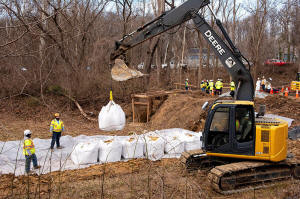
Workers build a cofferdam to stop the flow of raw sewage into the
Potomac River after a massive sewage pipe rupture in Glen Echo, Md.,
Friday, Jan. 23, 2026. (AP Photo/Cliff Owen)
 Officials offer up to $5,000 to
residents cleaning up sewage backups after certain storms, though
activists say more is needed. The city said the program is governed
by specific eligibility criteria.
Maryland’s progress is known because it's among
states that publicly report overflows. About half of states don't,
according to an Associated Press review of state reporting
practices. For a majority of states, the EPA recently extended a
federal electronic reporting deadline, from 2025 to 2028, to report
overflows. The agency said extensions were needed to smooth the
transition.
Fighting for resources
Flooding and water quality needs over the next two decades have
ballooned to at least $630 billion, the EPA estimated in 2024. Local
residents will pay most of that. The federal government has a
smaller role that’s expanded in recent years, but may soon decline.
The 2021 infrastructure law added billions for water needs, but this
is the last year money will go out to states for loans to local
projects. The Trump administration last year proposed deep cuts to
that program and to grants that help states fund environmental
oversight including monitoring and protecting water. Congress
rejected those cuts, preserving access to funds for Baltimore and
other communities, said Maryland Sen. Chris Van Hollen, a Democrat.
But environmental justice efforts to help poor, often largely
minority areas were cut as part of the Trump administration’s attack
on what it scorned as radical ‘diversity, equity and inclusion’
programs.
Some small grants were canceled, like $14 million to install septic
systems in majority-Black Alabama counties where residents live with
sewage piped from their homes onto their property. So were regional
assistance centers intended to help small communities plan complex
projects and compete for a big pool of new money.
One such center that served six Midwest states was setting up to
test drinking water and clean up mold in the East St. Louis,
Illinois, region, said Bonnie Keeler, who led the center. That
project was just one of dozens planned before the program was
spiked.

There still are major sources of financing. In November, the EPA
announced $6.5 billion for wastewater and drinking water projects
through a loan program, plus another $550 million that would be
handed to states. The loan program for states has run for nearly 40
years and provided more than $180 billion for over 50,000 low-cost
loans, the agency said. The agency offers some technical assistance
as well.
“EPA helps invest in our nation’s water infrastructure by
identifying needs, funding infrastructure projects through multiple
programs, and providing technical assistance to connect communities
and tribes to federal funding,” the agency said.
Bloomquist wants Baltimore to pay for damages and prevent it from
happening again. He had to miss several days of work after the
January backup and has to replace his basement floor.
“It’s been a saga and now everyone’s on edge. You know, we’re on our
group texts, people are like, ‘Oh no, it is raining,’” Bloomquist
said.
___
Wildeman reported from Hartford, Connecticut. Associated Press
writers Tammy Webber in Fenton, Michigan, and Gabriela Auon Angueira
in San Diego contributed.
All contents © copyright 2026 Associated Press. All rights reserved |