Responding to federal threat, legislation would protect Illinois
waterways
[March 11, 2026]
By Gabriel Castilho and Medill Illinois News Bureau
SPRINGFIELD — As the Trump administration moves to slash federal
protections for waterways and wetlands, Illinois Democratic lawmakers
and environmental advocates are racing to finally pass a measure that
would enact state safeguards.
The Wetlands Protection Act was discussed in both chambers of the
Illinois General Assembly last year but failed to get traction or make
it to the House and Senate floors, partly due to budget constraints in
the 2025 budget year.
“I hope things will turn around,” said Rep. Anna Moeller, D-Elgin. “It’s
just really important for our ecosystem, for flood control, for water
control, for water quality.”
A proposal from the Trump administration adds urgency to a longstanding
issue in Illinois. Last November, the federal EPA proposed a new rule to
the Clean Water Act that would bestow protection only to wetlands that
hold water during the wet season and with visible connections to major
waterways. Excluded are seasonal streams, marshes, bogs, swamps and
mangrove forests.
Seasonal streams are those wetlands that dry up during certain times of
the year.
In a statement outlining the rule changes last year, the EPA said it
wanted to cut the red tape and provide predictability, consistency and
clarity for American industry, energy producers, the technology sector,
farmers, ranchers, developers, businesses and landowners.
Currently, developers must obtain a permit from the Army Corps of
Engineers before building over a wetland to ensure environmentally
responsible practices.

If the EPA rule change is finalized this year, over two-thirds (707,566
acres) of Illinois’ wetlands would be without protections, according to
a University of Illinois Urbana-Champaign study released in September.
Neighboring states like Wisconsin, Missouri and Indiana already have
safeguards in place to protect their wetlands, but Illinois does not.
“We need to do something: 90% of our wetlands have already been
destroyed in Illinois,’’ Moeller said, “and we need to protect the
remaining 10%.”
Senate Bill 2401 would give the Illinois Department of Natural Resources
authority over wetland permitting on private land before construction
begins. The bill exempts certain agricultural activities like normal
farming, silviculture and maintenance of farms and stock ponds
The bill was re-referred for assignment at the end of the last session,
and no action has been taken on it this session.
Sen. Laura Ellman, D-Naperville, who sponsored the bill, said she is
hopeful this will be the year the state Wetlands Protection Act becomes
law. “We had tough budget years, which in short means other topics
receive great priority,” Ellman said in an email statement.
“I believe that as we continue to lay out the case for Senate Bill 2401
and other environment-related legislation, the push to take action now
is stronger than ever. As you know, actions speak louder than words.”
Does bill have governor’s support?
Still, Democrats supporting the bill face opposition from some
Republicans, the Illinois Farm Bureau as well as a question mark
surrounding support from Gov. JB Pritzker.
A spokesperson for Pritzker wrote: “The Governor’s Office will monitor
and review legislation as it moves through the General Assembly. Any
legislation that requires additional state resources will be carefully
reviewed with budgeteers to understand the fiscal impact.”
Without support from the governor and the Illinois Department of Natural
Resources, passage of the bill through the two Democratic-led chambers
might be difficult, supporters of the bill said.

“I think our thought is, frankly, if the governor and IDNR would come
out as supporting this, it would be a much easier sell to the
legislature,” said Brian Gill, senior director of government affairs and
policy for the Shedd Aquarium in Chicago, one of the organizations
supporting the bill.
With the dynamics of consistently tight budgets in Springfield in mind,
the Shedd changed its strategy in the state capital recently.
“We last year flipped from pointing at the General Assembly to asking
Gov. Pritzker to take a leadership role in this,’’ Gill said. “I think
those of us that support this certainly would probably support more
budget for IDNR to also handle this, but that is the bigger concern:
budget and resources.”
Moeller conceded the law might require additional resources from the
state.
“I don’t think the Department of Natural Resources is against this
legislation, but I think we are working with them to make sure that they
can implement the regulation — with everything else that they’re charged
with doing.”
[to top of second column]
|
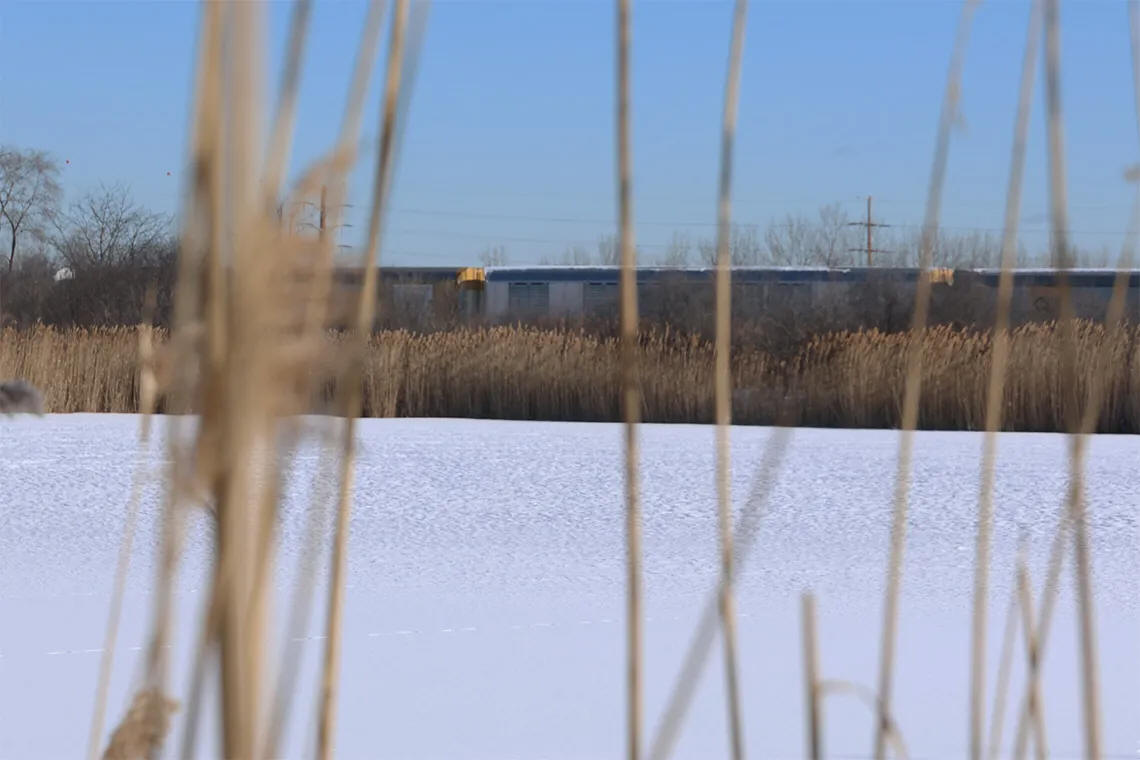
The Big Marsh Park restoration project and other nearby projects in
the Calumet region sit on areas formerly used for landfills and for
US Steel Works facilities. The Big Marsh Park has been open since
2016 with a bike park and a trail. (Medill Illinois News Bureau
photo by Gabriel Castilho)

Elsewhere, opposition to the bill centers around the added restrictions
to landowners and the potential impact on economic growth and
development in rural Illinois. In addition to the farming groups, last
year the Illinois Fertilizer and Chemical Association weighed in as
opposing it. When asked whether their position remains the same this
year, an IFCA spokesperson said, “We are monitoring the wetlands bill
and other bills of general interest to the ag industry as a whole.”
Sen. Jason Plummer, R-Edwardsville, has opposed the bill since 2024. On
his official website, he said the bill would have a massive negative
impact on farmers, the construction industry, anyone looking to build a
home and all private property owners.
“This legislation is absurd, and if it becomes law, it will just be one
more reason that people choose not to build a home or start a business
in Illinois,” he is quoted as saying on the website.
What about the Swampbuster Act?
Sanjay Sofat, director of environmental policy at the Illinois Farm
Bureau, said there are already effective government programs in place to
protect wetlands.
He cited the federal Swampbuster Act, which discourages farmers from
turning wetlands into cropland since 1985. Under the federal law, any
farmer who drains a wetland on their property is ineligible for federal
benefits such as subsidies, loans and insurance. According to the
environmental advocacy organization Food and Water Watch, the program
currently protects approximately 78 million acres of wetlands — almost
two-thirds of the wetlands left in the continental United States.
“The burden is, you are doubly regulating the same entity that is
already regulated on the Swampbuster,” he said.
However, Tucker Barry, communications director for the Illinois
Environmental Council, said the Swampbuster Act does not address the
legal protections gap that would arise if the new EPA rules were to be
finalized. While the Swampbuster rewards farmers’ compliance if they do
not convert wetlands, it does not define what a wetland is — instead it
uses the CWA definition of wetlands as “navigable waters.”

Barry argued that not all farmers are against wetlands protection. “Many
farmers understand that this bill is reasonable and offers vital
protections that help them protect their land from flooding, poor water
quality and soil health problems,” Barry said.
Environmental conservation advocates like the Environmental Council, The
Wetlands Initiative and the Shedd have been working to lobby for
wetland-friendly policies from Springfield for a long time while
maintaining restoration projects of their own.
Some counties in Illinois, meanwhile, have stepped up to fill the lack
of a firm state policy, Barry said.
DuPage County requires additional documentation for activities that
disturb the ground, removes vegetation, builds unpermitted structures,
or any activity that affects the flow or absorption of water.
Ellman, who represents the county, sees her bill as an extension of
those kinds of efforts.
“As there are wetlands protections already in place for DuPage County, I
am thinking beyond the scope of (Senate) District 21 in terms of how
important this matter is,” Ellman said. “By enforcing these protections
now, we are protecting our state’s ecosystem and more.”
Gabriel Castilho is a graduate student in journalism
with Northwestern University’s Medill School of Journalism, Media
and Integrated Marketing Communications, and is a fellow in its
Medill Illinois News Bureau working in partnership with Capitol News
Illinois.
Capitol News Illinois is a
nonprofit, nonpartisan news service that distributes state
government coverage to hundreds of news outlets statewide. It is
funded primarily by the Illinois Press Foundation and the Robert R.
McCormick Foundation.

|