Iran targets commercial ships, Dubai airport and oil facilities as
concerns grow over global energy
[March 11, 2026]
By JON GAMBRELL and DAVID RISING
DUBAI, United Arab Emirates (AP) — Iran attacked commercial ships on
Wednesday across the Persian Gulf and targeted Dubai International
Airport, escalating a campaign of squeezing the oil-rich region as
global energy concerns mounted and American and Israeli airstrikes
pounded the Islamic Republic.
Two Iranian drones hit near Dubai International Airport, home to the
long-haul carrier Emirates and the world’s busiest for international
travel. Four people were wounded but flights continued, the Dubai Media
Office said.
Iran's joint military command announced it would start targeting banks
and financial institutions in the Middle East, a threat that would put
at risk particularly Dubai, in the United Arab Emirates, which is home
to many international financial institutions, as well as Saudi Arabia
and the island kingdom of Bahrain.
Earlier, a projectile hit a container ship off the coast of Oman in the
Strait of Hormuz, setting it ablaze and forcing most of the crew to
abandon the vessel, the British military said. Kuwait said its defenses
downed eight Iranian drones and Saudi Arabia said it intercepted five
drones heading toward the kingdom’s Shaybah oil field.
Iran has effectively stopped cargo traffic in the narrow strait through
which about a fifth of all oil is shipped from the Persian Gulf toward
the Indian Ocean. It has also targeted oil fields and refineries in Gulf
Arab nations, aiming at generating enough global economic pain to
pressure the United States and Israel to end their strikes.
The U.N. Security Council was to vote later Wednesday on a resolution
sponsored by the Gulf Cooperation Council demanding Iran stop attacking
its Arab neighbors.
Israel said it renewed attacks on Tehran, Iran's capital, following
multiple strikes Tuesday that residents described as some of the
heaviest during the war. Explosions were also heard in Beirut and in
southern Lebanon after Israel said it was hitting targets connected to
the Iran-linked militant Hezbollah group.

Israel pounds Lebanon with new attacks
The attacks set a building ablaze in central Beirut's densely populated
Aicha Bakkar area, engulfing the top two floors. There were no immediate
reports of casualties.
Other Israeli strikes on southern and eastern Lebanon killed 14 people,
and a Red Cross worker also died Wednesday of wounds sustained Monday,
when his team was hit by an Israeli strike while they were rescuing
people from an earlier attack.
More than 500 people have been killed so far in Lebanon since Hezbollah
triggered the latest round of fighting with Israel after the American
and Israeli attacks on Iran started.
Iran launches multiple salvoes at Israel and Gulf Arab nations
Israel warned of three Iranian attacks early Wednesday, with sirens
heard in Tel Aviv and elsewhere but no immediate reports of casualties.
Saudi Arabia said it had destroyed six ballistic missiles launched
toward Prince Sultan Air Base, a major U.S.- and Saudi-operated facility
and intercepted two drones over the eastern city of Hafar al-Batin.
In the Strait of Hormuz north of Oman, a cargo ship was hit with a
projectile and set on fire, according to the United Kingdom Maritime
Trade Operations center, run by the British military.
The center also reported an attack on a container ship off the United
Arab Emirates, saying the “extent of the damage is currently unknown but
under investigation by the crew.” Another ship was hit by a projectile
in the Persian Gulf, it said. The crew was reported safe.
The ship attacks follow intense American airstrikes targeting Iranian
navy assets and the port city of Bandar Abbas on Tuesday.
Air defenses in the UAE worked to intercept incoming Iranian fire since
early Wednesday morning. Iranian attacks have killed six people and
wounded 122 others there so far. Bahrain also reported incoming Iranian
fire early in the morning.
The Iranian threat against financial institutions did not identify any
specifically, and came after a Tehran location of Bank Sepah, the
state-owned financial institution sanctioned by the U.S. over funding
its armed forces, came under attack early Wednesday, killing staffers
there, the state-run IRNA news agency reported.

[to top of second column]
|
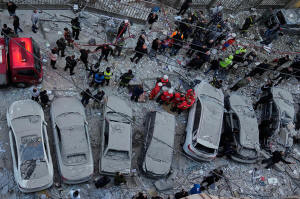
Rescue workers gather at the site where Israeli airstrikes hit
apartments in Beirut, Lebanon, Wednesday, March 11, 2026. (AP
Photo/Hussein Malla)

At the United Nations, the Security Council was to vote Wednesday
afternoon on the Gulf Cooperation Council resolution, according to
three diplomats speaking on condition of anonymity ahead of an
official announcement.
The draft resolution, obtained by The Associated Press, condemns
Iran’s attacks on Bahrain, Kuwait, Oman, Qatar, Saudi Arabia, the
UAE and Jordan. The measure calls for an immediate end to all
strikes and threats against neighboring states, including through
proxies.
It would be the first Security Council resolution considered since
the start of the war on Feb. 28.
Oil prices stay high on fears of prolonged shipping disruption
Oil prices remained well below Monday's peaks but the price of Brent
crude, the international standard, was still up some 20% Wednesday
from when the war began, and consumers around the world are already
feeling the pain at the pump.
The spike in oil prices has been rocking financial markets worldwide
because of worries that the war could block the global flow of oil
and natural gas for a long time.
The U.S. military said Tuesday it had destroyed 16 Iranian
minelayers near the Strait of Hormuz, though U.S. President Donald
Trump said in social media posts that there were no reports yet of
Iran mining the passage, a prospect that experts warned of preceding
the war.
If the strait is mined, it could take at least weeks to clean it up
once the conflict is over.
Some tankers, believed linked to Iran, are continuing to get through
the strait making so-called “dark” transits -- meaning they aren’t
turning on their Automatic Identification System tracks, which show
where vessels are. Vessels carrying sanctioned Iranian crude often
turn off their AIS trackers.
The security firm Neptune P2P Group said Wednesday there had been
seven ships pass through the strait since March 8. Of them, five
were linked to Iranian-associated shipping, it said. In ordinary
times the strait typically sees 100 ships or more transit daily from
the Persian Gulf into the Gulf of Oman.
Meanwhile, the commodity-tracking firm Kpler said Iran has restarted
crude exports through its Jask oil terminal on the Gulf of Oman. A
tanker loaded roughly 2 million barrels at Jask on March 7, it said.

Speculation over health of Iran’s new supreme leader grows
Concerns are growing over the health of Iran’s new Supreme Leader
Ayatollah Mojtaba Khamenei after comments about him “being injured.”
The 56-year-old Khamenei — the son of the late Supreme Leader
Ayatollah Ali Khamenei — has not been seen since since becoming
supreme leader on Monday. His father and wife both were killed in an
Israeli airstrike on the first day of the conflict.
Foreign nationals flee region as death tolls rise
In addition to the more than 500 killed in Lebanon, Iran has said
that more than 1,300 people have been killed there and Israel has
reported 12 people dead.
The U.S. has lost seven soldiers while another eight have suffered
severe injuries.
Many foreign nationals have been getting out of the Persian Gulf
region since the war began, including over 45,000 U.K. citizens, the
British Foreign Office said. Some 40,000 people returned to the
United States, according to the State Department.
___
Magdy reported from Cairo, and Rising from Bangkok. Associated Press
writers Sally Abou AIJoud in Beirut, Giovanna Dell’Orto in Miami,
Julie Watson in San Diego, and Edith M. Lederer at the United
Nations contributed to this story.
All contents © copyright 2026 Associated Press. All rights reserved |