What Americans think about the war in Iran, according to recent polls
[March 11, 2026]
By LINLEY SANDERS
WASHINGTON (AP) — Americans are divided along party lines on U.S.
military action against Iran, according to polls conducted since the war
began, with most polls showing opposition is higher than support.
Polls suggest that many Americans are worried the military action is
making the U.S. “less safe,” even as they see Iran as a threat to U.S.
security. There are also warning signs for President Donald Trump as he
confronts the possibility of a prolonged conflict that could come with
significant economic turmoil. Trump gave conflicting messages on Monday
about the war’s timeline, suggesting it could be near its end while also
threatening additional force against Iran if the country disrupted the
global flow of oil.
Fluctuating oil prices may already be alarming voters. Polls conducted
over the weekend found a large majority of Americans are worried about
the war causing oil and gasoline prices to rise. The vast majority
expect the U.S. action against Iran will last at least “months,” if not
longer.
Republicans are largely behind the president, a Republican, the polls
show, but there are indications that they are wary of any response that
would lead to U.S. troops on the ground in Iran. And after Trump
campaigned on the pledge of putting “America first” and ending U.S.
involvement in “forever wars,” the Iran conflict could become a
particular point of friction.
More oppose than support the US military action
About half of registered voters — 53% — oppose U.S. military action
against Iran, according to a new Quinnipiac Poll conducted over the
weekend. Only 4 in 10 support it, and about 1 in 10 are uncertain. A new
Ipsos poll also found more disapprove than approve of the strikes.

That's similar to the results of text message snap polls from The
Washington Post and CNN, both conducted shortly after the joint
U.S.-Israel attacks began, which also indicated that more Americans
rejected the military action than embraced it.
A recent Fox News poll found opinions more evenly divided: Half of
registered voters approved of the U.S. military action, while half
disapproved.
Several of the recent polls show a majority of Americans believe the
Trump administration has not provided a clear explanation of the reasons
behind the military strikes, and there are some divisions about whether
Iran truly posed an “imminent and direct threat” to the United States,
as the White House has said.
Most voters in the Quinnipiac poll — 55% — said they did not believe
Iran posed an “imminent military threat” to the U.S. before the current
military action. On the other hand, about 6 in 10 registered voters in
the Fox News poll said Iran poses a “real national security threat,” and
a recent AP-NORC poll found about half of U.S. adults were highly
concerned that Iran’s nuclear program posed a direct threat to the U.S.
Voters are worried about gas prices
As oil prices oscillate, the vast majority of voters are “very” or
“somewhat” concerned about oil and gasoline prices rising in the U.S.,
according to the Quinnipiac poll. Only about one-quarter of voters are
“not so concerned” or “not concerned at all.”
The highest levels of concern are driven by Democrats and independents,
but about half of Republicans are also at least somewhat concerned about
the war increasing gas prices.
[to top of second column]
|
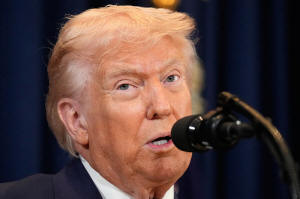
President Donald Trump speaks at a news conference, Monday, March 9,
2026, at Trump National Doral Miami in Doral, Fla. (AP Photo/Mark
Schiefelbein)

About two-thirds of Americans expect U.S. gas prices will “get
worse” over the next year as a result of the U.S. military action,
according to the Ipsos poll conducted March 6-9. Republicans were
more likely to say gas prices would worsen than improve as a result
of the war: 44% said they would get worse, while 26% expected they
would improve. About 2 in 10 thought they would remain the same.
Democrats and independents overwhelmingly expect gas prices will
worsen.
On Monday, Trump said the U.S. would take further action against
Iran if they made any attempt to stop the global oil supply.
About half worry about US safety, doubt Trump's judgment
As the Iran war spreads into the Middle East, many Americans also
worry Trump's military decisions have made the U.S. less safe.
About half of voters in both the Quinnipiac and Fox News polls said
the U.S. military action in Iran makes the U.S. “less safe,” while
only about 3 in 10 in each poll said it made the country safer. The
CNN poll found about half of U.S. adults thought the strikes would
make Iran “more of a threat” to the U.S., while only about 3 in 10
thought it would lessen the danger.
About 6 in 10 U.S. adults said they trusted Trump “not much” or “not
at all” to make the right decisions about the U.S. use of force in
Iran, according to the CNN poll. Republicans expressed more trust in
the president than Democrats or independents.
An AP-NORC poll conducted before the strikes similarly found that
56% of U.S. adults trusted Trump “only a little” or “not at all” to
make the right decisions about the use of military force abroad.
Concerns about deploying troops
Most voters are concerned about a possible expansion in the war’s
scope.
About three-quarters of voters oppose the idea of sending ground
troops into Iran, according to the Quinnipiac poll that was
conducted after the deaths of six U.S. service members were
announced. The death of a seventh service member was reported later.

The Trump administration has acknowledged the likelihood of American
casualties, and has not ruled out sending American soldiers to Iran.
Defense Secretary Pete Hegseth said last week that it was
“foolishness” to expect U.S. officials to say publicly “here’s
exactly how far we’ll go.”
Only about 2 in 10 in the Quinnipiac poll supported sending troops
to Iran. Even among Republican voters, the poll found more oppose
than support sending ground troops, 52% to 37%.
The new Ipsos poll found bipartisan concern that the U.S. military
action would risk the lives of American military personnel. About 9
in 10 U.S. adults are “very” or “somewhat” concerned about this,
including 86% or Republicans and 93% of Democrats.
All contents © copyright 2026 Associated Press. All rights reserved |