Inflation held steady last month, but that was before the attack on Iran
sent energy costs soaring
[March 12, 2026] By
CHRISTOPHER RUGABER and ANNE D'INNOCENZIO
KANSAS CITY (AP) — Inflation remained stubbornly elevated last month as
gas prices rose, but it's a snapshot of consumer prices before a
U.S.-Israeli attack on Iran sent energy costs soaring.
Consumer prices rose 2.4% in February compared with a year earlier, the
Labor Department said Wednesday, matching January’s increase. Excluding
the volatile food and energy, core prices climbed 2.5% from a year ago,
also matching January’s level, which was the lowest in five years. Both
remain above the Federal Reserve's 2% target.
Wednesday’s data has been overtaken by a conflict that began when the
U.S. and Israel attacked Iran on Feb. 28, causing wild gyrations in oil
prices as shipping lanes through the Persian Gulf suffered a rare
shutdown. Gas prices have jumped sharply and are expected to fuel higher
costs broadly. Inflation data for this month will be released in early
April.
The price spike will challenge the inflation-fighters at the Federal
Reserve and could slow consumer spending, which drives two-thirds of the
nation’s economic growth.
Prices could retreat if the war ends soon, as President Donald Trump has
hinted. But rising oil prices threaten to worsen inflation for at least
a few months with Americans already worn down by nearly five years of
sharply higher costs. “Affordability” has become a thorny political
issue for congressional Republicans with midterm elections later this
year.

On a monthly basis, prices rose 0.3% in February from the previous
month, up from 0.2% in January. Increases at that pace for an extended
period would push yearly inflation higher. Core prices moved up just
0.2%, down from a 0.3% rise in January.
There were some positive signs in Wednesday's report, with rental
inflation falling to just 0.1% on a monthly basis, the smallest increase
in five years. New car prices were unchanged in February and used car
prices fell 0.4%.
But grocery prices rose more quickly than in January, a trend that has
hammered family budgets. They rose 0.4% in February and were up 2.4%
from a year earlier. Gas prices increased 0.8% last month, though
they're down 5.6% compared with a year ago. And clothing costs jumped
1.3% just in February, likely due to tariffs.
“Ahead of the energy shock, trends in the consumer price index were
relatively tame,” said Laura Rosner-Warburton, senior economist at
MacroPolicy Perspectives. But she cautioned that the Federal Reserve’s
preferred inflation measure, which puts less weight on items that are
cooling, such as rents, will likely come in higher when it is reported
on Friday.
Fuel prices are on track to soar 20% this month, she added, “and that’s
huge.” Monthly inflation could rise by as much as 0.9% this month, she
estimates, which would be the highest in four years.
Oil prices that soared close to $120 a barrel late Sunday fell to $87 by
Wednesday after Trump suggested that the conflict would be a “short-term
excursion.” Still, he has also threatened more attacks and there is no
sign of a let-up.
Companies bracing for higher energy costs are already wresting with
tariffs, inflation, and growing labor costs. Many still want to avoid
passing costs on to customers, but that depends heavily on the duration
of the war.
Isaac Lee Collins, CEO of Fifth & Emery Frozen Yogurt & Chocolate in
Kansas City, said rising gas prices will make doing business more
expensive.

[to top of second column] |
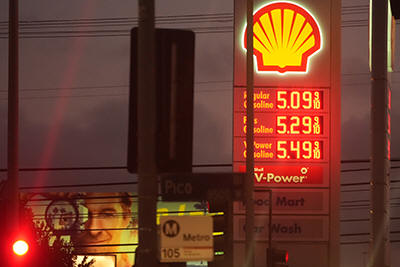
Gas prices are displayed, Monday, March 9, 2026, in Los Angeles. (AP
Photo/Damian Dovarganes)
 The chocolate he imports from France
got 15% to 20% more expensive last year, mostly because of tariffs.
“It’s just another surcharge that we’re going to get hit with,”
Collins said.
Stew Leonard Jr., CEO of the Stew Leonard’s supermarket chain, fears
his suppliers will start increasing prices as gasoline prices spike.
He receives truck loads of meats and fresh produce daily.
“He’s a regular guy that has a family, and if it’s costing him more
money to put fuel in this truck, he’s going to knock on my door and
say ’Hey, Stew. I need a little more for that,” he said.
If the costs of doing business increase at Stew Leonard's, there may
be price hikes on some goods, he said.
Some analysts warn prices will rocket higher if the Strait of Hormuz
remains closed. About 20% of the world’s oil and natural gas is
shipped through the narrow channel every day. On Wednesday, a
projectile hit a Thai cargo ship off the coast of Oman leading into
the Strait of Hormuz, setting it ablaze.
Oil prices could soar to $150 a barrel in the coming weeks if
shipments don’t resume, according to Wood Mackenzie, an energy
analytics firm.
The national average for regular gasoline in the U.S. jumped to
$3.58 a gallon Wednesday, according to AAA, an increase of about 20%
just in one month.
Core prices will be much less affected this month, but could tick
higher over time as more expensive gas pushes up airline fares,
shipping, and other transportation costs.
Darren Rebelez, the CEO of Casey’s General Stores, told investors
Tuesday that he doesn't expect a significant pullback in customer
spending unless gasoline nears $5 per gallon.
Even if price increases are short-lived, it will almost certainly
delay any interest-rate cut by the Federal Reserve, which meets next
week. It cut its key rate three times last year before leaving it
unchanged at its last meeting in January.

The Fed is already deeply divided over whether it needs to keep its
rate at its current level of about 3.6% to push inflation down
closer to its 2% goal, or whether it should reduce the rate to
support borrowing, spending, and hiring.
Last Friday, the government reported unexpectedly sharp job losses
for February as employers slashed 92,000 jobs. The unemployment rate
ticked up to 4.4%.
The weak jobs report puts the Fed in an especially difficult
position: It would normally reduce rates to boost growth and hiring,
but it typically raises rates — or at least keeps them where they
are — if inflation is a concern.
“That's always the worst-case scenario for the central bank,” said
Austan Goolsbee, president of the Federal Reserve Bank of Chicago,
on Bloomberg Friday. "As we get more uncertainties, I kind of think
that the time at which it makes sense to act keeps getting pushed
back.”
___
D'Innocenzio reported from New York.
All contents © copyright 2026 Associated Press. All rights reserved |