Trump visa changes squeeze rural schools relying on international
teachers
[March 12, 2026]
By MICHAEL MELIA
Like many school systems facing teacher shortages, South Carolina’s
Allendale County has looked overseas for help. A quarter of the teachers
in the rural, high-poverty district come from other countries.
The superintendent praises the international educators — mostly from
Jamaica and the Philippines — for their skill and dedication, but she is
preparing to lose some of them as the Trump administration reshapes visa
programs.
Facing higher visa sponsorship costs and uncertain immigration policies,
Superintendent Vallerie Cave said it feels too risky to extend some
international teachers whose contracts are up or bring on others.
“Some of my very best teachers are having to return to their countries,”
Cave said.
For rural schools especially, President Donald Trump’s immigration
crackdown is pinching a pipeline used widely to fill staffing shortages
that worsened during the COVID-19 pandemic. Rural districts can struggle
to attract American teachers to remote areas that lack plentiful
housing, shopping and services such as health care, especially for lower
salaries than some bigger districts offer.
Cave is hoping to hire local teachers to fill the gaps left by several
teachers' impending departures. If she can't, she may expand the
district’s use of online teachers. Elsewhere, districts are considering
hiring uncertified instructors, combining classes or dropping course
offerings.

In September, the White House announced a $100,000 fee on H-1B visas,
which allow highly skilled foreign workers to be employed in the U.S.
The Trump administration argued American employees were being replaced,
particularly in highly paid roles at tech companies. Critics have argued
the fee will worsen labor shortages outside of tech.
More than 2,300 people with H-1B visas work as educators across 500
school districts, according to an analysis by the National Education
Association teachers union. In a December lawsuit challenging the fee, a
coalition of 20 states argued that the fees would effectively prevent
school districts from hiring international teachers.
The Trump administration has provided a form to request exemptions on
the fee, and educators and advocacy groups have argued it’s in the
public’s interest for teachers to be exempted. Teachers also can come to
the U.S. on the more common J-1 visa, which allows short-term stays for
cultural exchange programs and is not subject to the new fee.
In rural Oregon, the Umatilla School District recruited two teachers
from Spain for math and science instruction. The teachers were
“phenomenal,” Superintendent Heidi Sipe said, but they returned home in
the summer.
“Unfortunately, due to some things at home and then the stress of the
unknown, they did choose to go back," Sipe said.
[to top of second column]
|
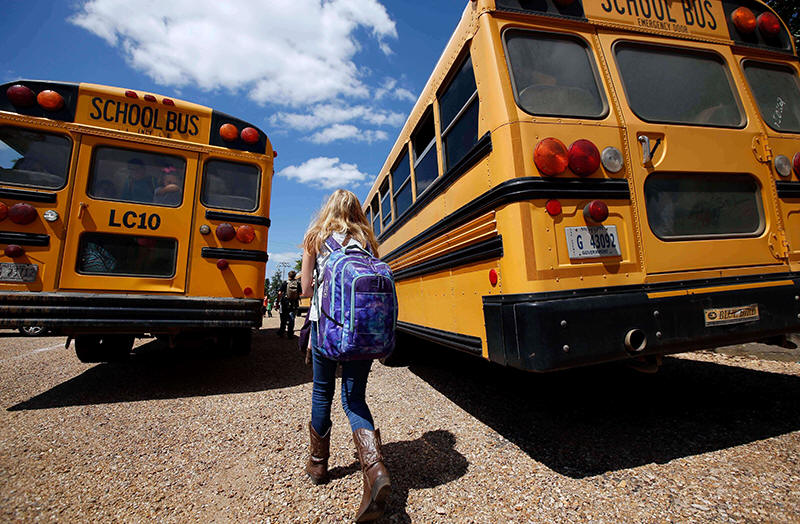
A student prepares to leave school, Aug. 13, 2014, southeast of
Brookhaven, Miss. (AP Photo/Rogelio V. Solis, File)

The district did not look for international candidates to replace
them because of the cost and uncertainty, but it was able to
advertise early and found local candidates for the openings, Sipe
said. Other school leaders are not optimistic they will have the
same success.
In Allendale County, the international teachers — on a mix of H-1B
and J-1 visas — have taught subjects including math, science and
language arts, plus special education. Even before the hike in fees,
it would cost between $15,000 to $20,000 to sponsor a single teacher
every year, Cave said.
School leaders agree hiring in-person, certified staff is the best
option — teachers who can sit with students to explain a concept and
build closer relationships throughout the school day. When that
option fails, they weigh tradeoffs.
Cave said she will look to introduce more virtual teachers through
Fullmind, a company the district already is using to provide three
state-certified instructors. Students meet in a classroom, and their
teacher joins them via video chat. Fullmind announced Thursday it
had acquired Elevate K-12 and now provides the remote instruction
for more than 225 school systems.
South Carolina lets districts hire non-certified teachers to meet
staffing needs, but Cave said she would bring in more online
teachers before pursuing that option. Her challenges with teacher
shortages, she said, have not let up since the pandemic, when many
school districts used federal relief money to post new positions,
then had difficulty finding enough teachers.
“I can't really do competitive pay,” she said. “For rural America,
impoverished America, it is still a problem recruiting teachers.”
At Halifax County Schools in rural North Carolina, 103 of the 159
teachers are from other countries. For the longer term, the district
is pursuing ways to recruit future educators as early as their
junior and senior years in high school.

More immediately, the district is hoping to hire international
teachers coming from other districts who want to have their J-1
visas changed to H-1B visas, which could allow the school system to
avoid the $100,000 fee, said Carolyn Mitchell, the district's
executive director of human resources.
“You have to try to figure out every alternative way when you know
that you may need people,” Mitchell said.
All contents © copyright 2026 Associated Press. All rights reserved |