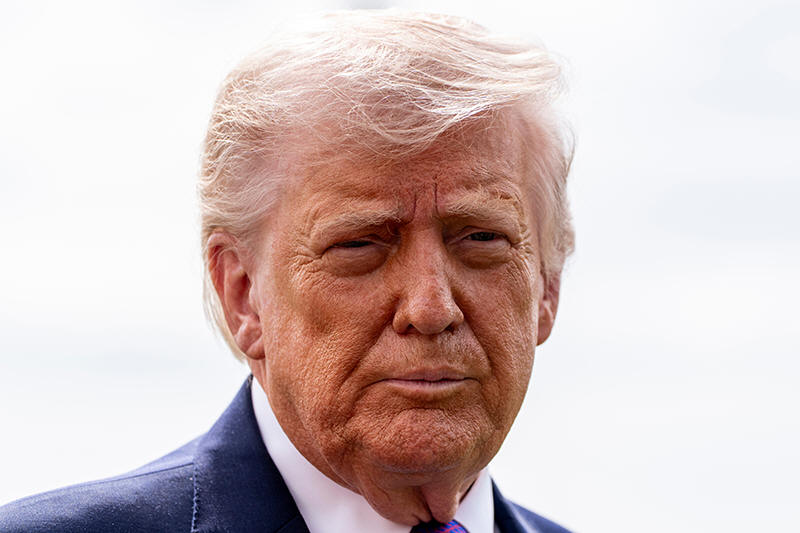
Trump keeps telling America he's winning in Iran. He's less clear in
explaining how the war ends
[March 12, 2026]
By AAMER MADHANI
WASHINGTON (AP) — Facing jittery global markets and drooping poll
numbers since launching a war with Iran, President Donald Trump has
cycled from calls for “unconditional surrender” to sounding amenable to
an end state in which Iran trades one hard-line ayatollah for another.
Shifting comments from the Republican president and his top aides are
adding to the precariousness of the 12-day-old conflict, which is
impacting nearly every corner of the Middle East and causing economic
tremors around the globe. With neither side budging, the war is now on
an unpredictable path and a credible endgame is unclear.
Defense Secretary Pete Hegseth said Tuesday it was up to Trump “whether
it’s the beginning, the middle or the end” of the war. Trump, during the
course of one speech at a House Republican gathering Monday, went from
calling the war a “short-term excursion” that could end soon to
proclaiming “we haven’t won enough."
“We have hit them harder than virtually any country in history has been
hit, and we’re not finished yet,” Trump told reporters at the White
House on Wednesday.
The vacillation has fueled criticism from those who say Trump lacks a
clear goal. “They didn’t have a plan," Sen. Mark Kelly, D-Ariz., told
reporters. "They have no timeline. And because of that, they have no
exit strategy.”
A constantly shifting goal line
Since ordering the Iran bombardment, Trump has continually shifted his
timelines and goals for the war.
Over the past few days, Trump has called for the “unconditional
surrender" of Iran's leaders, while suggesting he had already succeeded
in achieving his objective of decimating Iran’s military.

At the same time, Trump's team has sought to soothe anxious Americans
that the war will not be long and drawn out even as the president has
insisted he has not ruled out the option of using U.S. ground troops.
The U.S. military says it has effectively destroyed the Iranian navy and
made huge strides in defanging Iran’s ability to launch missiles and
drones at its neighbors. Yet the critical Strait of Hormuz, through
which roughly 20% of the world’s oil passes on a typical day, remains
essentially closed to business, and Iranian leaders are unbowed.
The Revolutionary Guard said Iran would not allow “a single liter of
oil” through the vital waterway until the United States stopped its
bombing campaign. Ali Larijani, Iran’s top national security official,
offered a menacing message on Tuesday after Trump had threatened to
attack Iran “TWENTY TIMES HARDER” if Tehran stopped oil flowing through
the strait.
“The sacrificial nation of Iran doesn’t fear your empty threats,”
Larijani wrote on X. “Even those bigger than you couldn’t eliminate
Iran. Be careful not to get eliminated yourself.”
Trump ally Newt Gingrich, a former Republican House speaker, said the
administration should have moved on securing the strait on Day One of
the conflict.
“If they can’t keep it open, this war will in fact be an American defeat
before very long, because the entire world, including the American
people, will react to the price of oil if the strait stay closed very
long,” Gingrich said in an appearance on Fox Business.
Making the case to Americans
Trump has struggled to make his case to Americans about why preemptive
action against Iran was necessary and how it squared with his pledge to
keep the United States out of the “forever wars” of the past two
decades. Thus far, seven U.S. troops have been killed and about 140
injured in the retaliatory salvos from Iran.
One of several reasons Trump has offered to justify launching the war
was that he had a “feeling” that Iran was getting set to attack the U.S.
White House press secretary Karoline Leavitt slightly amended that
position, telling reporters that the president “had a feeling” that was
“based on fact.”
But Pentagon officials have told congressional staffers in private
briefings that the U.S. does not have intelligence indicating that Iran
was planning to preemptively attack the U.S.
[to top of second column]
|
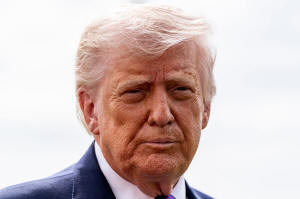
President Donald Trump speaks with reporters before departing on
Marine One from the South Lawn of the White House, Wednesday, March
11, 2026, in Washington. (AP Photo/Alex Brandon)

Recent polling shows Trump's decision to attack Iran has not come
with the rallying-around-the-flag effect that has typically
accompanied the start of recent U.S. wars.
About half of voters in Quinnipiac and Fox News polls said the U.S.
military action in Iran makes the U.S. “less safe,” while only about
3 in 10 in each poll said it made the country safer. A CNN poll
found about half of U.S. adults thought the military action would
make Iran “more of a threat” to the U.S., while only about 3 in 10
thought it would lessen the danger.
In that CNN poll, about 6 in 10 U.S. adults said they trusted Trump
“not much” or “not at all” to make the right decisions about the
U.S. use of force in Iran.
European allies are treading carefully after British Prime Minister
Keir Starmer and Spanish Prime Minister Pedro Sánchez faced the
wrath of Trump, who deemed them not sufficiently supportive in
backing his war of choice.
Trump on Wednesday lashed out again at Spain, which has said it will
not allow the U.S. to use jointly operated bases in southern Spain
in any strikes not covered by the U.N. charter.
“I think they've been very bad — not good at all,” Trump said. “We
may cut off trade with Spain.”
Even German Chancellor Friedrich Merz, who has been broadly
supportive of the U.S.-Israeli campaign against Iran, said on
Tuesday that “more questions arise with every day of war.”
Deflecting responsibility for school bombing
Trump has chosen to deflect responsibility for the bombing of a
girl's school in southern Iran on the first day of the conflict,
killing at least 165 people.
Trump on Saturday blamed the attack on Iran, saying its security
forces are "very inaccurate" with munitions.
On Monday, after the investigative group Bellingcat posted verified
video that showed a U.S. Tomahawk cruise missile hitting a
Revolutionary Guard facility near the school, causing the explosion,
Trump again insisted it could have been Iran's fault but said that
he would accept whatever a U.S. investigation into the matter might
find.
The president erroneously claimed that Tehran had access to
Tomahawks, a U.S.-manufactured weapon system that is only available
to the U.S. and a few close allies.

Asked by a reporter, Leavitt did not directly answer why Trump
falsely asserted that Iran has access to the U.S.-made missile.
Instead, she responded in part that “the president has a right to
share his opinions with the American public” while noting “he has
said he’ll accept the conclusion of that investigation.”
Senate Minority Leader Chuck Schumer, D-N.Y., told reporters that
Trump's claim “is beyond asinine.”
“Again, he says whatever pops into his head no matter what the truth
is," Schumer said. “And we all know he lies, but on something as
formidable as this, it’s appalling.”
Sen. Kevin Cramer, R-N.D., was among Trump allies gently making the
case that it was important for the administration to clarify what
happened to the school.
Cramer said the military must “do everything you can to eliminate
those mistakes going forward.”
“But you also can’t undo it," he added.
All contents © copyright 2026 Associated Press. All rights reserved |