Business coalition warns against phasing out use of natural gas in
Illinois
[March 13, 2026]
By Jenna Schweikert and UIS Public Affairs Reporting (PAR)
SPRINGFIELD — A coalition of 19 manufacturer, business and labor
organizations have petitioned to end ongoing workshops studying the
future of natural gas in Illinois after a statewide resource adequacy
report warned of energy shortages.
In their petition to the Illinois Commerce Commission filed Feb. 24, the
coalition called continued efforts to phase out natural gas in Illinois
“unreasonable and ill-advised.” The petition cited the report’s finding
that Illinois still relies on natural gas, even as the state moves
toward renewable energy sources and decarbonization goals.
Conducted by the ICC in partnership with the Illinois Power Agency and
Illinois Environmental Protection Agency, the report assessed progress
toward the state’s energy and emissions goals and measured the current
and projected status of electric reliability.
Illinois aims to move to 100% carbon-free power by 2045, as mandated in
the 2021 Climate and Equitable Jobs Act.
The Illinois Manufacturers’ Association, a coalition of over 4,000
manufacturers in the state, is one of the petitioners. IMA President and
CEO Mark Denzler said the group brought the petition because the report
already answers a key question:
“What that report said is … we have supply-and-demand issues, and that
Illinois is going to struggle to provide enough power for our businesses
and families,” Denzler said. “Their recommendations are, you know, we
need to keep current plants operating.”
The report detailed an increase in demand for power — largely from an
influx of data centers — alongside a decrease in supply as the state
retires coal and oil to meet CEJA targets. The combination increases
energy prices and could lead to electrical grid strain, the report
concluded.

But this report is only one piece of the energy puzzle, according to
Curt Stokes, an attorney who specializes in utilities cases for the
Environmental Defense Fund.
“We think that that study should inform future of gas, but it’s
definitely not a reason to terminate future of gas,” Stokes continued.
“Future of gas is looking at electrification as one pathway to
decarbonize the gas sector, but they’re … also looking at, like, a ton
of other technologies.”
Future of gas workshops
In 2023, the ICC issued an order to begin workshops exploring the future
of natural gas in Illinois, otherwise known as FOG, to address
affordability and assess progress toward CEJA goals.
The order established one series of workshops to identify relevant
topics around natural gas and another to gather stakeholder perspectives
and proposed legislative and regulatory solutions.
“Utilities were spending a lot of money on infrastructure, and Illinois
had just passed its CEJA legislation aiming for a 100% clean energy
economy,” Stokes said. “The commission knew that something had to change
from the natural gas utilities if Illinois was going to meet that goal.”
What was originally a 16-month process has now stretched into two years,
with another 10 months still to go before the final report planned for
December.
In an email to Capitol News Illinois, ICC Director of Communications
Cayli Baker said the workshops were extended “at the request of
stakeholders involved in the process.”
“The extension ideally allows more time to assemble a robust “Pathways
Study” that quantifies costs/benefits of various decarbonizations
strategies identified in phase 1 of the workshop proceeding,” Baker
said.
Denzler said the IMA opposed FOG initially and had limited opportunity
to weigh in.
“What’s happened here is the government did things backward,” Denzler
said. “What they should have done is the resource adequacy plan that
said, here’s our current resources, here’s what resources we need in the
future. And then that could determine, is there a future of gas?”

[to top of second column]
|

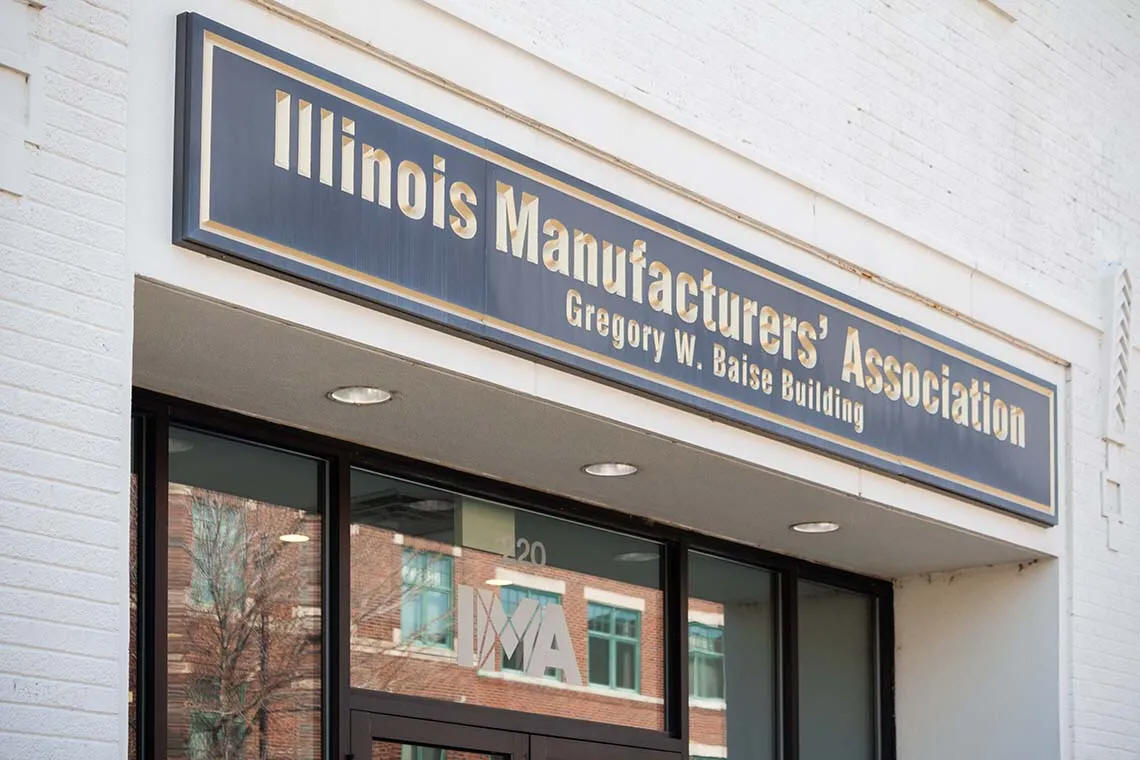
The Illinois Manufacturers’ Association building, located in
Springfield. The IMA is one of over a dozen organizations
petitioning the Illinois Commerce Commission to end workshops
researching the future of natural gas in Illinois. (Capitol News
Illinois photo by Jenna Schweikert)

Baker said that while the resource adequacy plan was mandated by CEJA
before the FOG proceedings, the two are separate.
“The Future of Gas proceedings are designed to look at decarbonization
options specific to the natural gas sector, whereas the resource
adequacy report mandated by CEJA examines our electricity system and
whether sufficient power will be available to meet electricity demand,”
Baker said in the email. “While intertwined these topics are distinct —
different pieces of the puzzle.”
Sarah Moskowitz, executive director of the Citizens Utility Board, a
statewide utility watchdog, said the workshops are an unprecedented
opportunity to explore the “stickiest” energy transition topics.
“The future of gas process is the arena to hash those topics out, and
there’s no need at this point to foreclose on those discussions,”
Moskowitz said.
CUB is an advocate against utility rate hikes, which originally
motivated the ICC to approve the Future of Gas proceedings.
The future of natural gas
Without an equal supply in another energy source, Illinois continues to
rely on natural gas and cannot phase it out without risking electrical
grid strain, according to the resource adequacy report.
Stokes said state agencies and legislators should take the resource
adequacy study “very seriously,” but the integrated resource plans
mandated by the Clean and Reliable Grid Act will provide a bigger
picture of Illinois’ energy resources.
“The municipal and cooperative utilities do their own studies in 2027
but for the investor-owned utilities, that process is going to start
later this year,” Stokes said. “We’ll have a much clearer picture when
that process is complete, on how we can get enough renewable, clean
capacity on the grid in order to meet our capacity needs.”
The IMA supports an “all of the above approach” to energy that includes
natural gas and renewable energies, Denzler said.

“We have to have natural gas, we have to keep current plants operating,
and we have to invest in new electric generation in order to provide
power for homes and businesses,” Denzler said.
Clean energy is not always reliable and doesn’t provide enough energy
for certain industries, Denzler added.
“Large industrial companies that use a lot of energy, it’s really hard,
if not impossible, to rely completely on renewable,” Denzler said. “It’s
the right thing to do … but politically driven deadlines to say, we’re
going to close gas facilities and clean coal facilities by a certain
date without having enough generation to backfill that hole is a
problem.”
The petition’s initial prehearing is scheduled for March 18. There are
four workshops left in the FOG proceedings.
“I think the takeaway is there’s definitely a pathway (to decarbonize),
and identifying what exactly that path is is what that (resource plan)
process is designed to do,” Stokes said.
Capitol News Illinois is
a nonprofit, nonpartisan news service that distributes state government
coverage to hundreds of news outlets statewide. It is funded primarily
by the Illinois Press Foundation and the Robert R. McCormick Foundation. |