Illinois Supreme Court travels to Macomb to hear cases on pretrial
release, student transportation
[March 13, 2026]
By Peter Hancock
MACOMB — The Illinois Supreme Court heard arguments Wednesday in a case
involving a Livingston County man who claimed he should have been
granted pretrial release after his arrest last year for punching a
sheriff’s deputy in the nose.
The justices also heard arguments from the East St. Louis School
District challenging an appellate court order that it provide free bus
transportation to students who live in the district but attend a private
Catholic school.
While neither of those cases is likely to result in a landmark ruling
that will be taught in law schools for generations to come, they were
out of the ordinary for one reason: Instead of hearing the arguments in
their courtroom across the street from the Statehouse in Springfield,
the seven justices traveled some 85 miles west to hear the cases on the
campus of Western Illinois University in Macomb.
The event was part of a recent court program known as “riding the
circuit,” in which the justices travel to different parts of the state
to allow citizens who can’t easily attend a court session in Springfield
to see the court in action and learn about what it does.
“This practice began during the 13th century in England,” Chief Justice
P. Scott Neville told an audience of about 400 people, including many
students from the university and nearby high schools. “Then in 1789, the
U.S. Constitution created the Supreme Court, and they adopted the
practice. In 1818, when Illinois became a state, the state of Illinois
adopted this very same practice. The current Supreme Court has adopted
the practice, and we have been traveling from campus to campus.”

Pretrial release
In the first case, the justices are being asked to interpret an aspect
of the state’s Pretrial Fairness Act, which eliminated the use of cash
bail in determining whether a defendant could be released from custody
while awaiting trial.
The case involved Jimmie Marshall, who was arrested in March 2025 for
punching a Livingston County sheriff’s officer several times in the face
during an altercation that had begun with a fight between his stepson
and another juvenile.
According to court records, Sgt. Andy Rork suffered a fractured nose
during the altercation. When Marshall appeared at his detention hearing
on a charge of aggravated battery on a police officer, the court noted
Marshall’s history of violent offenses, including a 2006 conviction for
second-degree murder and a 2018 conviction for battery.
The court ordered him to be held in custody pending trial, concluding he
posed a significant risk to the community and was unlikely to abide by
any conditions of pretrial release.
In April, Marshall filed a motion to be released, which the circuit
court denied. He then appealed to the Fourth District Court of Appeals
raising a new issue, that the state failed to show he committed a
detainable offense and threatened the safety of the community.
In July, the Fourth District court rejected his appeal, finding that
because Marshall did not challenge the sufficiency of the state’s
evidence in his initial motion, he had effectively waived the right to
make such a claim on appeal.
In August, Marshall pleaded guilty and was sentenced to probation.
Nonetheless, he continued his appeal by asking the Supreme Court to
review the case, even though the question had become moot as far as his
case was concerned. He argued he was never told that he was waiving a
right to raise certain issues on appeal and that he had ineffective
counsel.
[to top of second column]
|
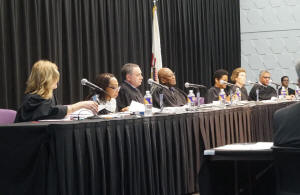
The Illinois Supreme Court held a session on the campus of Western
Illinois University in Macomb on Wednesday, March 11, 2026, as part
of its tradition of “riding the circuit,” which is meant to make the
court more accessible to people in all parts of the state. (Capitol
News Illinois photo by Peter Hancock)

Assistant appellate defender Deborah Pugh said the court should rule on
the question anyway, despite the fact that the case was moot, to clarify
an important issue in the Pretrial Fairness Act.
“With pretrial fairness cases, they’re uniquely susceptible to becoming
moot because of the quickness with which people are trying to plead
guilty or have charges dropped,” she said.
Private school busing
The second case could determine how far public school districts have to
go to provide transportation services to students who live within their
boundaries but attend private or parochial schools.
Under a 1999 state law, school districts that provide transportation
services to their students must also provide transportation services to
students who attend charter schools or other nonpublic schools.
The dispute involves a long-running series of disputes between East St.
Louis School District 189 and Sister Thea Bowman Catholic Grade School.
In 2015, a circuit court ordered the district to provide Bowman students
with the same level of transportation service as district students.
Following that order, the district established two bus routes to carry
students to and from the Bowman school. But the district abruptly
canceled that arrangement starting in the 2022-23 school year, prompting
the lawsuit now before the Supreme Court.
School district officials argue that under the law, they are only
required to pick up and drop off students at points along their regular
routes and that they are not required to establish special routes or
drive out of their way to accommodate students who attend other schools.
But Susan Simone, an attorney for the plaintiff families, argued that
under the district’s logic, the plaintiff children would have to walk an
additional four to eight miles to reach their school from the end of
their bus route.
“It does nothing to advance the legislative purpose of providing safe
transportation to the Bowman students on the same basis, but instead
defeats the statutory purpose,” Simone said.
Garrett Hoerner, the attorney representing the school district, said
whatever the court decides will have financial implications for all
school districts in Illinois, not just East St. Louis.
“The impact of this statutory interpretation is going to affect 800-plus
school districts in this state that provide transportation to their
public school students,” he said. “The statutory interpretation that
this court will determine is going to affect statewide.”
The court took both cases under advisement and is likely to issue
decisions later this year.
Capitol News Illinois is
a nonprofit, nonpartisan news service that distributes state government
coverage to hundreds of news outlets statewide. It is funded primarily
by the Illinois Press Foundation and the Robert R. McCormick
Foundation.
 |