Under pressure from Trump, Republicans plan long talkathon on voting
bill
[March 13, 2026]
By MARY CLARE JALONICK and LISA MASCARO
WASHINGTON (AP) — Under pressure from President Donald Trump, Senate
Republicans plan to launch a “full and robust debate” next week on
legislation to impose strict new proof-of-citizenship requirements, an
effort to show Trump that they are serious about the bill even though it
doesn’t have enough support to pass.
Senate Majority Leader John Thune, R-S.D., is planning a talkathon on
the Senate floor for an indefinite period of time, though it won’t
officially be the “talking filibuster” that Trump has suggested.
Republicans plan to hold the floor for days, if not weeks, to pressure
Democrats.
“I can guarantee that we are going to put Democrats on the record,”
Thune said on the Senate floor Thursday as he announced the plan to take
up the bill, which has already passed the House.
Trump has said he won’t sign any other legislation until the bill —
known as the Safeguard American Voter Eligibility or SAVE America Act —
is passed. It faces unified opposition from Democrats, meaning that the
Senate likely can’t approve it unless Republicans change the rules and
eliminate the filibuster. Many GOP senators are unwilling to go that
far.
Trump has made the bill a priority ahead of the midterm elections,
arguing that Republicans need it to win — even as his party won the
presidency and congressional majorities in 2024 without it. Federal law
already requires that voters in national elections affirm under oath, at
the risk of prosecution, that they are U.S. citizens.

The bill would also require that voters provide a photo ID when casting
ballots, as many states already require.
An alternate path
The president’s insistence on the bill, and an energized push from the
GOP base, has put pressure on Thune. The GOP leader has repeatedly said
they don’t have the votes to eliminate the filibuster, which triggers a
60-vote threshold, or even to move to the talking filibuster that Trump
has aggressively lobbied them to deploy.
Even if they did have the votes, a talking filibuster would not
guarantee passage. Supporters of that approach say that Democrats would
eventually tire of speaking or allow the legislation to pass. But
Democrats would also be allowed to bring up an indefinite number of
amendments on any subject, forcing Republicans to take hard votes in an
election year and delaying the process even more.
“We can’t find a piece of legislation in history that’s been passed that
way,” Thune said this week.
Caught between Trump and Democratic opposition, Republican senators have
come up with an alternate plan to hold the floor themselves — denying
Democrats the opportunity for a weekslong stage to talk. The strategy
avoids the procedural pitfalls, even if the process is likely to end
with a failed vote. Republicans are also expected to consider several
amendments on issues that Trump has named as priorities, including an
end to most mail-in balloting.
[to top of second column]
|
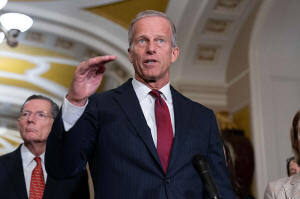
Senate Majority Leader John Thune, R-S.D., speaks to reporters after
a weekly Republican luncheon, at the Capitol in Washington, Tuesday,
March 10, 2026. (AP Photo/Jose Luis Magana)

“Republicans are looking forward to this debate,” Thune said.
Hoping to appease Trump
Similar to the talking filibuster, though, the plan does have risks
— mainly that it won’t satisfy Trump, who has demanded passage and
threatened to hold up almost everything else in Congress.
Utah Sen. Mike Lee, a Republican who has led the effort with Trump
to pass the SAVE America Act and has pushed for the talking
filibuster, said Thursday that it’s not yet clear how it will play
out.
“I think he understands that we need to put in an aggressive effort
here,” Lee said of Trump. “And a lot of that is going to have to be
determined in real time as we go about it.”
The extent of Trump’s satisfaction with the process, Lee said, “will
depend on whether in his view, we gave it everything we have.”
Republican Sen. Katie Britt of Alabama said the goal is to figure
out how to put it on the floor and “actually achieve a result.”
“We’re working through what that means and what we need to be
prepared to do,” Britt said.
Democrats ready to push back
Democrats uniformly oppose the legislation, arguing that it would
disenfranchise some 20 million American voters who don’t have birth
certificates or other documents readily available.
Sen. Alex Padilla, the ranking Democrat on the Senate Rules
Committee, said his side of the aisle is organizing “to bring our
arguments — and the facts — to the floor as well.”
He said it would be more accurate to call it the “Save Trump’s Ass
Act,” because the only way he said Republicans can try to hold on to
power in this November’s elections is to make it harder for eligible
people to vote.
Padilla said the SAVE America Act “is not a voter ID bill. It is a
voter suppression bill. It is a voter purging bill.”
All contents © copyright 2026 Associated Press. All rights reserved
 |