Cuban president confirms US talks as island's energy and economic crises
intensify
[March 14, 2026]
By MILEXSY DURÁN, DÁNICA COTO, MATTHEW LEE and AAMER
MADHANI
HAVANA (AP) — Cuba has held talks with the U.S. government, Cuban
President Miguel Díaz-Canel said Friday, marking the first time the
Caribbean country has confirmed widespread speculation about discussions
with the Trump administration as it grapples with a severe energy
crisis.
Díaz-Canel said the talks “were aimed at finding solutions through
dialogue to the bilateral differences between our two nations.
International factors facilitated these exchanges.” He did not elaborate
on those factors, or provide any specifics about the talks, which U.S.
President Donald Trump has alluded to in the past.
Cuba's relations with the U.S. have been fraught for decades and
punctuated by animosity, with the exception of a brief rapprochement
during former President Barack Obama's second term.
Asked for comment on Friday, the White House pointed to Trump's public
comments about discussions with Cuba that he said were being led by U.S.
Secretary of State Marco Rubio and intended to press major changes in
Cuban policies and governance.
Trump has suggested that top Cuban leaders would be smart to avoid the
fate of former Venezuelan President Nicolás Maduro, who was ousted and
arrested in a U.S. military operation in January.
Shortly after Díaz-Canel spoke, two U.S. officials said that Rubio, the
son of Cuban immigrants and a longtime Cuba hawk, and top aides met at
the end of February in the Caribbean with the grandson of retired Cuban
leader Raúl Castro, who is believed to play an influential role in the
government despite not holding an official post.

The officials, who spoke on condition of anonymity because of the
sensitivity of the discussions, said that Rubio had met secretly with
Raúl Guillermo Rodríguez Castro on the sidelines of a Caribbean
Community leaders meeting in St. Kitts and Nevis on Feb. 25.
At the time, Rubio refused to say who, if anyone, he was speaking with
in or close to the Cuban government.
Díaz-Canel said that the purpose of the talks with the U.S. was to
identify “bilateral problems that require solutions based on their
severity and impact” and find solutions to them.
He said that the aim was “to determine the willingness of both parties
to take concrete actions for the benefit of the people of both
countries. And in addition, to identify areas of cooperation to confront
threats and guarantee the security and peace of both nations, as well as
in the region.”
‘Impact is tremendous’
Díaz-Canel said that no petroleum shipments have arrived in Cuba in the
past three months, which he blamed on a U.S. energy blockade. He said
the island is running on natural gas, solar power and thermoelectric
plants, and that the depletion of fuel oil and diesel forced two power
plants to shut down and has limited the generation of power at solar
parks.
The most recent blackout was blamed on a broken boiler at a
thermoelectric plant that forced the shutdown of Cuba’s power grid.
The president said that Cuba, which produces 40% of its petroleum, has
been generating its own power, but that it hasn’t been sufficient to
meet demand. The lack of power has affected communications, education
and transportation, and the government has had to postpone surgeries for
tens of thousands of people as a result, he said, adding: “The impact is
tremendous.”
“Even with everything we’re putting together, we still need oil,” he
said, adding that production output also has dropped. “Without energy,
no country can produce at normal levels. All of this has meant making
adjustments to employment.”
Last month, Cuba implemented austere fuel-saving measures and has
converted more than 115 bakeries to run on firewood or coal.
[to top of second column]
|
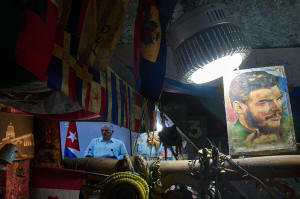
An image of Cuban Revolutionary hero Ernesto "Che" Guevara stands
next to a TV showing Cuban President Miguel Diaz-Canel speaking,
inside a souvenir shop in Havana, Cuba, Friday, March 13, 2026. (AP
Photo/Ramon Espinosa)

“Cubans are desperate,” said Elvis Hernández, 62. “You can’t live
without water or electricity. That’s why we want a consensus to be
reached. If there are talks, let them be productive. Let them
achieve something good through those conversations.”
Miguel García, 65, welcomed the news of talks with the U.S.
“If all of this leads to agreements and solutions that will improve
our lives, then all the better, because the situation is quite
difficult right now,” he said.
Staffing of embassy in Havana
The U.S. State Department has weighed potentially drawing down
staffing at the U.S. Embassy in Havana as the fuel shortages caused
by the American blockade could affect day-to-day diplomatic
operations, according to three U.S. officials.
The officials stressed that there is still time to solve the problem
and that the embassy and the State Department were looking at
potential solutions, including possibly importing fuel from private
sources if the Cubans allow it.
A reduction in staffing at the embassy in Havana would likely lead
to a U.S. demand for a similar reduction in staffing at the Cuban
embassy in Washington, the officials said.
Brian Fonseca, who studies the Americas at Florida International
University, said that a reduced presence at the U.S. embassy would
be a less than ideal scenario at a moment when Trump is pressing for
dramatic change in the Cuban government.
“The diplomatic staff are your eyes and ears on the ground,” Fonseca
said. “A downgrading scenario could complicate or challenge U.S.
understanding of what’s going on, on the ground.”
Trump's warning
Critical oil shipments from Venezuela to Cuba were halted after the
U.S. attacked the South American country and arrested Maduro.
Since then, the Trump administration has been warning Cuba of a
similar fate.
Trump told a gathering of Latin America leaders in Florida last week
that Cuba is “very much at the end of the line” and that he was
looking forward to “great change” coming soon to the island.
Díaz-Canel also said Friday that FBI officials would visit Cuba as
soon as both countries continue to share information about the
recent shooting of a Florida-flagged boat in Cuban waters. Four of
10 Cubans from the U.S. were killed after the government accused
them of opening fire on local troops.

A fifth suspect later died from his injuries, according to the Cuban
government. The five other suspects have been detained and face
terrorism charges.
___
Coto reported from San Jose, Costa Rica; Lee and Madhani from
Washington. Ariel Fernández, in Havana, Seung Min Kim, in
Washington, and María Verza, in Mexico City, contributed to this
report.
All contents © copyright 2026 Associated Press. All rights reserved |