Could the Chicago Bears leave
Illinois? Indiana makes a play for the historic franchise
[March 14, 2026]
By JOHN O'CONNOR
SPRINGFIELD, Ill. (AP) — A turf war over a football team is
developing between two Midwestern states with a sometimes-discordant
history.
The storied Chicago Bears want to leave historic Soldier Field,
where they've played for half a century. Indiana lawmakers are
attempting to lure them from the Windy City with a plan to finance
and build a domed stadium in Hammond, Indiana, about 25 miles (40
kilometers) from their current home on Lake Michigan's shore.
The Illinois General Assembly has responded with legislation that
would give tax breaks to so-called megaprojects of at least $100
million, a plan that would encompass the Bears' proposal to build a
complex in the northwest Chicago suburb of Arlington Heights, about
the same distance from Soldier Field as Hammond.
Critics complain it's a bad deal for Illinois, where property taxes
are already among the highest in the nation — especially when
taxpayers still owe hundreds of millions of dollars on a Soldier
Field renovation from two decades ago.
Here's a look at what's shaping up to be a showdown.
Why the big deal?
The Bears, one of only two remaining NFL founding members, are
legend. Their nine championships, including a Super Bowl win, are
second only to the rival Green Bay Packers — though recent decades
have brought mostly heartbreak. The franchise carries an $8.9
billion price tag, among the most valuable of the NFL’s 32 teams,
according to Forbes.
Born in the central Illinois city of Decatur in 1920, the Bears have
called Chicago home for 105 years. Losing them to the Hoosier State
would be a major thumb in the eye.

What's wrong with Soldier Field?
With 61,500 seats, it's the NFL's smallest. The Bears have always
rented their facilities — the Cubs' Wrigley Field from 1921 to 1970,
and Soldier Field, maintained by the Chicago Park District, since.
Like most teams, they want to own a stadium, giving them control
over operations, scheduling and revenue streams from ticket sales,
concessions, parking, naming rights and more.
And Soldier Field is open air. An enclosed facility would allow for
other marquee sporting events: Super Bowls, NCAA Final Fours or
WrestleMania, for instance.
Why the imbroglio between the states?
Along with the states' established cultural and economic differences
and an intense college basketball rivalry, the political fissure
between Democrat-dominated Chicago and conservative Indiana has
widened. It amped up last year when Indiana adopted a commission to
study changing the state's boundaries to include some central
Illinois counties whose voters have approved ballot measures calling
for secession from Chicagoland.
Arlington Heights, back to Chicago, to Hammond
The Bears have threatened to leave Chicago previously. When they
broached moving in 1975, then-Mayor Richard J. Daley replied, “Like
hell they will.”
[to top of second column] |
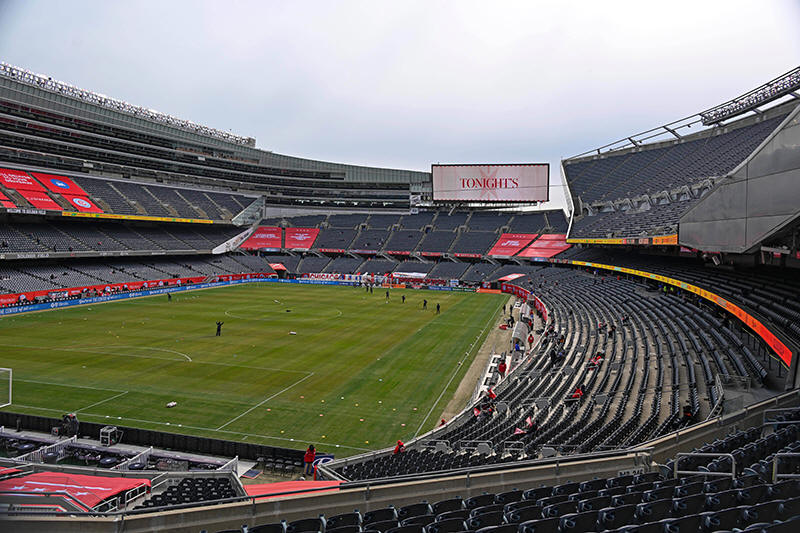
Soldier Field is seen for an MLS soccer match between the Chicago
Fire and the CF Montréal, Saturday, Feb. 28, 2026, in Chicago. (AP
Photo/Matt Marton, File)

But the City of Big Shoulders heaved an anxious
sigh in 2023 when the Bears paid about $200 million for a 326-acre
(132-hectare) former horse-racing track in Arlington Heights. They
have envisioned a $5 billion, taxpayer-assisted development for a
domed stadium and campus of housing, hotels, entertainment and
retail space.
In 2024, the Bears offered a $5 billion plan, partially
taxpayer-funded, for an enclosed stadium next to Soldier Field,
which garnered little interest in the capital of Springfield. Late
last fall, the team turned to Indiana.
Where the proposals stand
Indiana's lure creates the Northwest Indiana Stadium Authority to
finance, construct and lease a domed stadium near Wolf Lake in
Hammond. Indiana Gov. Mike Braun signed it into law on Feb. 26. The
Bears would agree to a 35-year lease. Borrowed state money would
cover the as-yet-unknown cost of construction, repaid by increased
local hospitality taxes.
In Illinois, majority Democrats have advanced legislation in the
House that would provide incentives for any so-called megaproject of
at least $500 million — or less, down to $100 million, depending on
the number of jobs created. Developers would pay property taxes
frozen at the parcel's pre-construction value for as long as 45
years. During that time, they would make annual payments in lieu of
taxes negotiated with local governments. There would also be a sales
tax exemption on building materials for up to 15 years.
Critics claim weakness in Illinois plan
Opponents say the Illinois legislation, with its decades-long
property tax freeze, would simply mean increased taxes for
homeowners and other businesses — the payment in lieu of taxes would
be a bonus.
Democratic Gov. JB Pritzker, who supports the plan, last week
countered that the proposal would encourage development on land that
isn’t producing property taxes while ensuring increased revenue for
local governments.
Meanwhile, a substantial debt remains on the last accommodation.
Taxpayers in 2001 put up $399 million to finance a $587 million
renovation of Soldier Field. With interest, the remaining tab is
$467 million, according to the state's Commission on Government
Forecasting and Accountability.
The Bears' $7 million annual lease runs through 2033. Breaking it
would cost the Bears a $10.5 million penalty for each year left on
the agreement.
All contents © copyright 2026 Associated Press. All rights reserved
 |