Illinois bill aims to address gender discrepancies in CPR training
[March 16, 2026]
By Georgia Epiphaniou and Medill Illinois News Bureau
SPRINGFIELD — When someone experiences a heart attack, the emergency
protocol is universal for all genders — first responders are supposed to
place the patient on their back and their hands in the center of the
chest, then push hard and fast.
Yet, women are 27% less likely to receive bystander CPR than men because
of hesitancy to follow protocol, fueled by fears of inappropriate
touching, exposing the chest or drawing accusations of sexual assault,
according to the Journal of the American Heart Association.
House Bill 4788, sponsored by Rep. Maura Hirschauer, D-Batavia, aims to
defeat this stigma, normalizing CPR performance on women by introducing
female manikins in secondary school CPR training.
The idea for the legislation began with a Naperville High School
student, senior Ashlynn Goldstein. “I had been CPR certified a lot of
times — never in my life had I ever encountered a female manikin,”
Goldstein said.
Her capstone project in high school examines why disparities exist in
the performance of CPR between men and women, Illinois current statutes
addressing CPR training, and how those policies are handled in schools.
“That was kind of where that idea of passing a bill for high schools
came about, and Hirschauer took up the case,” said Goldstein, who
drafted the bill with her teacher and proposed it to legislators.

The bill is currently assigned to the Education Policy Committee. It
requires CPR training in secondary schools to include at least one
female manikin for every two male versions, starting in the 2028-29
academic year.
Hirschauer, who said she is interested in “righting the wrongs of gender
disparity,” emphasized the importance of introducing female manikins in
high schools.
“I’m always a fan of reaching people at their earliest. … So it felt
like a really good way to capture a lot of people, and then a really
good way to break down the stigma of CPR on a female if we’re starting
young,” she said.
State Rep. Katie Stuart, D-Edwardsville, was added as a co-sponsor to
the bill Thursday.
With every Illinois high schooler required to receive CPR training,
Goldstein also sees an opportunity to reach a wider audience.
“That is your next generation of adults,” Goldstein said. “They are the
next people who are going into the workforce, going out into the world,
and it’s more effective with the younger ages versus older.”
In the U.S., 40 states and the District of Columbia require CPR training
in schools before high school graduation. There are no laws embedding
the use of female manikins in school training curriculums. Such training
can make a difference.
A 2024 study by the American Heart Association Journal, surveying 112
participants who received CPR instruction on both male and female
manikins, concluded that the training increased confidence in performing
CPR on women. Although 28.4% initially reported feeling either slightly
or very uncomfortable using the female manikin, 81.6% said they felt
more confident performing CPR on women after practicing with it.
“To date, most CPR training programs in the United States and globally
continue to use the standard flat-chested manikin since training
materials with secondary sex characteristics such as breasts have been
lacking,” according to a recent study in ScienceDirect.
“Normalizing the female anatomy and allowing hands-on simulation
practice with breasted manikins may reduce reluctance to perform (CPR)
on women, dispel misconceptions and myths, and cultivate confidence
among the public rescuers to engage in life-saving skills, regardless of
gender,” the study said.

[to top of second column]
|
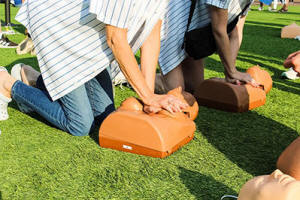
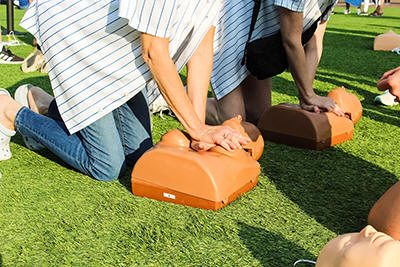
The Illinois Heart Rescue seasonal training at Cubs CPR Day at
Wrigley Field in Chicago. The organization provided female CPR
manikins for the program. (Courtesy of Courtney Schwerin O'Reilly /
Illinois Heart Rescue)

Bill faces hesitation over costs
Despite Hirschauer’s enthusiasm for the bill and the state’s past
support of CPR training in schools, the bill faces headwinds.
The Illinois Principals Association expressed skepticism around the
bill, citing concerns about burdening schools with the costs.
“We have other things that are kind of pressing on that financial
button, if you will, and we always share those concerns with
legislators,” said Alison Maley, the government and public relations
director of the principals association.
Lauren’s Law, passed in Illinois in 2008, mandated CPR training in all
of the state’s high schools but also became an example of how financial
considerations can thwart good intentions. The law does not provide any
additional funding for compliance, therefore making higher income
districts better positioned to meet the requirements.
To bridge the gap, Illinois Heart rescue, an organization committed to
improving outcomes when people experience cardiac arrest beyond hospital
settings, got involved. It provides training, manikins and automated
external defibrillators to lower-resource districts and schools that
would otherwise struggle to finance the training themselves.
Illinois Heart Rescue has already introduced female manikins in their
training programs.
“We made the decision as a program to use breasted manikins in all of
our classes,’’ Courtney Schwerin O’Reilly, executive director of
Illinois Heart Rescue, said. “It was mildly controversial, but it was
important to me that we had that representation.”
Goldstein acknowledged the cost-related concerns in the drafting of her
bill. Instead of compelling schools to purchase female manikins, which
cost $800, the bill provides the option of installing chest covers on
existing ones instead, which are priced at approximately $14 to $18.

The marketplace has begun to recognize the need for change as well.
WorldPoint, a global distributor and one of the industry’s largest
suppliers of CPR manikins, has developed two innovative, three-in-one
manikins — CPR Taylor and CPR Tommi — each designed to convert between
adult male, adult female and child. The products are released in light
and dark skin colors.
“It shouldn’t be an add on, it shouldn’t cost more money, it shouldn’t
be its own additional purchase thereby making it more expensive,” said
ShellyAmato, executive vice president of WorldPoint. “It should be
standard. You get a male and you get a female with every manikin.”
That fits into Goldstein’s goal of raising awareness on the issues
surrounding CPR for women and seeing a broader impact in society. If the
Illinois legislature can pass Hirschauer’s bill, perhaps it can serve as
a model.
“My hope is, honestly, for other states to take inspiration from that,’’
she said.
Georgia Epiphaniou is a graduate student in
journalism with Northwestern University’s Medill School of
Journalism, Media, Integrated Marketing Communications, and a fellow
in its Medill Illinois News Bureau working in partnership with
Capitol News Illinois.
Capitol News Illinois is
a nonprofit, nonpartisan news service that distributes state
government coverage to hundreds of news outlets statewide. It is
funded primarily by the Illinois Press Foundation and the Robert R.
McCormick Foundation. |