Trump suggests he may delay China trip as he pressures Beijing for help
with Strait of Hormuz
[March 16, 2026]
By WILL WEISSERT
WASHINGTON (AP) — President Donald Trump is suggesting he may delay his
much-anticipated visit to China at the end of the month as he seeks to
ramp up the pressure on Beijing to help reopen the Strait of Hormuz and
calm oil prices that have soared during the Iran war.
In an interview Sunday with the Financial Times, Trump said China's
reliance on oil from the Middle East means it ought to help with a new
coalition he is trying to put together to get oil tanker traffic moving
through the strait after Iran’s threats have throttled global flows of
oil. Trump said “we'd like to know” before the trip whether Beijing will
help. "We may delay,” Trump said in the interview.
The uncertainty underscores just how much the U.S.-Israeli strikes on
Iran have reshaped global politics in the past two weeks. Calling off
the face-to-face visit with Chinese President Xi Jinping could have its
own major economic consequences: Relations between Washington and
Beijing have been fraught as both sides have threatened the other with
steep tariffs over the past year.
The White House did not immediately respond to requests for comment.
In Beijing, a Foreign Ministry spokesperson said only that China and the
U.S. have maintained communication on Trump's visit. “Head-of-state
diplomacy plays an irreplaceable strategic guiding role in China-U.S.
relations,” Lin Jian said at a daily briefing.

Trump's new comments came as U.S. Treasury Secretary Scott Bessent was
meeting with Chinese Vice Premier He Lifeng on Monday in Paris for a new
round of trade talks that were meant to pave the way for Trump’s Beijing
trip. The U.S. and China have declared a truce that has prevented both
sides from levying dueling tariffs, but the stakes remain high.
In the early days of the Iran conflict, Trump had said U.S. navy vessels
would escort oil tankers through the strait, and downplayed the threat
posed by Iran. But as oil prices soared, he and his administration have
been forced to consider new options — including the idea, broached this
weekend, for other countries to join the push with their own warships.
So far, none has yet formally heeded the call.
[to top of second column]
|
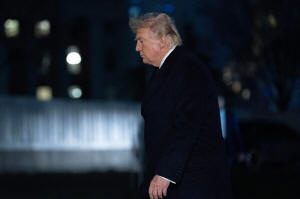
President Donald Trump walks on the South Lawn upon his arrival to
the White House, Sunday, March 15, 2026, in Washington. (AP
Photo/Jose Luis Magana)

Trump told reporters aboard Air Force One as he returned to
Washington from a weekend in Florida that the U.S. had spoken to
“about seven” nations about offering military support. He wouldn't
say which ones, though, and demurred when he was asked directly
about China — though he subsequently suggested that he'd made such
an offer to Beijing.
“China's an interesting case study," he said, noting its reliance on
Gulf oil. "So I said, ‘Would you like to come in’ and we'll find
out. Maybe they will, maybe they won't.”
War in Iran has sent the price of oil skyrocketing, which has raised
the price Americans pay at the pump, just as the midterm election
season begins to heat up. China, though, has faced its own economic
pressures and recently lowered its 2026 target for growth slightly
to 4.5% to 5%, its slowest projected growth since 1991 — meaning
prolonged disruptions in the strait could have long-term impacts for
Beijing as well.
Lin, at the briefing in Beijing, did not respond directly to
questions about Trump’s call for outside help in the strait. He
noted the impact on goods and energy trade and repeated his
government's call for an end to the fighting.
"China once again calls on all parties to stop military actions
immediately, avoid further escalation of tensions, and prevent
instability in the region from having a greater impact on global
economic development,” he said.
___
Associated Press writer Ken Moritsugu in Beijing contributed.
All contents © copyright 2026 Associated Press. All rights reserved |