Argentina’s wine industry withers on the vine as consumption hits a
record low
[March 17, 2026] By
CLARA PREVE
BUENOS AIRES, Argentina (AP) — Argentina’s once thriving wine industry
is facing its worst crisis in more than 15 years, with record-low
domestic consumption, dwindling exports and low-yielding crops.
Against this sobering reality, hundreds of wine enthusiasts still
gathered last week in Mendoza, the heart of Argentina's wine region, to
celebrate the annual National Wine Harvest Festival. Attendees watched
dance performances, enjoyed live music and voted for the new queen of
the Vend Imia festival.
The festival was marking its 90th year as domestic wine consumption in
Argentina plummeted to an all-time low of 15.7 liters (4.1 gallons) per
person in 2025, according to the National Institute of Viticulture, or
INV. Compare that to 1970, when Argentines consumed as much as 90 liters
(24 gallons) per person annually.
Furthermore, 1,100 vineyards have shut down across the country and 3,276
hectares (8095 acres) of grape production have vanished.
Fabián Ruggieri, president of the Argentine Wine Corp trade group,
attributes the drop largely to a “sharp decline in purchasing power”
that began in 2023. This trend, he said, is most acute among middle- and
low-income consumers who traditionally consumed wine on a daily basis.
For Federico Gambetta, director of the Altos Las Hormigas winery, a
medium-sized winery in Mendoza, the crisis is exacerbated by a shift in
consumption patterns.

“People no longer consume wine en masse,” said Gambetta, noting that
consumers now seek “coherence” and a sense of purpose behind their
purchase.
While older generations favored high-alcohol, full-bodied wines, younger
consumers prioritize other attributes, such as “approachability,
freshness and lightness” — qualities typically found in white wines and
rosés.
One of Gambetta’s red wines — Malbec Los Amantes 2022 — was recently
ranked 41st among the world's 100 best wines. Yet, he notes that
starting in 2010 his winery began to modify its wine — once defined by a
traditional, heavier profile — to appeal to a new generation of
consumers seeking lighter styles.
“Everything has mutated,” Gambetta said. “If you're not dynamic, you're
lost.”
The U.S. is experiencing a similar shift as the older wine-focused
demographic ages out and younger adults fail to fill the gap. A report
by Silicon Valley Bank found that millennial and Gen Z drinkers are
spread across more categories and drinking less overall, particularly
those under 29.
[to top of second column] |
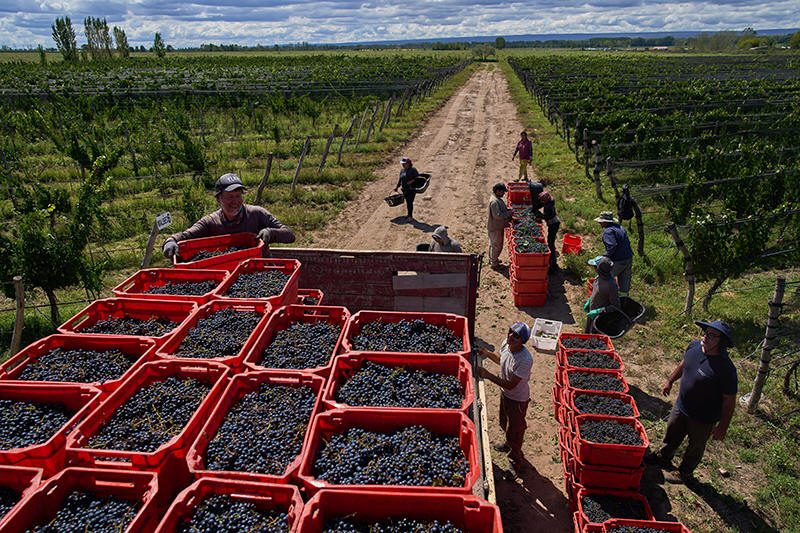
Worker load crates of grapes onto a truck at the Canopus Farm in El
Cepillo, Mendoza province, Argentina, Tuesday, March 10, 2026. (AP
Photo/Rodrigo Abd)
 The international market offers
little relief. As the world’s 11th largest wine exporter, Argentina
saw its exports fall to 193 million liters (51 million gallons) in
2025 — a 6.8% year-on-year decline and the lowest volume since 2004,
according to INV.
Ruggieri notes that exports are being hampered by financing issues,
high logistics costs and a lack of competitiveness resulting from
external tariffs. While its neighbor and wine competitor Chile
enjoys free trade agreements with over 60 economies — often reaching
markets like China with tariff rates close to zero — Argentina faces
tariffs between 10% and 20% in most markets.
Local producers like Gabriel Dvoskin, owner of the 10-hectare
Canopus winery that produces approximately 50,000 bottles of wine
each year, also struggles with inflation.
Dvoskin, who exports to 15 countries, with the U.S. as his main
market, acknowledges that Argentina’s high production costs and
rampant inflation place his wines at a disadvantage compared with
international competitors.
“Our inflation makes us a bit expensive,” Dvoskin said. “My
equivalent in France has a much lower cost for dry inputs — bottles,
corks, etc. — than I do.”
For Gambetta, the current crisis reinforces a key lesson for the
industry: product quality is non-negotiable.
“Right now, everything is very delicate, and one wrong step can
bankrupt you,” Gambetta said.
All contents © copyright 2026 Associated Press. All rights reserved
 |