US drivers see gas prices jump to their highest level since 2023 as the
Iran war drags on
[March 18, 2026] By
WYATTE GRANTHAM-PHILIPS
NEW YORK (AP) — The Iran war has rattled the global flow of oil, with
steeper fuel costs already straining households worldwide. And in the
U.S., drivers are now facing the highest prices they've seen at the pump
in nearly two and a half years.
According to motor club AAA, the national average for a gallon of
regular gasoline jumped to $3.79 on Tuesday, up from $2.98 consumers
were paying before the U.S. and Israel launched the war with joint
attacks against Iran on Feb. 28. The last time gas prices were as
expensive as they are now was in October 2023.
“It’s pretty hard. I mean, times are tough for everybody right now,"
Amanda Acosta, a Louisiana resident, told The Associated Press while
filling up her car's tank this week. “I’m getting way less gas and
paying way more money.”
She isn't alone. Pain at the pump has been one of the most immediate
economic impacts of the conflict, because the price of crude oil — the
main ingredient in gasoline — has soared and swung rapidly in recent
weeks, due to supply chain disruptions and cuts from major producers
across the Middle East. Brent crude, the international standard, settled
at over $103 a barrel on Tuesday, up from roughly $70 just weeks ago.
And benchmark U.S. crude topped $96 a barrel.
Many eyes are on the White House. Before the war, President Donald Trump
once bragged about keeping gas prices low. But he's since pivoted to try
and paint high oil prices as a positive outcome for the U.S. Last week,
Trump said that because the U.S. is now largest crude producer in the
world, “when oil prices go up, we make a lot of money.”

Companies that supply oil benefit from higher prices. But steeper costs
always pinch consumers' wallets — and today's rising prices arrive as
many households continue to face wider cost of living strains. It could
also push up already stubborn inflation, at least in the short run, and
potentially hammer the economy more significantly if steep costs drag
on. Experts say that that could apply more pressure on the Trump
administration, particularly as affordability continues to stay at the
top of voters' minds.
Drivers see impact of higher fuel prices
"I just want all of it to end. I just want to get out of there, out of
Iran," said Meghan Adamoli, a New Jersey resident who was among
customers filling up at a Multani station on Tuesday. While Adamoli said
she can personally “roll with the punches” when it comes to gas prices,
she knows that a lot of others can't.
Dan Bradley, a flatbed truck driver from Pennsylvania, said he's felt
the rising prices for both his work and personal vehicles. Beyond
regular gasoline, the U.S. average for diesel topped $5 a gallon on
Tuesday, per AAA, up from about $3.76 before the conflict started.
“It sucks when you’re filling up,” said Bradley. “What are you going to
do, not get gas?”
Meanwhile, Texas resident Clay Plant said that rising oil costs is good
for the economy of his town, Lubbock. He noted that he sees more people
work as drilling picks up.
“It’s kind of a good sign for us in west Texas,” Plant said. “I look at
it as my friends and family get to eat and they get to go to work.”
Search for more supply and uncertainty ahead
The U.S. is now a net exporter of oil — and other parts of the world
that rely more heavily of fuel imports from the Middle East, notably
Asia, have seen more stark energy shocks amid the war. But that doesn’t
mean America is immune to price spikes.
[to top of second column] |
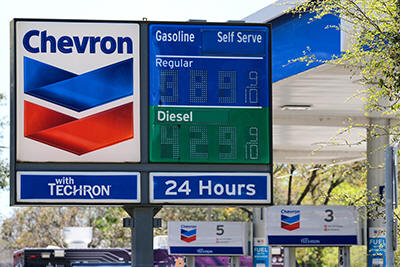
Prices are displayed on a Chevron gas station sign in Houston,
Tuesday, March 17, 2026. (AP Photo/Ashley Landis)
 Oil is a globally-traded commodity.
And most of what the U.S. produces is light, sweet crude — but
refineries on the East and West coasts are primarily designed to
process heavier, sour product. As a result, the country also needs
imports.
The road ahead is uncertain, and prices could worsen if the war
drags on. Iran has effectively halted nearly all tanker movement in
the key Strait of Hormuz, where roughly one-fifth of the world’s oil
once sailed through on a typical day. That’s led to cuts from some
major producers in the region, because their crude has nowhere to
go. Trump has demanded that other countries send warships to reopen
the waterway, but has yet to garner sign-ons as many ask for more
clarity about America’s next steps for the war. Meanwhile, Iran,
Israel and the U.S. have all struck oil and gas facilities.
All of this has left countries scrambling for other supply. Last
week, the International Energy Agency pledged to release 400 million
barrels of oil available from its member nations’ stockpiles. Trump,
who previously downplayed the need to tap into reserve oil, later
confirmed that the U.S. would pull 172 million barrels from the
Strategic Petroleum Reserve as part of the IEA’s effort. The
administration also announced it will temporarily free up Russian
oil from U.S. sanctions for its war on Ukraine.
Still, analysts say these efforts will be a short-term bridge.
Refineries buy crude oil in advance, and it takes time for new
supply to trickle down to consumers. And while steep crude costs is
the top driver of gas prices today, a handful of other factors are
also on the table. U.S. gas prices typically tick up a bit at this
time of year, as more drivers hit the road and the warming weather
brings a shift to “summer blend” fuel, which is more expensive to
make than winter blend.
As always, some states also have pricier averages than others, due
to factors ranging from nearby supply to differing tax rates. On
Tuesday, California had the highest average of over $5.54 per
gallon, while Kansas had the lowest of about $3.21.
Experts warn all of this could eat into wider spending. As consumers
pay more to cover necessities like gas, many households —
particularly those that are middle or low income — will be forced to
cut their budgets in other places, explains Francesco D’Acunto, a
finance professor at Georgetown University. More expensive fuel also
impacts other sectors, from transporting groceries to household
utility bills.

These combined inflation shocks, and overall high uncertainty during
times of war, also “makes many houses and consumers freeze,”
D’Acunto added. He said that could cause some to hold off on bigger
financial decisions — like buying a car or house — farther down the
road. “So potentially even that will have such an effect on the
overall economy.”
________
AP Journalists Stephen Smith in Madisonville, Louisiana, Geoff
Mulvihill in Cherry Hill, New Jersey, and Mingson Lau in Claymont,
Delaware, contributed.
All contents © copyright 2026 Associated Press. All rights reserved |