In Black pastor's arrest, Alabama Supreme Court rules police can demand
to see identification
[March 18, 2026]
MONTGOMERY, Ala. (AP) — Ruling in the case of a Black pastor who
was arrested while watering his neighbor’s flowers, the Alabama Supreme
Court said police can demand to see identification during a stop if they
are dissatisfied with a person's verbal answers. |

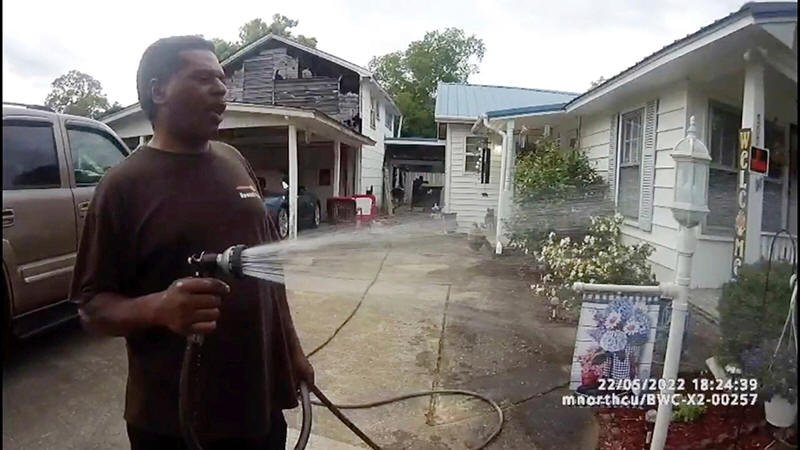
This image made from bodycamera video released by the Childersburg
(Ala.) Police Department and provided by attorney Harry Daniels shows
Michael Jennings, left, watering flowers in Childersburg, Ala., May 22,
2022. (Childersburg Police Department via AP, File) |
|
Justices issued the 6-3 decision last week after a federal judge
presiding over a lawsuit about Michael Jennings' 2022 arrest
asked the court to clarify whether officers can demand to see a
person's identification under the state's "stop-and-identify”
law. The minister was arrested when he declined to show
Childersburg police identification.
Justice Will Sellers wrote that state law, “does not exclude
from its purview a request for physical identification when a
suspect provides an incomplete or unsatisfactory response to an
officer’s demand to provide his or her name and address and an
explanation of his or her action.”
In May 2022, officers questioned Jennings in his neighbor’s
yard. Another neighbor had called 911 because she saw an
unfamiliar car and a “young Black male” around the house.
Officers who responded found Jennings watering flowers and asked
what he was doing.
Jennings identified himself as "Pastor Jennings" and told
officers that he lived across the street and was caring for his
neighbor's yard while they were vacationing. Officers asked to
see his identification and Jennings refused, saying he hadn't
done anything wrong. The woman who called 911 also later
identified Jennings as another neighbor.
Jennings was charged obstructing a government operation. The
charge was later dismissed.
Jennings sued the city and the officers for false arrest. A
federal judge dismissed the lawsuit, but the 11th U.S. Circuit
Court of Appeals reversed the decision. U.S. District Judge R.
David Proctor then asked the state Supreme Court to determine
whether the state law prohibits an officer from demanding
identification if the person gives an incomplete or
unsatisfactory response to questions.
Matthew Cavedon, director of the Cato Institute’s Project on
Criminal Justice, said the decision is a “significant expansion
of government power over people."
The Cato Institute and the American Civil Liberties Union had
written an amicus brief in the case arguing the statute does not
authorize any demands for physical identification. Cavedon said
the case centers on what happens if a person gives an answer
that the officer doesn’t find satisfactory.
“The significance now for Alabamians is if an officer’s not
satisfied with whatever answer you give, I sure hope you’ve got
your driver’s license or passport on you," he said.
All contents © copyright 2026 Associated Press. All rights
reserved |
|
|