Fed keeps key rate unchanged as Powell vows to stay until DOJ
investigation is finished
[March 19, 2026] By
CHRISTOPHER RUGABER
WASHINGTON (AP) — The Federal Reserve kept its key interest rate
unchanged Wednesday and Chair Jerome Powell highlighted the increasingly
uncertain outlook for the U.S. economy and inflation in the wake of the
Iran war, suggesting the Fed could stand pat for an extended period.
Fed policymakers maintained their forecast for an additional rate cut
this year, but in a news conference, Powell suggested that the central
bank remains concerned about inflation that was still stubbornly
elevated even before the conflict's impact on gas prices.
“The thing I really want to emphasize is, nobody knows,” Powell said,
referring to the impact of the Iran war. “The economic effects could be
bigger, they could be smaller, they could be much smaller, they could be
much bigger. We just don't know.”
Powell said the central bank would need to see further progress in the
price of goods declining as the impact of tariffs fades before cutting
rates further. The Fed reduced its short-term rate three times last year
to 3.6%, before pausing in January and on Wednesday.
“The rate forecast is conditional on the performance of the economy, so
if we don’t see that progress then you won’t see the rate cut,” Powell
said.
Investors were discouraged by such comments, sending share prices
sharply lower. The broad S&P 500 index dropped 1.4%.
Fed officials “are aware they've missed their inflation target for five
years, and they do not want to continue to miss it indefinitely,” said
Nathan Sheets, chief economist at Citi and a former top economist at the
Fed. Inflation, according to the Fed's preferred measure, was 2.8% in
January, up from 2.3% nearly a year ago. It's also above the Fed's
target of 2%.

At the press conference, Powell did clarify a key question about the
Fed’s future: He said he has “no intention” of leaving the central bank
until an investigation into his congressional testimony about the Fed’s
building renovation is dropped.
Last Friday, a judge threw out a pair of subpoenas that the Justice
Department had issued to the Fed, dealing a blow to the investigation.
But U.S. Attorney Jeannine Pirro has said she will appeal the ruling.
Powell’s term as Fed chair is scheduled to end on May 15, and President
Donald Trump has nominated a former top Fed official, Kevin Warsh, as
his replacement. Warsh’s confirmation has been delayed because key
Republican senators are opposed to the DOJ probe.
Once the investigation is resolved and even after Warsh is confirmed,
Powell could elect to stay on the board to finish his term as a Fed
governor, which lasts until January 2028. But he told reporters he had
not yet decided whether to do so.
Powell also maintained a largely optimistic outlook for the economy,
pointing out that in recent years it has been hit with numerous shocks —
tariffs, the Fed's own rate hikes in 2022 and 2023, the aftermath of the
pandemic — and has avoided recession all along.
[to top of second column] |
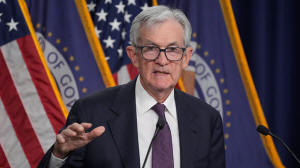
Federal Reserve Chair Jerome Powell speaks during a news conference
Wednesday, March 18, 2026, in Washington. (AP Photo/Manuel Balce
Ceneta)
 “The U.S. economy has been doing
really well through a lot of challenges,” Powell said. “It’s been
amazing to see.”
In the Fed's quarterly economic projections, also released
Wednesday, officials only modestly raised their forecasts for
inflation, and now expect it will end this year at 2.7%, up from
their December forecast but slightly below the 2.8% it reached in
January. They expect core inflation, which excludes the volatile
food and energy categories, to also finish the year at 2.7%.
Fed officials slightly boosted their outlook for growth this year
and expected unemployment to stay unchanged at 4.4%.
Tim Duy, chief economist at SGH Macro, said the forecasts were
essentially “stale” as policymakers avoided fully taking into
account the impacts of the Iran war on the economy.
The Fed considers core prices a better measure of longer-run
inflation. Consumer prices will spike higher in the coming months as
gas prices have soared, but those increases could unwind by the end
of the year, particularly if the conflict ends soon.
One Fed official, governor Stephen Miran, dissented in favor of a
quarter-point cut. Miran was appointed by President Donald Trump
last September.
Gas prices jumped Wednesday to a nationwide average of $3.84 a
gallon, according to AAA, up 92 cents from a month ago. The increase
will push inflation much higher in March, but core inflation, since
it excludes gas, could be much less affected.
Typically, the Fed would look past a supply shock like the
disruption in oil supplies from the Middle East and its impact on
inflation. Once it ends, any inflation it produces may fall back,
without the Fed having to raise rates. As a result, the Fed could
leave rates unchanged — or even cut them to boost weak hiring.
Even before the Iran war, problems had cropped up in both the
inflation and jobs data, putting the Fed in a tight spot. Prices
rose more quickly in January than in recent months, according to the
Fed's preferred measure, with inflation excluding food and energy
reaching 3.1% compared with a year earlier. That is little changed
from where it was two years ago, a sign that prices are still rising
at a stubbornly elevated pace.
Yet hiring has also stumbled. Businesses and other employers shed
92,000 jobs in February, the government reported earlier this month,
an unexpectedly weak showing that followed an encouraging gain of
130,000 in January. The unemployment rate ticked higher to a
still-low 4.4% from 4.3%.
—-
Alex Veiga in Los Angeles contributed to this story.
All contents © copyright 2026 Associated Press. All rights reserved
 |