Strikes hit world's largest natural gas field in Iran, and Tehran
retaliates with more attacks
[March 19, 2026]
By JON GAMBRELL, SAM METZ and JULIE WATSON
DUBAI, United Arab Emirates (AP) — Iran broadened its strikes on major
energy facilities in the Middle East, eliciting strong warnings Thursday
from Gulf Arab states that called it a dangerous escalation that
threatened to draw them into direct combat with Tehran.
The strikes come after Israel killed Iran’s intelligence minister and
reportedly attacked the world’s largest natural gas field in Iran as the
war escalated pressure on the region’s economic lifeblood: energy.
Qatar, Saudi Arabia and the United Arab Emirates all denounced the
Iranian attacks targeting their natural gas fields, with Saudi Arabia’s
top diplomat saying assaults on the kingdom meant “what little trust
there was before has completely been shattered.”
It remains unclear what steps the Gulf Arab states might take militarily
as they’ve sought not to enter combat alongside the United States and
Israel in the war, now in its third week. While Israel did not claim the
South Pars gas field attack, Defense Minister Israel Katz promised more
“surprises” after saying it killed Iran’s intelligence minister, Esmail
Khatib, in an earlier airstrike as it works to decapitate the leadership
of Tehran’s theocracy.
Iran condemned the strike on South Pars, with Iranian President Masoud
Pezeshkian warning of “uncontrollable consequences" that "could engulf
the entire world.”
In Washington, President Donald Trump said that Israel would not attack
South Pars again, but warned on social media that if Iran continued
striking Qatar’s energy infrastructure, the U.S. would retaliate and
“massively blow up the entirety” of the field.

“I do not want to authorize this level of violence and destruction
because of the long term implications that it will have on the future of
Iran,” Trump said on social media.
Oil prices surges amid attacks on major energy supplies
The United States was informed about Israel’s plans to strike Iran’s
massive South Pars natural gas field, but did not take part in it,
according to a person familiar with the matter. The person, who was not
authorized to comment publicly and spoke on condition of anonymity,
would not say if the Trump administration agreed with the Israeli
decision to attack the gas field — part of the world’s largest such
resource and a pillar of Iran’s energy supplies.
Iran escalated strikes on its Persian Gulf neighbors’ energy facilities,
hitting gas facilities in Qatar after Israel launched the attack against
the South Pars offshore natural gas field it shares with Doha. Qatar in
response ordered Iranian Embassy officials to leave the country within
24 hours.
Tehran also struck the Habshan gas facility and Bab field in the United
Arab Emirates, which the government there called a “dangerous
escalation” in the Islamic Republic’s war against Israel and the United
States. Authorities in Abu Dhabi say the gas operations had been shut
down after interceptions over the sites.
The attacks on Qatar and the United Arab Emirates are ratcheting up
pressure on the Gulf Arab states, which have been defending against
Iranian attacks since the war began on Feb. 28 but haven’t taken any
offensive action against Iran as their military bases, civilian sites
and energy operations have come under attack.
The price of oil surged another 5% to over $108 a barrel on
international markets as Iran continued to squeeze the Strait of Hormuz
shipping channel — through which one-fifth of the world’s oil travels.
As the Trump administration looks for ways to boost oil supplies, the
Treasury Department eased sanctions on Venezuela Wednesday, saying U.S.
companies will be allowed to do business with the country's state-owned
oil and gas company.
A day earlier, Israel killed top Iranian security official Ali Larijani
and the head of the paramilitary Revolutionary Guard’s Basij force, Gen.
Gholam Reza Soleimani.
Iran retaliated by unleashing missile strikes against Israel. Israel
said an Iranian missile hit the occupied West Bank, marking the
territory’s first fatalities during the Iran war, though missile debris
has damaged homes and businesses.
Iran also attacked Saudi Arabia’s vast Eastern Province, home to many of
its oil fields, as well as Kuwait, Bahrain and the United Arab Emirates.

[to top of second column]
|
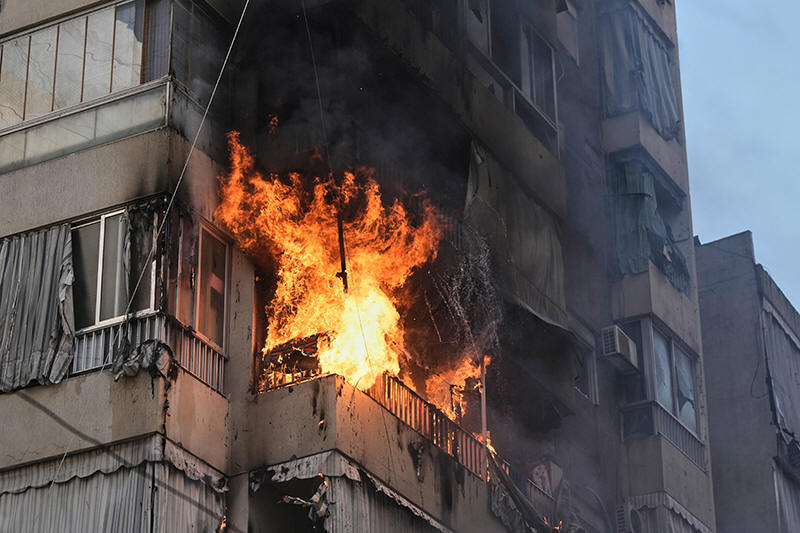
Smoke and flame rise from a residential building following an
Israeli airstrike in central Beirut, Lebanon, Wednesday, March 18,
2026. (AP Photo/Bilal Hussein)

First fatalities reported in West Bank during Iran war
The Palestinian Red Crescent said at least three people were killed
in the occupied West Bank town of Beit Awa as Iran fired missiles
toward Israel. At least 13 others were injured. Earlier authorities
said at least four people had died, but they adjusted the number as
crew assessed the scene.
The Israeli military told The Associated Press an Iranian missile —
not shrapnel from an interception — hit in the West Bank. Officials
described it as a cluster munition that got past Israel’s air
defense system.
Gulf countries' oil facilities take more hits
Qatar Energy said on X that a missile hit its massive Ras Laffan
liquefied natural gas facility, sparking a fire that caused
“extensive” damage before it was extinguished. The company had
already halted production there because of Iranian attacks.
The company warned Thursday that additional Iranian missile attacks
damaged more liquefied natural gas sites in the energy-rich nation,
“causing sizable fires and extensive further damage" but no injuries
and crews were battling the blazes.
An attack set a ship ablaze early Thursday off the coast of the
United Arab Emirates, authorities said. The British military’s
United Kingdom Maritime Trade Operations center said that “a vessel
has been hit by an unknown projectile, which has resulted in a fire
onboard.”
It said the vessel was just off the coast of Khor Fakkan in the UAE,
near the mouth of the Strait of Hormuz. Over 20 vessels have been
attacked during the Iran war so far as Tehran tries to effectively
close the waterway, which leads from the Persian Gulf to the open
ocean. Iran insists the waterway is open, just not to the U.S. or
its allies.
Iran launches more multiple-warhead missiles at Israel
Responding to the killing of Larijani, the paramilitary
Revolutionary Guard said Wednesday it had attacked central Israel
with multiple-warhead missiles that have a better chance of evading
defense systems.

Larijani a senior policy adviser to the late Supreme Leader Ali
Khamenei was sanctioned by the U.S. Treasury in January for his role
“coordinating” Iran’s violent suppression of nationwide protests.
Iranian Supreme Leader Ayatollah Mojtaba Khamenei expressed
condolences for the slaying of Larijani, saying in a statement
published in Iranian media that his killing "shows the extent of his
importance and the hatred of the enemies of Islam towards him.”
The younger Khamenei has not made a public appearance since his
father was killed in the war’s opening salvos, during which he
reportedly was also wounded.
More than 1,300 people in Iran have been killed during the war.
Israeli strikes have displaced more than 1 million Lebanese —
roughly 20% of the population — according to the Lebanese
government, which says 968 people have been killed.
In Israel, 14 people have been killed by Iranian missile fire. At
least 13 U.S. military members have been killed.
___
Metz reported from Ramallah, West Bank, and Watson from San Diego.
Associated Press writers Samy Magdy in Cairo, Qassim Abdul-Zahra in
Baghdad, Julia Frankel in Jerusalem, Darlene Superville, Aamer
Mahdani and Michelle L. Price in Washington, and Sally Abou AlJoud
in Beirut contributed to this report.
All contents © copyright 2026 Associated Press. All rights reserved |