Energy fallout from Iran war signals a global wake-up call for renewable
energy
[March 20, 2026] By
ANIRUDDHA GHOSAL, ANTON L. DELGADO and ALLAN OLINGO
HANOI, Vietnam (AP) — The war in Iran is exposing the world’s reliance
on fragile fossil fuel routes, lending urgency to calls for hastening
the shift to renewable energy.
Fighting has all but halted oil exports through the Strait of Hormuz,
the narrow waterway that carries about a fifth of the world’s oil and
liquefied natural gas, or LNG. The disruption has jolted energy markets,
pushing up prices and straining import-dependent economies.
Asia, where most of the oil was headed, has been hit hardest, but the
disruptions also are a strain for Europe, where policymakers are looking
for ways to cut energy demand, and for Africa, which is bracing for
rising fuel costs and inflation.
Unlike during previous oil shocks, renewable power is now competitive
with fossil fuels in many places. More than 90% of new renewable power
projects worldwide in 2024 were cheaper than fossil-fuel alternatives,
according to the International Renewable Energy Agency.
Oil is used in many industries beyond generating electricity, such as
fertilizer and plastics production. So most countries are feeling the
impact, while those with more renewable power are more insulated since
renewables rely on domestic resources like sun and wind, not imported
fuels.
“These crises regularly occur,” said James Bowen of the Australia-based
consultancy, ReMap Research. “They are a feature, not a bug, of a fossil
fuel-based energy system.”

China and India built renewable buffers, but China's is larger
China and India, the world’s two most populous countries, face the same
challenge of generating enough electricity to power growth for over a
billion people. Both have expanded renewable energy, but China did so on
a far larger scale despite its continued reliance on coal-fired power.
Today China leads the world in renewables. About one in 10 cars in China
are electric, found the International Energy Agency. It's still the
world’s largest importer of crude oil and the biggest buyer of Iranian
oil. But electrifying parts of its economy with renewables has reduced
its reliance on imports.
Without that shift, China would be “far more vulnerable to supply and
price shocks,” said Lauri Myllyvirta of the Centre for Research on
Energy and Clean Air. China also can rely on reserves built when prices
were low and shift between using coal and oil as fuel in factories, he
said.
India also has expanded its use of clean energy, especially solar power,
but more slowly and with less government support for manufacturing
renewable energy equipment and connecting solar to its power grid.
After Russia’s invasion of Ukraine in 2022, India prioritized energy
security by buying discounted Russian oil and boosting coal production.
It also ramped up solar and wind, helping to cushion supply disruptions
but not avoid them entirely, said Duttatreya Das of the think tank
Ember.
“Everyone cannot be China," Das said.
India is now facing a shortage of cooking gas. That's driving a rush to
buy induction cooktops and raising fears of restaurant shutdowns.
Fertilizers and ceramics industries may also be hit.
Rich countries fallback on fossil fuels
The energy shock is familiar to wealthy countries in Europe and East
Asia.
In 2022, some European governments tried to cut dependence on fossil
fuels. But many soon focused on finding new fossil fuel suppliers
instead, said Pauline Heinrichs, who studies climate and energy at
King’s College London.
Germany rushed to build LNG terminals to replace Russian gas with mostly
American fuel while the energy transition, including efforts to cut
demand, slowed, she said.

Europe’s excess spending on fossil fuels since the Russia-Ukraine War
amounted to about 40% of the investment needed to transition its power
system to clean energy, according to a 2023 study.
“In Europe, we learned the wrong lesson,” Heinrichs said.
In import-dependent Japan, policy responses to past shocks have focused
on diversifying fossil fuel imports rather than investing in domestic
renewables, said Ayumi Fukakusa of Friends of the Earth Japan.
[to top of second column] |
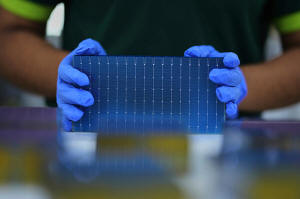
A worker stacks single solar cells at a ReNew manufacturing plant on
the outskirts of Jaipur, India, Thursday, Aug. 21, 2025. (AP
Photo/Manish Swarup, File)
 Solar and wind make up just 11% of
Japan's energy production, on a par with India but behind China's
18%, according to Ember. Japan's energy use is much lower than both
nations.
The Iran war led the agenda during Japanese Prime Minister Sanae
Takaichi 's meeting this week with U.S. President Donald Trump.
Trump, who has long urged Japan to buy more American LNG, recently
called on allied nations like Japan to “step up” in assisting secure
The Strait of Hormuz.
South Korean President Lee Jae-myung said the crisis could be “a
good opportunity” to shift faster to renewable energy.
Poor countries are the most exposed
Poorer nations in Asia and Africa are competing with wealthy
European and Asian countries and big buyers like India and China for
limited gas supplies, pushing up prices.
Import-dependent economies — such as Benin and Zambia in Africa and
Bangladesh and Thailand in Asia — could face some of the biggest
shocks. Costly fuel makes transport and food more expensive, and
many countries have limited foreign-exchange reserves, restricting
their ability to pay for imports if prices stay high.
Africa may be especially exposed because many countries rely on
imported oil to run their transport and supply chains.
It makes strategic sense for African countries to build their
long-term energy security by investing in cleaner energy, said
Kennedy Mbeva, a research associate at the Centre for the Study of
Existential Risk at the University of Cambridge.
But not all are opting for renewables: South Africa is considering
building an LNG import terminal and new gas-fired power plants.
Others, like Ethiopia which banned gasoline and diesel fueled cars
in 2024 to promote electric vehicles, are doubling down on
renewables.
The real challenge is not just to withstand the next shock, but to
ensure it doesn't “derail the country’s development trajectory,”
said Hanan Hassen, an analyst at Ethiopia’s government-linked think
tank, the Institute of Foreign Affairs.

Renewables provide a cushion for some
Increased use of renewable energy has helped shield some Asian
countries from the energy shock.
Pakistan’s solar boom has preempted more than $12 billion in fossil
fuel imports since 2020 and could save another $6.3 billion in 2026
at current prices, according to think tanks Renewables First and the
Centre for Research on Energy and Clean Air.
Vietnam's current solar generation will help the country save
hundreds of millions of dollars in potential coal and gas imports in
the coming year, based on current high prices, according to the
research group, Zero Carbon Analytics.
Other countries are stretching tight supplies.
Bangladesh has closed universities to save electricity. It has
limited storage capacity to absorb supply shocks, so the government
started rationing fuel after a flurry of panic buying at filling
stations, said Khondaker Golam Moazzem, an economist with the Centre
for Policy Dialogue in Dhaka.
For now, governments must just manage shortages and control prices.
Thailand has suspended petroleum exports, boosted its gas production
and begun drawing on reserves.
If the conflict bleeds into April, Thailand’s finite reserves and
limited budget for subsidies mean prices will shoot higher, warned
Areeporn Asawinpongphan, a research fellow with the Thailand
Development Research Institute.
“The time for promoting domestic renewables should have happened a
long time ago," Asawinpongphan said.
___
Delgado reported from Bangkok, Thailand, and Olingo reported from
Nairobi, Kenya.
All contents © copyright 2026 Associated Press. All rights reserved |