Trump faces his most difficult Iran war decision: Will he deploy US
troops to seize uranium?
[March 20, 2026]
By AAMER MADHANI and SEUNG MIN KIM
WASHINGTON (AP) — President Donald Trump is facing perhaps the most
daunting question of the war with Iran, one that could define his time
in office: Will he put U.S. troops on the ground in Iran to secure some
970 pounds of enriched uranium that Tehran could potentially use to
build nuclear weapons?
Trump has offered shifting reasons for launching the war, but he has
been consistent in articulating that a primary objective in joining
Israel in the military action is ensuring that Iran will “never have a
nuclear weapon.”
The president has been more circumspect about how far he's willing to go
to follow through on his pledge to destroy Iran's weapons program once
and for all, including seizing or destroying the near-bomb-grade nuclear
material that Iran possesses.
Much of it is believed to be buried under the rubble of a mountain
facility pummeled in U.S. bombings Trump ordered last June that he had
claimed “obliterated” Tehran's nuclear program.
It's a risky, complicated project that many nuclear experts say cannot
be done without a sizable deployment of U.S. troops into Iran, a
dangerous and politically fraught operation for the Republican
president, who has vowed not to entangle the U.S. in the sort of
extended and bloody Middle East conflicts that still loom large on
America's psyche.
At the same time, lawmakers and experts remain concerned that if Iran
hard-liners emerge from the fighting, they'll be more motivated than
ever to build nuclear weapons as they look to deter the U.S. and Israel
from future military action, a dynamic that makes taking control of
Iran's enriched uranium even more critical. That stockpile could allow
Iran to build as many as 10 nuclear bombs, should it decide to weaponize
its program.

Some lawmakers, like Sen. Richard Blumenthal, D-Conn., say they remain
deeply fearful that the president has put the nation on a path that will
require putting troops inside Iran for what he called Trump’s confused
and chaotic objectives.
“Some of the objectives that he continues to espouse simply cannot be
achieved without a physical presence there -- securing the uranium
cannot be done without a physical presence," said Blumenthal, a member
of the Senate Armed Services Committee.
Meanwhile, Republican allies of Trump stress that there are plans in
place to deal with the enriched uranium. Senate Foreign Relations
Committee chairman James Risch, R-Idaho, on Wednesday cited “a number of
plans that have been put on the table.” He declined to elaborate.
Others acknowledged the complications of deploying troops into Iran.
“No one has given me a briefing on how you would do it without boots on
the ground,” said Sen. Rick Scott, R-Fla., a member of the Senate Armed
Services Committee. “It doesn’t mean you can’t. But no one’s ever
briefed me about it.”
Scott added it's not tenable to allow the stockpile to remain: “I think
it would be helpful to get rid of it.”
Trump and advisers are nontransparent about deliberations over
uranium
Nearly three weeks into a conflict that's left hundreds of people dead,
tested long-standing alliances and brought pain to the global economy,
Trump and his top advisers have been nontransparent about their
deliberations over Iran's uranium stockpile.
“I’m not going to talk about that,” Trump said last week when asked
about the enriched uranium. “But we have hit them harder than virtually
any country in history has been hit, and we’re not finished yet.”
Later that day, during an appearance in Kentucky, Trump appeared to
claim the strikes had already neutralized the threat. “They don’t have
nuclear potential," he said.
Meanwhile, Defense Secretary Pete Hegseth told reporters earlier this
week that the administration sees no point in telegraphing “what we’re
willing to do or how far we’re willing to go" while asserting "we have
options, for sure.”
Experts say it's doable but won't be easy
Richard Goldberg, who served as director for countering Iranian weapons
of mass destruction for the National Security Council during Trump's
first term, said that seizing or destroying the enriched uranium is
certainly doable, if the president decides to go that route.
[to top of second column]
|
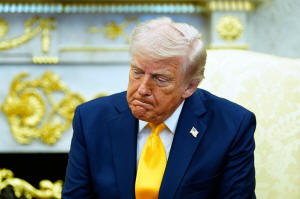
President Donald Trump listens as he meets with Japan's Prime
Minister Sanae Takaichi in the Oval Office of the White House,
Thursday, March 19, 2026, in Washington. (AP Photo/Alex Brandon)

The U.S. and Israeli forces have been making strides toward creating
the conditions — namely, establishing total air superiority — that
would allow for special operations forces operators, who are trained
in blowing up centrifuges and dealing with nuclear material, to
conduct such an operation.
To be certain, a troops-on-the-ground effort is expected to be far
more complicated than other recent high-profile, lightning-strike
insertion operations, such as the January capture of Venezuela's
Nicolás Maduro or the May 2011 killing of Osama bin Laden, Goldberg
said. And the likely need to remove rubble to get to the canisters
of enriched uranium adds another layer of complexity, because it
would require heavy construction equipment.
"But if you actually own the airspace and you can have close air
support and drones and everything else up in the sky for pretty wide
perimeter, presumably you could do a lot,” said Goldberg, who is now
a senior adviser at the Foundation for Defense of Democracies, a
hawkish Washington think tank.
International Atomic Energy Agency chief Rafael Grossi told
reporters in Washington this week that the assumption is much of the
enriched uranium remains in the trio of Iranian nuclear sites
bombarded last year by the U.S.
“The impression we have … is that it hasn’t been moved,” said Grossi,
adding that a bulk of the material is beneath the rubble at Iran’s
Isfahan facility while lesser amounts are at the Natanz and Fordow
facilities that were destroyed in last year’s American strikes.
Iranian Foreign Minister Abbas Araghchi said in a Sunday appearance
on CBS' “Face the Nation” that Iran offered to dilute the enriched
uranium stockpile during his talks with Trump's negotiators, Steve
Witkoff and Jared Kushner, that failed to produce a deal shortly
before the U.S. and Israel began the bombardment.
Testifying before a Senate committee on Wednesday, Director of
National Intelligence Tulsi Gabbard in her prepared remarks said
that the U.S. attacks on Iran had “obliterated” Iran’s nuclear
enrichment program and buried underground facilities.
Gabbard said the U.S. has been monitoring whether Iran’s leaders
will try to restart its nuclear program but said that they have not
tried to rebuild their nuclear enrichment capability. She added that
the clerical authority overseeing Iranian government has been
degraded in Israel's strikes on its leadership but remains intact.

Brandan Buck, a senior foreign policy fellow at the Cato Institute,
said that an effort to extract or dilute the enriched material would
likely take more than 1,000 troops at each Iranian site and would
take time to complete.
On the other hand, not acting to secure the enriched uranium also
comes with risk. Should Iran's hard-liners remain in power, and with
enriched material, they will now have greater motivation to build a
nuclear weapon.
“Trump has put himself between a rock and a hard place,” Buck said.
“Throughout this, he has had maximalist aims, but he’s wanted to
maintain minimal effort in order to keep the costs low.”
___
Associated Press writers Stephen Groves, Matthew Lee and Lisa
Mascaro contributed to this report.
All contents © copyright 2026 Associated Press. All rights reserved |