States seek to unmask federal immigration agents -- and their own police
[March 20, 2026]
By DAVID A. LIEB
Proposals to prohibit federal immigration agents from masking their
faces have gained new life in states — thanks in part to a court ruling
that blocked the nation's first such law, in California.
A little over a month after the California law was suspended, Washington
state's Democratic governor, Bob Ferguson, signed a new law Thursday
limiting facial coverings on law enforcement officers. It took effect
immediately and could soon spread to other states.
Similar anti-masking bills won final approval earlier this month from
Democratic-led legislatures in Oregon and Virginia and have cleared at
least one chamber in Hawaii, Maryland and Vermont. The proposals push
back against President Donald Trump's immigration enforcement tactics in
which federal agents — some wearing masks — have swept up thousands of
people for potential deportation, stirring criticism that the masks free
them to act aggressively with impunity.
Ferguson decried the tactics as "deeply un-American” while signing the
mask restrictions into law.
But the Department of Homeland Security denounced the new Washington
state measure as “irresponsible, reckless and dangerous.”
“To be crystal clear: we will not abide by this unconstitutional ban,”
the department said in a statement.
The question of its constitutionality is not clear cut.

A federal judge in February ruled that California's mask ban
discriminated against federal law enforcement officials because it
applied to federal and local officers but not to state-level law
enforcement officers. The ruling marked a victory for Trump's
administration, which challenged the California law. But it also laid
out a pathway for states to make another attempt.
The new Washington law restricts facial coverings for all federal, state
and local law enforcement officers — a key distinction intended to avoid
claims of discrimination against federal officials. Most bills pending
in other states also would apply to all law enforcement officers.
“I think that the California decision, in many ways, operated like a
green light for some states that had been thinking, `Can we actually do
this?'" said Bridget Lavender, staff attorney for the State Democracy
Research Initiative at the University of Wisconsin Law School.
What's prompting mask restrictions?
Though U.S. law enforcement officers do not routinely wear masks,
Trump’s administration has given individual officers the leeway to do so
as a means of protecting themselves and their families from potential
harassment and threats. Some protesters also have worn masks while
clashing with immigration agents.
California lawmakers began pursuing restrictions last year after some
federal immigration agents wore face coverings during large-scale
enforcement actions in Los Angeles. In September, Democratic Gov. Gavin
Newsom became the first to sign a law banning federal officers from
wearing facial coverings that obscure their identities. The law
contained exceptions for medical masks, tactical gear and a few other
things.
Since last year, Democratic lawmakers in more than 30 states have filed
legislation seeking to restrict the use of facial coverings by law
enforcement officers, according to an Associated Press analysis using
the bill-tracking software Plural. That includes a new California bill,
which attempts revive the mask restrictions by also applying them to
state law enforcement officers.

How would the new mask limits be enforced?
Washington's new measure prohibits law enforcement officers from wearing
facial coverings while interacting with the public, with exceptions for
undercover and tactical team officers, religious purposes and medical
masks. among other things. It includes no specific penalties. But it
allows people detained by masked officers to sue them, seeking money for
damages.
[to top of second column]
|
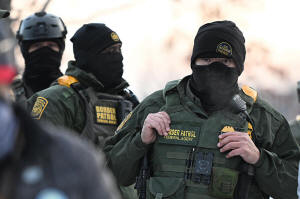
Federal agents look on as protesters gather outside the Bishop
Henry Whipple Federal Building, Thursday, Jan. 8, 2026, in
Minneapolis, Minn. (AP Photo/Tom Baker, File)

“Masking up creates intimidation and fear,” said Washington state
Sen. Javier Valdez, a Democrat who sponsored the legislation. "If
you’re a law enforcement official, the public deserves to know who
you are.”
A measure passed last week in Virginia provides an incentive for law
enforcement agencies to adopt policies restricting facial coverings.
Officers who violate the state ban could face misdemeanor charges
punishable by up to 12 months in jail and a $2,500 fine. But if
their agency has a policy on facial coverings, any violations would
be handled by that agency instead of resulting in state charges.
The Virginia measure was sponsored by Democratic state Sen. Saddam
Azlan Salim, who came to the U.S. from Bangladesh as a child and has
since become a citizen.
“I grew up here knowing if somebody comes here with a mask, no
identification, either they are going to rob you or you’re going to
get kidnapped,” he said.
Republicans wonder why can protesters can wear masks
During debate earlier this month in Oregon, Republican lawmakers
raised objections that the anti-masking provisions would apply only
to law enforcement officers — not protesters — and warned that the
ban could contribute to negative perceptions.
“The demonization of public safety officers is something that has a
deep impact that reverberates across our citizenry," state Sen.
David Brock Smith said after voting against the bill. “There are
individuals that riot and dox these public safety individuals.”

During debate in the Washington House, Republican state Rep. Jim
Walsh recalled attending a Seattle event where angry protesters wore
masks. No harm occurred that day, but “it would be reasonable for a
law enforcement officer to obscure his or her face to protect
themselves from the mischievous criminal,” Walsh said.
What mask limitations exist for the public?
Though Oregon and Washington aren't on the list, 23 other states and
the District of Columbia have laws prohibiting people from wearing
masks in public places to conceal their identity, intimidate others
or avoid recognition while committing crimes, according to the
International Center for Not-for-Profit Law. Some Republican state
lawmakers are looking to add to those limitations.
Arizona already directs courts to consider identity-obscuring masks
as an aggravating factor when sentencing people for felonies. A bill
passed earlier this month by the Republican-led House would expand
the covered offenses and require an enhanced sentence, unless the
mask was worn for sincerely held religious beliefs.
A bill awaiting a vote in the Missouri House would create a
misdemeanor crime of “masked intimidation” for concealing one's face
with the intent to instill fear in others. It's aimed at public
demonstrations, not police.
“I think it just speaks to the priorities that you have," said
Missouri House Speaker Jon Patterson, a Republican. “It is somewhat
interesting that some states want to ban the masking of criminals;
others want to ban the masking of law enforcement.”
All contents © copyright 2026 Associated Press. All rights reserved |