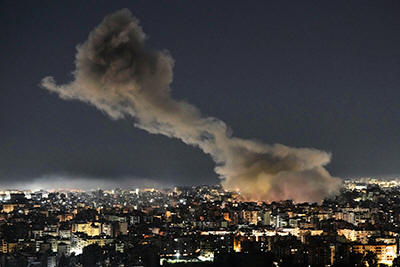
Israel strikes Hezbollah's civilian as well as military wings in an
attempt to crush the group
[March 21, 2026]
By BASSEM MROUE
BEIRUT (AP) — An Israeli strike on a health center in southern Lebanon
instantly killed 12 medical workers, seriously wounded one and left four
missing under the rubble for hours.
The March 13 strike in the village of Burj Qalaouiyah, one of the single
deadliest strikes in Lebanon since the latest Israel-Hezbollah war began
on March 2, targeted a center run by Hezbollah’s health arm, the Islamic
Health Society, which has so far lost 24 members over the past two
weeks.
Since the latest war began, Israel’s military has not only been
targeting the group’s military assets but also its civilian institutions
in an apparent attempt to weaken the Iran-backed group further and try
to push its supporters away from it.
Hezbollah is a political party as well as an armed group, and its health
and social service institutions have helped strengthen its base of
support over the years.
In addition to health centers, Israel has destroyed more than a dozen
branches of Hezbollah’s financial arm, al-Qard al-Hasan. Other strikes
heavily damaged Hezbollah’s Al-Manar TV headquarters and its Al-Nour
radio stations.
The strikes also have targeted the group's Amana gas stations and
discount shops known as Sajjad, where low-income people can buy highly
subsidized products.
On Wednesday, an Israeli airstrike on an apartment in central Beirut
killed Mohammed Sherri, the head of political programs at Hezbollah's
Al-Manar TV, along with his wife.

Israel has accused Hezbollah of using health facilities for military
purposes and has said al-Qard al-Hasan — officially a charitable
organization that provides interest-free loans — finances the group's
military activities. Lebanon's Health Ministry denies the Israeli claims
about Hezbollah's health facilities being used for military purposes.
“This is a different war that will not end with a ceasefire,” said Hilal
Khashan, a political scientist at American University of Beirut. “This
war will not end before Israel achieves its full objective - that is,
the elimination of Hezbollah not only as a military movement, but also
the ultimate objective is to erase Hezbollah from the Lebanese political
picture.”
Hezbollah is under internal and external pressure to disarm and knows
this latest fight is crucial. Intense clashes along Lebanon's southern
border between Hezbollah fighters and advancing Israeli troops have left
dozens of Lebanese gunmen dead.
During a visit to the northern front Monday, Israel's army chief Gen.
Eyal Zamir said that Hezbollah is now fighting “a war for its very
existence and is paying a heavy price for entering this battle.” He
added that pressures exerted by Israel's military will only “increase
more and more.”
Hezbollah vows to keep fighting
“This is an existential battle. It is not a limited or simple battle,”
Hezbollah leader Naim Kassem said in a televised speech over the
weekend. Kassem vowed that his group would fight to the end and never
surrender.
Israel says that Lebanon has failed to disarm the group in accordance
with the Lebanese government's own plans, and that therefore Israel will
carry out the mission itself.
Unlike previous conflicts with Israel, the current one comes as the
Lebanese government has called Hezbollah’s military activities illegal
and authorities have detained several members of the group for carrying
weapons without a license.
Like previous wars, Hezbollah is being criticized by its opponents in
Lebanon who blame the Iran-backed group for triggering this war by
firing rockets into Israel. Hezbollah fired the rockets to avenge the
killing of Iran's Supreme Leader Ali Khamenei, less than two days after
the U.S. and Israel began their attacks on Iran, triggering a war in the
Middle East.

[to top of second column]
|
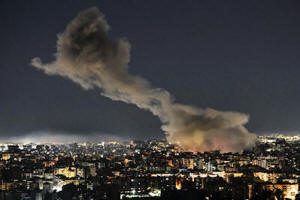
Smoke rises from Israeli airstrikes that struck a building housing
Al-Manar channel studios in Dahiyeh, a southern suburb of Beirut,
Lebanon, early on Tuesday, March 3, 2026. (AP Photo/Bilal Hussein,
File)

Israel retaliated with a campaign of airstrikes on parts of Lebanon
that has so far left more than 1,000 people dead and over 1 million
displaced from their homes in southern and eastern Lebanon as well
as in Beirut’s southern suburbs.
“Hezbollah took a suicidal initiative that will not change the
equation,” said legislator Samy Gemayel, who heads the nationalist
Kataeb Party, adding that Tehran is using Lebanon "as a platform to
defend Iran.”
A previous 34-day war between Israel and Hezbollah in 2006 ended
with a draw. A 14-month conflict that started in October 2023 — when
Hezbollah fired rockets in support of Palestinians a day after the
Oct. 7, 2023, Hamas-led attack on southern Israel — killed much of
Hezbollah’s political and military command and left the group
severely weakened but not destroyed.
Strikes followed by backlash
After airstrikes hit Hezbollah’s institutions even in central
Beirut, residents protested and forced the group to close a branch
of al-Qard al-Hasan in the heart of the capital. Bowing to the
pressure, workers removed the financial institution's sign and
dismantled ATMs, marking the end of its presence in central Beirut.
Amnesty International has said that the al-Qard al-Hasan branches
are not legitimate military targets under international humanitarian
law and that the strikes should be investigated as war crimes.
“The Israeli military has appeared to assume that labelling
something as Hezbollah-affiliated, be that healthcare workers, homes
in border villages, or financial institutions, makes it targetable.
That’s wrong,” said Heba Morayef, regional director for the Middle
East and North Africa at Amnesty International.
Mahmoud Karaki of Hezbollah’s Islamic Health Society said that
during the last war in 2024, his group lost 153 members in Israeli
attacks. But he vowed that the group would continue its work as it
has done in previous wars.
“By targeting us, they are targeting the safety network for the
people and their steadfastness in areas under attack,” Karaki said

The Israeli military’s Arabic spokesperson alleged that Hezbollah is
using ambulances to transport weapons and fighters, a charge that
the paramedic group strongly denies.
Hezbollah and Iranian officials have said that any halt in
U.S.-Israeli strikes on Iran should also include a stop to Israeli
attacks in Lebanon.
Senior Hezbollah official Mahmoud Qamati told Lebanon’s Al-Jadeed TV
on Monday that “Iran will not leave Lebanon nor the resistance, nor
will it allow that Lebanon remains vulnerable," adding that "Lebanon
will be part of this victory and will not be left alone.”
When Iran’s Foreign Minister Abbas Araghchi was asked if Tehran
could accept a ceasefire to stop strikes on Iran while they continue
in Lebanon, he said: “I don't think so.”
“We do not believe in a ceasefire; we believe in ending the war. And
ending the war means exactly that — ending the war on all fronts,”
Araghchi told Al Jazeera English, adding that this includes Lebanon,
Yemen, Iraq, Iran and "other countries of the region.”
All contents © copyright 2026 Associated Press. All rights reserved |