Small comforts fade and big worries grow as fuel prices surge globally
[March 24, 2026] By
MATT SEDENSKY
A birthday beach trip. Weekend jaunts with the kids. Even a bedtime
beer.
As gas prices remain high, people around the globe are stretching their
paychecks, giving up small comforts as everyday costs bloat and they try
to keep up with their biggest bills.
“For now, we’re still managing to hold on,” said Luis Catalano, a taxi
driver waiting to fuel up at a gas station in Buenos Aires, Argentina.
“But I don’t know for how long.”
Even as glimmers of hope for a potential breakthrough in the war in Iran
emerged, the conflict persisted for a 24th day on Monday and the vital
oil pathway of the Strait of Hormuz remained at a virtual standstill.
Across continents, the costs were hitting home.
“You can’t make it to the end of the month,” said German Toledo, a
38-year-old road safety worker who was fueling up at the YPF station
where Catalano idled. Like others, Toledo said surging gas prices have
piled on to other rising costs and stagnant wages, making the pain more
acute. His salary hasn’t budged in five years.
One job, Toledo said, is no longer enough to make ends meet.
U.S. President Donald Trump injected a bit of optimism Monday that
relief might arrive at the pump, saying talks were ongoing with Iranian
leaders and that they were eager to make a deal to end the war. Those
claims drove down global oil prices, with the price for a barrel of
Brent crude falling 9.7% to $101.26, down from nearly $120 last week.

Iran denied any talks had been held, and its parliament speaker called
Trump’s claims a ploy to manipulate markets. Either way, the news had no
immediate impact on consumer prices.
Oil follows snaking journeys that can take weeks to go from drill sites
to gas pumps. It must pass through refineries, where it is turned to
fuel, before it is shipped off via pipelines and tankers to terminals,
and then on to gas stations. Pump prices similarly lag global markets,
sometimes taking weeks to respond.
So, motorists continue to bear the cost.
“I’m just barely getting by,” said Catalano.
As with any economic disruption, people with the least have been hurt
the most, leaving them to scour already bare-bones budgets for new
places to cut back.

[to top of second column] |
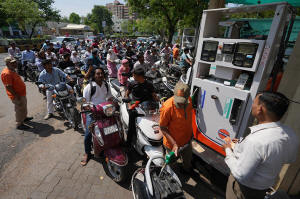
Motorists queue up to get fuel at a pump, fearing a possible fuel
shortage due to the US Iran war, in Ahmedabad, India, Monday, March
23, 2026. (AP Photo/Ajit Solanki)
 Kevin Plucken, a 35-year-old janitor
in Cologne, Germany, can only afford to put 20 euros of gas into his
car at a time. On the hunt to cut his “burdensome” costs, he’s had
to change how he spends his weekends. Instead of driving his two
children for an activity somewhere, he looks for things to do close
to home.
“It’s just too expensive,” he said.
At sites dotted around the globe, it seemed many could agree that
the spike in gas was just the latest blow for average people who’ve
grown accustomed to relentless high costs.
“Everything is going up,” said Felicia Iwasa, of Lagos, Nigeria.
“The economy is not easy for us.”
In the Philippine capital of Manila, drivers of the colorfully
adorned street icons known as “jeepneys” have likewise struggled,
with costs for the diesel they rely on rising even higher than
gasoline. The vehicles morphed out of jeeps left behind by American
troops during World War II. They were modified, reproduced, and
outfitted in showy décor, becoming a key way of getting around for
working-class Filipinos.
Johnny Pagnado, a 55-year-old driver, said he’s cutting whatever
costs he can, down to his nightly bedtime bottle of beer. But he
worries about longer-term impacts, like how he’ll afford to send
four children to college.
Another driver, 34-year-old Sandy Roño, said a beach trip to
celebrate his birthday next month is likely off. He couldn’t even
afford his rent last month and wasn’t able to make the payment on
his jeepney.
If prices stay so high, Roño said, he’ll be forced to find new work.
“I’ll stop driving and look for another job,” he said.
___
Contributing to this report were Associated Press writers Jim Gomez
and Joeal Calupitan in Manila, Philippines; Daniel Niemann in
Cologne, Germany; Victor Caivano in Buenos Aires, Argentina; and Dan
Ikpoyi in Lagos, Nigeria.
All contents © copyright 2026 Associated Press. All rights reserved |