Kim vows to 'irreversibly' cement North Korea’s nuclear status
[March 24, 2026]
By KIM TONG-HYUNG
SEOUL, South Korea (AP) — North Korean leader Kim Jong Un has pledged to
irreversibly cement his country’s status as a nuclear power while
maintaining a hard-line stance toward South Korea, which he called the
“most hostile” state, state media said Tuesday.
In a speech Monday to Pyongyang’s rubber-stamp parliament, Kim accused
the United States of global “state terrorism and aggression,” in an
apparent reference to the war in the Middle East, and said the North
will play a more forceful role in a united front against Washington amid
rising anti-American sentiment. But Kim didn’t call out U.S. President
Donald Trump by name and said whether his adversaries “choose
confrontation or peaceful coexistence is up to them, and we are prepared
to respond to any choice.”
His comments largely aligned with his statements at last month’s ruling
Workers’ Party Congress, where he vilified Seoul but left open the door
for dialogue with the Trump administration, urging Washington to drop
its demands for the North’s nuclear disarmament as a precondition for
talks.
State media said the Supreme People’s Assembly, which concluded its
two-day session Monday, passed a revised constitution but did not
specify the changes. There had been expectations the revisions would
codify South Korea as a permanent enemy and remove references to shared
nationhood. That's in line with Kim’s hard-line stance after he declared
in 2024 that the North would abandon its long-term goal of a peaceful
unification with the South.
Analysts say Kim’s vilification of South Korea reflects his view that
Seoul, which helped arrange his first meetings with Trump in 2018 and
2019, is no longer a useful intermediary with Washington but an obstacle
to his push for a more assertive regional role. He has also shown
sensitivity to South Korean soft power, driving aggressive campaigns to
block the influence of its culture and language among North Koreans as
he seeks to tighten his family’s authoritarian grip.
In his speech, Kim expressed pride in the country’s rapid expansion of
nuclear weapons and missiles in recent years, calling it the “right”
choice to counter future threats and “hegemonic pursuits” by
“gangsterlike” imperialists, a term the North often uses for the United
States and its allies.

[to top of second column]
|
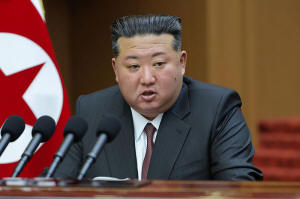
In this photo provided by the North Korean government, its leader
Kim Jong Un delivers a speech during a session of the Supreme
People’s Assembly at parliament in Pyongyang, North Korea Monday,
March 23, 2026. Independent journalists were not given access to
cover the event depicted in this image distributed by the North
Korean government. The content of this image is as provided and
cannot be independently verified. (Korean Central News Agency/Korea
News Service via AP)

“The dignity of the nation, its national interest and its ultimate
victory can only be guaranteed by the strongest of power,” Kim said.
“The government of our republic will continue to consolidate our
absolutely irreversible status as a nuclear power and will aggressively
wage a struggle against hostile forces to crush their (anti-North
Korean) provocations and schemes.”
Kim has suspended all meaningful dialogue with Washington and Seoul
since the collapse of his second summit with Trump in 2019 over U.S.-led
sanctions on the North.
Kim has recently been prioritizing Russia in his foreign policy, sending
thousands of troops and large amounts of military equipment to support
Moscow’s war in Ukraine, possibly in exchange for aid and military
technology. Facing the possibility of the war winding down, analysts say
Kim may try to keep his options open by taking a more measured approach
toward Washington to preserve future dialogue, with the long-term aim of
securing U.S. sanctions relief and tacit recognition as a nuclear state.
However, some experts believe that the United States and Israel’s joint
attacks on Iran and the killing of Tehran’s previous supreme leader may
have raised Kim’s bar for reviving dialogue with Washington.
Separately, North Korean state media said Belarusian President Alexander
Lukashenko will visit the country at Kim’s invitation, but did not
immediately say when the visit will take place.
All contents © copyright 2026 Associated Press. All rights reserved |