Supreme Court sounds skeptical of late-arriving ballots, a Trump target
[March 24, 2026]
By MARK SHERMAN
WASHINGTON (AP) — The Supreme Court 's conservative majority on Monday
sounded skeptical of state laws that allow the counting of late-arriving
mail ballots, a persistent target of President Donald Trump.
A ruling, likely to come by late June, that bars counting ballots
arriving after Election Day would send officials scrambling in 14 states
and the District of Columbia, just a few months before the 2026 midterm
congressional elections to change their ballot rules.
An additional 15 states that have more forgiving deadlines for ballots
from military and overseas voters also could be affected.
The legal challenge is part of Trump’s broader attack on most mail
balloting, which he has said breeds fraud despite strong evidence to the
contrary and years of experience in numerous states. Trump has
repeatedly claimed that his loss to Joe Biden in 2020 resulted from
fraud even though more than 60 court decisions and his own attorney
general said that argument had no merit.
The court heard arguments in a case from Mississippi pitting the state
against Trump's Republican administration and the Republican and
Libertarian parties. At issue is whether federal law sets a single
Election Day that requires ballots to be both cast by voters and
received by state officials.

While there was no explicit reference to the 2020 election, several
conservative justices gave voice to some of Trump's complaints. Justice
Samuel Alito wondered about the appearance of fraud in situations where
“a big stash of ballots” that arrive late “radically flipped” an
election.
Defending the state law, Mississippi Solicitor General Scott Stewart
pointed out that the Trump administration and its allies in the case
have yet to submit a single case of fraud due to late-arriving mail
ballots.
The court's liberal justices indicated they would uphold state laws with
post-Election Day deadlines.
“The people who should decide this issue are not the courts, but
Congress, the states and Congress,” Justice Sonia Sotomayor said.
Forcing states to change their practices just a few months before the
election risks “confusion and disenfranchisement,” especially in places
that have had relaxed deadlines for years, state and big-city election
officials told the court in a written filing.
California, Texas, New York and Illinois are among the states with
post-Election Day deadlines. Alaska, with its vast distances and often
unpredictable weather, also counts late-arriving ballots.
Alaska elections officials said Monday they are preparing for the fall
elections under existing law. "If a ruling requires operational changes,
we will work through those in coordination with the appropriate state
entities to ensure compliance and to provide clear information to
voters,” the Alaska Division of Elections said in a statement.
Lawyers for the Republican and Libertarian parties, as well as Trump's
administration, are asking the justices to affirm an appellate ruling
that struck down a Mississippi law allowing ballots to be counted if
they arrive within five business days of the election and are postmarked
by Election Day.

[to top of second column]
|
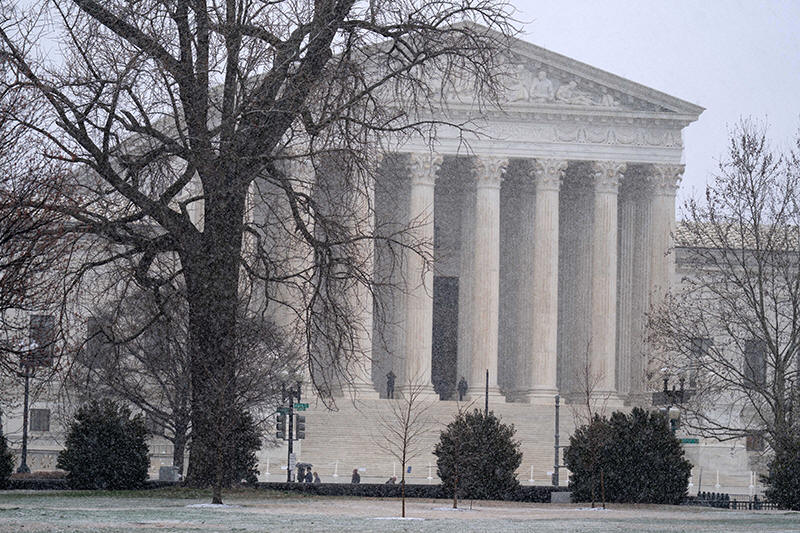
The U.S. Supreme Court is seen during a snowy day on Capitol Hill
Thursday, March 12, 2026, in Washington. (AP Photo/Jose Luis Magana)

Paul Clement, representing the political parties, played on fears of
fraud by invoking Democrat-dominated Chicago, infamous for election
shenanigans. Voting ends at 8 p.m. in Chicago, Clement said, but
state law allows ballots postmarked by Election Day to be received
later.
A voter paying close attention to the election returns could in
theory try to swing the election by submitting a mailed ballot to
the post office after the polls were closed, he said.
“I am not here to say there could ever be voting fraud in Chicago,”
Clement said to laughter in the courtroom.
Sotomayor had earlier needled Clement that under the ruling he
sought, the Bush v. Gore decision that decided the 2000 election in
favor of Republican George W. Bush would have come out differently
because military ballots that broke heavily for Bush in his 537-vote
win wouldn't have been counted. Clement disputed the point.
The justices seem more concerned about the cascading problems that
could arise no matter who wins the case.
Ballots could be received until the start of the next Congress, two
months after the election, if a state wanted, Justice Neil Gorsuch
suggested.
On the other side, Justice Elena Kagan said the logic of the
challenge to late-arriving ballots also would be used to rule out
early voting and absentee ballots.
Limits on early-voting also seemed to bother Chief Justice John
Roberts, who seemed the conservative member of the court most likely
to side with Mississippi, along with Justice Amy Coney Barrett.
The court also grappled with whether state laws allowing for
late-arriving ballots from military and overseas ballots could
survive.

Last year, Trump signed an executive order on elections that aims to
require votes to be “cast and received” by Election Day. The order
has been blocked in pending court challenges.
At the same time, four Republican-dominated states — Ohio, Kansas,
North Dakota and Utah — eliminated grace periods last year,
according to the National Conference of State Legislatures and
Voting Rights Lab.
In striking down Mississippi's grace period, Judge Andrew Oldham of
the 5th U.S. Circuit Court of Appeals wrote that the state law
allowing the late-arriving ballots to be counted violated federal
law.
Oldham and the other two judges who joined the unanimous ruling,
James Ho and Stuart Kyle Duncan, all were appointed by Trump during
his first term.
All contents © copyright 2026 Associated Press. All rights reserved |