Georgia could become the first state with weapons detection in all
public schools
[March 25, 2026]
By JEFF AMY
ATLANTA (AP) — Georgia could become the first state to require every
student to be checked for weapons when arriving at a public school each
day.
A bill is nearing passage that would require weapons detection systems
in a further reaction to a 2024 school shooting that killed four.
“That rifle would have never reached our hallways," said Daria
Lezczynska, a junior at Apalachee High School in Winder, where the
shooting took place. “Lives would have been saved. Families would not be
grieving, Students like me would not be carrying this trauma.”
Some schools have long used metal detectors or required students to
carry clear backpacks to cut down on weapons. But a new generation of
technology marries computer analysis with cameras or the same
electromagnetic fields as metal detectors to detect knives and guns. The
systems have spread rapidly through schools, arenas, stadiums and
hospitals.
“It’s very commonplace for me to walk through a weapons detection system
when I enter into a courthouse," said Chuck Efstration, the bill's
sponsor and Republican house majority leader who represents the
Apalachee campus. "Georgia’s students and educators deserve similar
security with weapons detection systems inside of every Georgia public
school.”

There’s little rigorous research nationwide proving that weapons
detectors prevent school shootings. In Georgia, there are questions
about who will pay what can be $10,000 or more per system. School
employees must staff checkpoints and search bags. And even supporters of
the systems say searchers can become dulled by a multitude of false
alarms and miss the few actual weapons. Some question whether weapons
detectors are necessary in elementary schools, as Efstration's bill
mandates. And those who find Georgia's gun laws too permissive say
installing weapons detectors everywhere is a form of surrender,
accepting that society will be awash in guns and violence.
A Senate committee on Monday passed an amended version of Efstration’s
bill, meaning it needs final votes in the Senate and House in the
closing days of Georgia's 2026 legislative session before reaching
Republican Gov. Brian Kemp’s desk for his signature or veto.
Few schools traditionally required weapons checks
It's unclear how many schools nationwide use weapons detectors. A U.S.
Department of Education survey found that in the 2021-2022 school year,
6.2% of all schools and 14.2% of high schools nationwide required random
metal detector checks. Only 2.4% of all schools and 6.2% of high schools
required daily metal detector checks. More schools required clear
bookbags or banned bookbags than required daily metal detector checks.
Checks were more likely to be required when a school was in a city, when
the majority of students were nonwhite, and when large majorities of
students were poor.
Atlanta's school district spent more than $4 million to roll out new
systems in 2021 in middle and high schools, replacing old-style metal
detectors. District Police Chief Ronald Applin said officials wanted
something that students could move through more quickly, saying
traditional detectors were “too cumbersome.”
[to top of second column]
|
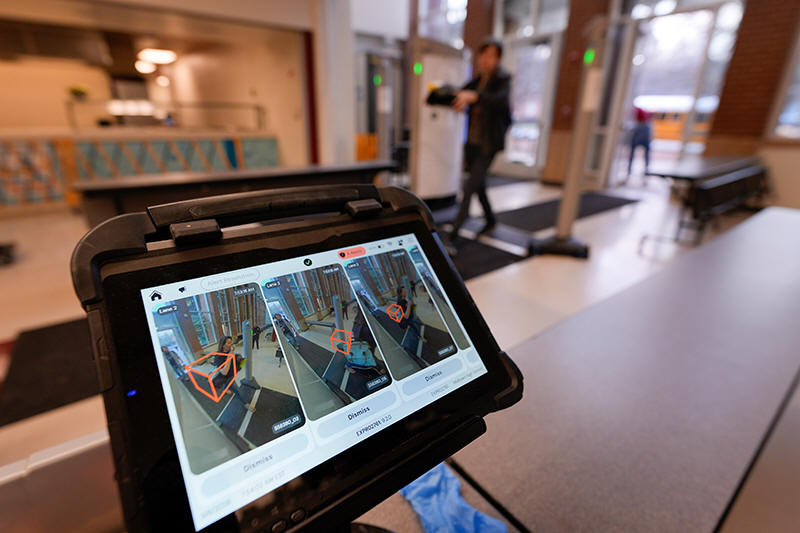
An alert resolution tablet is seen in the security area at Midtown
High School, Friday, March 6, 2026, in Atlanta. (AP Photo/Mike
Stewart

Applin said guns found at Atlanta schools fell from 32 the year
before the new system to four so far this year.
The 1,700 students at Midtown High School typically hold their
laptops in the air as they pass through detection gates, with a
computer screen telling employees whether a bag needs a secondary
search.
“It’s not real adversarial at the metal detector," said School
Resource Officer Meredith Littles. "A lot of people get worried
about the dynamics of what that looks like. But it’s very
non-intrusive.”
False alarms can dull vigilance
One key question is how sensitive to make the system, said Nikita
Ermolaev, a research engineer at IPVM, which tests and researches
security technology. Too sensitive, and alarms go off for
everything. Not sensitive enough, and weapons slip through. And
trying to maintain vigilance is a challenge.
“You have 100 alarms and the first 99 of them are false alarms on
laptops or binders, right? You’re naturally going to assume that the
100th alarm is also going to be on something benign,” Ermolaev said.
“And that’s how sometimes weapons such as guns or knives can go
through the system.”
Then there's the cost. Georgia gives each public school campus
$50,000 a year for school safety, but many districts are already
using that money to pay on-campus officers. House budget writers
have proposed borrowing an additional $50 million for grants to
districts.

“While we absolutely think weapons detection is imperative, it can
only be made possible with appropriate funding,” said Gretchen
Walton, an assistant superintendent in Cobb County, which with
103,000 students is Georgia's second-largest school system.
Others, including some Democrats, see the focus on weapons detection
as misplaced. They say Georgia should be looking to limit children's
access to guns.
“We have allowed guns and weapons of war to become more available
than a pack of gum in this state, then act confused when people keep
dying,” said Democratic state Rep. Bryce Berry, a public school
teacher who voted against the bill in the House. “Let’s stop hiding
behind procedure and politics and pretending that the threat our
children face is some vague, mysterious force.”
All contents © copyright 2026 Associated Press. All rights reserved
 |