Yearslong ethanol policy standoff could cost Illinois drivers at the
pump yet again
[March 26, 2026]
By George Alexandrakis and Medill Illinois News Bureau
SPRINGFIELD — With gas prices surging to a national average of just
under $4 per gallon due to the U.S. bombing of Iran, a yearslong policy
standoff over ethanol-blended fuel threatens to push prices even higher
in Illinois for a second straight year.
At issue is the use of E15 gasoline — a blend of 15% ethanol and 85%
gasoline that’s cheaper than regular fuel and increases demand for corn.
But federal rules have blocked its use during the summer in recent years
because the warmer months create conditions where vapors from
ethanol-infused gasoline could contribute to unhealthy levels of smog.
The Trump administration soon could announce that it will temporarily
lift the restrictions on E15 sales during the summer amid pressure
surrounding rising costs due to the conflict in Iran, according to
sources familiar with the matter cited by Reuters. But a White House
official said no final decision has yet been made and called the
reporting premature.
The sale of ethanol, which is made from corn, began to get more
complicated in 2022 when eight Midwestern states — Illinois, Iowa,
Kansas, North Dakota, South Dakota, Nebraska, Wisconsin and Minnesota —
surrendered a federal waiver that allowed the usage of E10 (10% ethanol)
during the summer months. The governors framed their petition as a
state-level solution, but industry advocates said the broader goal was
to pressure Congress into a nationwide permanent fix for E15 fuel use.
The federal government reacted by issuing summer emergency waivers from
2022-24, temporarily lifting Environmental Protection Agency
restrictions that would otherwise bar retailers from selling E15 fuel
during the summer.

Delays in 2025
However, during the first months of the Trump administration in early
2025, there was a delay in issuing the emergency waiver. It took until
late April, resulting in higher prices for a longer period because
retailers had already bought the more-expensive product.
The feds have not issued a waiver yet this year. In hopes of avoiding a
repeat of 2025, Gov. JB Pritzker joined six of his counterparts earlier
this month in a letter to EPA Administrator Lee Zeldin urging an
emergency waiver announcement by March 15. That didn’t happen.
The letter, which was signed by Pritzker as well as the governors of
Iowa, Nebraska, Missouri, Wisconsin, Minnesota and South Dakota, also
requested that any E15 waiver that is provided includes an identical one
for E10 — the most common fuel distributed in the U.S. — to ensure fuel
standards stay the same across the board.
“Given that Congress has yet to deliver regulatory relief to expedite
nationwide, year-round E15 sales, we join with many others to call on
the EPA to provide a nationwide emergency waiver for E15 during the
coming months to ensure ample, low-cost fuel options for consumers,” the
letter said.
When the EPA granted last year’s emergency waiver on April 28, Zeldin
cited President Donald Trump’s commitment to lower energy costs and to
farmers who grow the corn for ethanol.
“In my confirmation hearing, I pledged to establish certainty when it
came to the sale of E15 year-round,’’ Zeldin said in a news release.
The EPA did not respond to questions sent by Capitol News Illinois about
what it plans to do for this summer, and for a permanent solution.
Illinois retailers’ uncertainty
Nate Harris, CEO of the Illinois Fuel and Retail Association, which
represents over 500 members in the state’s gas station and convenience
store industry, said he remains concerned, recalling what happened a
year ago.

“The problem with waiting until late April is that my members that have
already purchased this more-expensive product are going to be stuck
holding it,” Harris said. “The industry last year lost tens of millions
of dollars and will likely do so again, which is unnecessary because the
ability to just opt back into the waiver exists.”
In addition to the financial losses incurred by retailers, consumers
temporarily dealt with higher prices — as much as 30 cents per gallon
more, according to Harris.
[to top of second column]
|
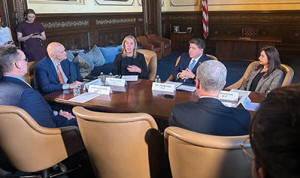
Gov. JB Pritzker speaks at a news conference following his 2026
budget address. Pritzker joined six other Midwestern governors in a
letter to EPA Administrator Lee Zeldin urging an emergency waiver on
the use of E15 ethanol gasoline this summer. (Medill Illinois News
Bureau photo by George Alexandrakis).

Harris said he hopes that because of global oil market volatility due to
the war in Iran, there is more urgency to get an emergency waiver
announced sooner in 2026 than 2025, a sentiment echoed in the letter
sent by Pritzker and the other governors to the EPA.
An earlier announcement could significantly blunt the logistical damage
for retailers who must navigate a complicated system to secure their
products in advance but may not entirely eliminate it.
Harris and others would like to see a permanent fix to the problem, and
to them the easiest solution would be for Illinois to opt back into the
original E10 waiver.
A spokesperson for Pritzker’s office could not be reached to ask whether
the governor intends to ask that the state opt back into the E10 waiver.
“Every year waiting on emergency waivers from the federal government is
no way to generate stability and certainty for businesses,” said Harris.
“All the state needs to do is opt back into the regular waivers and we
can avoid all those headaches from last year.”
Corn growers have concerns
Fuel retailers are not the only group of people pushing for a decision
on E15. Illinois corn and ethanol producers warn that the uncertainty
behind what will happen each summer goes beyond the gas pump. It also
hits their pocketbooks.
“One in every four to five bushels of grain corn raised in Illinois is
going into biofuels, and this is creating jobs and tax dollars,” said
Illinois State Rep. Charles Meier, R-Okawville. “So by (not selling
E15), it is going to hurt the Illinois economy.”
He and other Illinois lawmakers have a dual interest in the issue — they
are concerned about what their constituents will be paying for fuel, and
they want to help the corn farmers who have a financial interest in the
success of ethanol.
Meier, who represents a rural district in southwestern Illinois, also
took aim at the waiver process itself. “We need a permanent fix to
this,” Meier said. “Just looking at it every summer and trying to move
forward with emergency rules shouldn’t be what we’re doing.”

If action is delayed like it was in 2025, the impact will not be the
same across every part of Illinois. According to Harris, the Chicago and
St. Louis metro areas already use a different ethanol blend during the
summer due to air quality requirements in larger and more urban areas.
The cost of producing the specific blend wouldn’t rise, but the cost of
getting it to consumers would because of how it would compete for space
in the same pipeline network.
Meanwhile, downstate markets such as Peoria, Champaign and other
communities across southern Illinois outside the Metro East region would
face a double hit: the higher transportation and production costs for
the specialty blend, according to Harris.
An Illinois Department of Agriculture news release calling for a quick
decision on the waiver quotes several Democratic members of Congress who
want a permanent federal solution. Among them was Rep. Eric Sorensen,
D-Moline, who serves on the House Agriculture Committee and represents
rural communities stretching from Rockford to Decatur.
Earlier in March, Sorensen had attempted to amend the Farm Bill
currently under consideration by the Agriculture Committee in Congress
to include language enabling the year-round sale of E15. But the
amendment was blocked over questions of jurisdiction.
Sorensen, in a news release, said he hopes Congress eventually will act.
“We need certainty for farmers and lower prices at the gas pump,’’ he
said.
George Alexandrakis is a graduate student in
journalism with Northwestern University’s Medill School of
Journalism, Media and Integrated Marketing Communications, and is a
fellow in its Medill Illinois News Bureau working in partnership
with Capitol News Illinois.
Capitol News Illinois is
a nonprofit, nonpartisan news service that distributes state
government coverage to hundreds of news outlets statewide. It is
funded primarily by the Illinois Press Foundation and the Robert R.
McCormick Foundation. |