Lawmakers seek measure to make small-scale plug-in solar panels
available to renters
[March 28, 2026]
By Nikoel Hytrek and UIS Public Affairs Reporting (PAR)
A bill to make solar power more accessible to renters and others who
face barriers to the alternative energy source is moving through the
Illinois Senate.
The plug-in solar bill allows people to install small solar panel
systems that can be plugged into normal wall outlets for personal use.
Instead of a rooftop, the panels could be set up on a balcony, in a
yard, or on a porch or patio.
“Plug-in solar is exactly what it sounds like: small, low-cost solar
panels that plug directly into a standard outlet and help offset the
energy use,” said Sen. Rachel Ventura, D-Joliet, who is the lead sponsor
of the bill. “No expensive installation, no major construction, no
waiting months for approval.”
Because most residential solar requires rooftop installation, people who
live in apartments or who rent their homes have been unable to take
advantage of solar power to cut down on electricity bills. Lawmakers
said this was a major motivation for the bill.
Under current Illinois law, people would have to get an interconnection
agreement before using plug-in solar systems, but the bill removes that
requirement. Customers who use a plug-in solar system would also not be
required to get the electricity provider’s approval before installation,
pay a fee related to installation, or install additional equipment.
“Illinois has been a leader in renewable energy, and this legislation
keeps us moving forward by making solar more available, more affordable,
and more achievable for everyone,” said Rep. Daniel Didech, D- Buffalo
Grove, the sponsor for the House version of the bill.
Further, landlords and homeowners’ associations would not be able to ban
or “unreasonably restrict” or regulate plug-in solar systems.
Instead, users would only have to notify the electricity provider about
the solar panel system within 30 days of installation. The law would
require those providers to develop simple online notification forms.
“Right now, outdated rules are getting in the way,” Ventura said.
“Senate Bill 3104 cuts through the red tape by exempting these small
systems from the same requirements designed for large scale solar. That
means faster access, lower costs, fewer barriers for everyday people.”
These exemptions apply to small systems that usually have between
300-400 watts of power output, but the bill grants permission for
systems up to 1,200 watts — those would just be subject to more rules.
The greater rules kick in for systems with an output of 392 or more
watts.

[to top of second column]
|
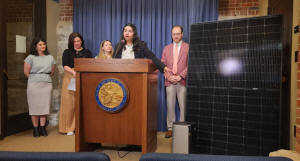
Kavi Chintham of Voter Solar gestures at a 391-watt plug-in solar
panel and battery at a Thursday news conference about a bill to
expand access to plug-in solar panel systems. (Capitol News Illinois
photo by Nikoel Hytrek)

In general, the bill allows for solar panel systems that are:
Designed to be connected to a building’s electrical system through an
existing outlet.
Located on an exclusive-use balcony, patio, yard, porch, or similar
area.
Intended primarily to offset part of a person’s energy consumption.
Certified by a nationally recognized
testing laboratory.

Plug-in solar systems also normally include batteries, which allow
people to save excess energy to use later in the day and avoid using the
grid power. For safety, the systems have built-in protections like
automatic shutoffs in case of power outages.
“This is a carefully designed policy that makes sure we’re preserving
safety while updating rules that were written for these large rooftop
systems. It removes this one-size-fits-all regulatory approach,” said
Kavi Chintam, Illinois campaign manager for Vote Solar, a nationwide
organization that seeks to reduce barriers to solar power.
Utah is the only other state to have passed plug-in solar legislation,
but lawmakers in multiple other states like Pennsylvania, Minnesota and
New York have introduced bills.
The bill passed in the Senate Energy and Public Utilities Committee on
March 12 and is now waiting on an amendment to address questions and
concerns from utilities and labor unions.
Capitol News Illinois is
a nonprofit, nonpartisan news service that distributes state government
coverage to hundreds of news outlets statewide. It is funded primarily
by the Illinois Press Foundation and the Robert R. McCormick Foundation. |