Egypt’s early closing order jolts Cairo’s night life as war-driven oil
costs soar
[March 30, 2026] By
SAMY MAGDY
CAIRO (AP) — The Egyptian government is seeking ways to conserve
oil-powered electricity during the U.S.-Israel war with Iran, enacting
at least one policy that threatens Cairo's identity as a city that never
sleeps.
The government imposed new nationwide closing times Saturday for stores,
restaurants and cafes, ordering them to shut early and interfering with
their ability to operate during critical hours.
“It’s ruinous,” said Youssef Salah, a cafe owner in Cairo. “It deprives
us from our peak time.”
The decision is one of a series of measures the government has taken in
recent weeks to mitigate the fallout of the U.S. and Israeli war against
Iran, which has shaken the Middle East and the global economy. Though
Egypt is not a party to the widening conflict, the most populous Arab
country is one of the most impacted by the war’s far-reaching
repercussions, including higher oil prices and disrupted shipping
routes.
'We must protect people’s livelihoods'
The early closures will have dire repercussions on hundreds of thousands
of small businesses found on almost every street, alley and lane across
the country. Some of them — including many eateries, juice shops and
cafés — usually operate nonstop.
Salah, the café owner in Cairo’s middle-class neighborhood of Sayeda
Zeinab, said he was forced to cut his 35-member workforce by 40%.
The 46-year-old father of three used to keep his venue open 24 hours a
day, with peak hours starting in the evening till the first hours of the
new day. The late-night shifts are now abolished, he said.

“It’s painful,” Salah said as he closed his shop doors at 9 p.m. (19:00
GMT) on Saturday.,
Yet two days into the decision, some Egyptians danced around the
government order. Some cafes closed their front doors as patrons inside
went about smoking shisha or playing chess, dominos or cards.
Others took to social media to criticize the early closures.
“The Butterfly effect,” Mahmoud Elmamlouk, editor of Cairo24, one of the
biggest news outlets in Egypt, wrote on social media after cafe shops
shuttered their doors Saturday evening. “The closure of Strait of Hormuz
has deprived us from smoking shisha in Talbia,” he wrote, referencing a
working-class neighborhood in greater Cairo.
Ayman Harbi, who works at a store in Downtown Cairo, called on the
government to extend the opening hours at least till midnight, saying
that closing at 9 p.m. is “extremely difficult” for business like his.
“Our work in the summer usually starts after 8 p.m. (18:00 GMT),” he
said. “Forcing me to close at 9 p.m. (19:00 GMT) makes the workday
pointless.”
Magdy al-Deeb, a business owner, urged the government to reverse the
decision to preserve jobs, especially for cafes and small businesses.
“Where will all those people (workers) go,” he asked of those who could
lose their jobs. Smoking a shisha — the tobacco burning water pipe — in
a Cairo café, he said society "must protect people’s livelihoods.”
[to top of second column] |
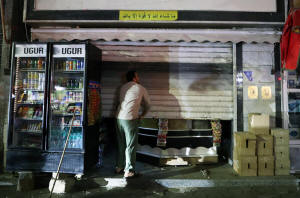
A man closed his shop after earlier closing hours applied, as part
of a series of measures the government has taken to mitigate the
fallout of the U.S. and Israeli war against Iran, in Cairo, Egypt,
late Saturday, March 28, 2026. (AP Photo/Khaled Elfiqi)
 The decision to close businesses
early has also changed to the lifestyle for Egyptians accustomed to
being able to buy virtually anything at any time, especially in big
cities like Cairo and Alexandria.
A nighttime tour across Cairo Saturday and Sunday revealed the
city's usually vibrant streets turned eerily quiet.
'Exceptional' measures
Shops, restaurants, malls and cafes across the country have been
ordered to close at 9 p.m. (19:00 GMT) for a month.
The measures -- described by the government as “exceptional” —
include dimming streetlights and roadside advertising. The
government’s district offices in the New Administrative Capital,
east of Cairo, were also ordered to close by 6 p.m. (16:00 GMT).
Civil servants were also asked to return working from home for one
day a week in April.
The government exempted tourist-attraction areas from its
energy-saving measures, given that tourism is a major source of
foreign currency for the cash-strapped country. The exempt areas
include the Red Sea tourist resorts of Hurghada, Sharm el-Sheikh,
Marsa Alam, as well as the antiquities-rich southern cities of Aswan
and Luxor.
Prime Minister Mustafa Madbouly said the measures aim to curtail oil
consumption.
“The alternative would be to resort again to further price
increases,” he warned.
The government already hiked prices for fuel and cooking gas earlier
this month as global energy prices soared with the virtual closure
of the Strait of Hormuz, a crucial chokepoint for about a fifth of
global oil supply.
Repercussions are particularly painful for Egypt
Global energy prices have skyrocketed since the start of the war on
Feb. 28, when the U.S. and Israel launched massive airstrikes on
Iran, which retaliated with attacks on oil and gas infrastructure
across the Persian Gulf and by squeezing traffic through the Strait
of Hormuz.
The increases hit Egypt hard given that its population of over 108
million people consumes $20 billion of oil products annually,
including fuel used to operate power plants.
The country imports 28% of its gasoline and 45% of its diesel and
Madbouly said the nation's oil bill had more than doubled from
January to $2.5 billion.
All contents © copyright 2026 Associated Press. All rights reserved
 |