Illinois State Board of Education wants to revamp how it counts
low-income students
[May 02, 2026]
By Peter Hancock
SPRINGFIELD — The Illinois State Board of Education is asking lawmakers
this year for $200,000 to develop a new way of counting low-income
students.
Although that’s only a small fraction of the overall $10.9 billion
general revenue fund budget the agency is seeking to fund preK-12 public
schools next year, the request points to a larger issue that public
schools could be facing over the next several years as the number of
students officially counted as “low-income” is expected to drop.
That’s because Illinois currently counts low-income students based on
their enrollment in federal support programs, including Medicaid, the
Children’s Health Insurance Program, Temporary Assistance for Needy
Families and the Supplemental Nutrition Assistance Program, or SNAP.
However, under new eligibility rules that were part of the federal
budget law Congress passed last year known as H.R. 1, or the “One Big
Beautiful Bill Act,” the number of people enrolled in those programs is
expected to decline.
Those include changes to SNAP eligibility that went into effect May 1
that disqualify many groups of noncitizens and impose new work
requirements on many able-bodied adults.
Although the rules mainly affect adults and therefore aren’t expected to
have an immediate impact on students, officials believe they could
eventually cause entire households to become unenrolled in federal aid
programs, resulting in fewer children being enrolled as well in future
years.

“We believe we have time to come up with an alternative method,” Robin
Steans, executive director of the education research and advocacy group
Advance Illinois, said in an interview.
The changes in federal eligibility rules for Medicaid, SNAP and other
federal programs could have a direct impact on the amount of state
funding many districts receive through the Evidence-Based Funding
formula.
That’s the formula that lawmakers adopted in 2017 that calls for $300
million in additional funding for public schools each year, with the
bulk of that money earmarked for the least adequately funded districts.
The formula uses several factors to determine an “adequacy target” for
each district, including the number of teachers and paraprofessionals a
district needs based on its enrollment and demographic factors.

[to top of second column]
|

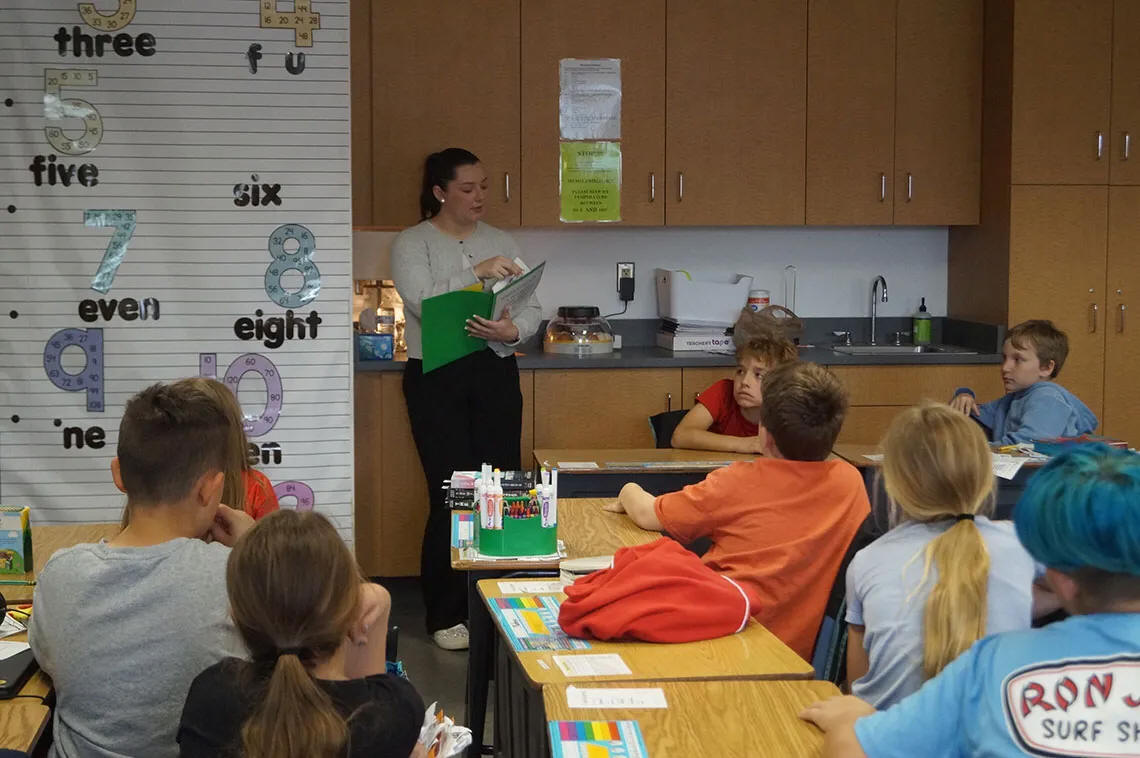
Changes in federal eligibility rules for aid programs like SNAP, the
Supplemental Nutrition Assistance Program, could create new budget
pressures for Illinois school districts that serve large numbers of
low-income students. (Capitol News Illinois photo by Peter Hancock)
For example, for kindergarten through third-grade classes, the statute
says each district should receive funding for one full-time equivalent
teacher for 15 low-income students, and one for every 20 non-low-income
students. For grades 4-12, the formula calls for one teacher for every
20 low-income students and one for every 25 non-low-income students.
According to data from the state’s 2025 report card, there were just
over 1.8 million students enrolled in Illinois public schools during the
2024-25 school year. Of those, 49.7%, or 933,470, were classified as
low-income.
The highest concentration of low-income students for any single district
was in Carbon Cliff-Barstow School District 36, in the Quad Cities
region, which reported 100% of its students qualified as low-income.
Lake Forest School District 67, in Lake County, reported only 1.3% of
its students were low-income.
Although many observers say they do not expect the changes in
eligibility rules to have an immediate impact on districts’ official
poverty rates, they do note that overall enrollment in Medicaid and SNAP
has been declining in recent years, for reasons they say they cannot yet
explain.
According to data from the Illinois Department of Human Services, fewer
than 1.7 million people in the state were receiving SNAP benefits in
March 2026. That’s down 13.7% from a year earlier, and 17.8% from March
2023.
Likewise, according to the Department of Healthcare and Family Services,
Medicaid enrollment in Illinois in fiscal year 2025, at 3.26 million,
was down 5.7% compared to the year before, and 18% lower than it was in
fiscal year 2023.
“It’s the right time for the state to explore (other methodologies),”
Steans said, noting that the declining enrollment rates “don’t comport
with our lived experiences.”
Capitol News Illinois is a nonprofit, nonpartisan news
service covering state governinment that is distributed to more than 400
newspapers statewide. It is funded primarily by the Illinois Press
Foundation and the Robert R. McCormick Foundation. |