|
There was no explosive eruption from Mayon, which has been
erupting mildly on and off since January, but huge deposits of
lava on its southwestern slope suddenly cascaded down in a
pyroclastic flow — an avalanche of hot rocks, ash and gas —
before nightfall on Saturday, said Teresito Bacolcol, director
of the Philippine Institute of Volcanology and Seismology.
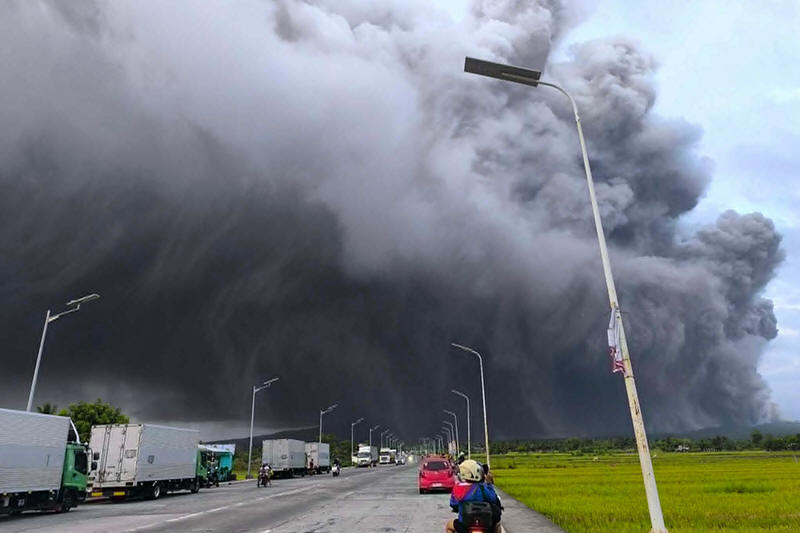
No deaths or injuries were reported, but massive clouds of ash
scattered over 87 villages in three towns, catching many by
surprise and slowing down motorists due to poor visibility,
officials said.
“The ashfall was just so thick and there was zero visibility
even in our national road,” Mayor Caloy Baldo of Camalig town,
which lies near the volcano's foothills, said.
“Some villagers panicked but we advised them to calm down,”
Baldo told The Associated Press.
Vegetable farms were damaged by the ashfall, which also killed
four water buffaloes and a cow in Camalig, Baldo said, adding
that a cleanup was underway in his town of 8,000 people in Albay
province.
“It’s calm again now but the danger is always there,” Bacolcol
said of Mayon's condition Monday.
The 2,462-meter (8,077-foot) volcano is one of the Philippines’
top tourism draws because of its near-perfect cone shape. But
it’s also the most active of the country’s 24 volcanoes.
Authorities raised the five-step alert around Mayon to level 3
in January after a series of mild eruptions that caused
intermittent rockfalls, some as big as cars, from its peak
crater along with deadly pyroclastic flows.
Alert 5 means an explosive and life-threatening eruption is
underway with deadly volcanic lava and pyroclastic flows and
heavy ashfall.
All contents © copyright 2026 Associated Press. All rights
reserved |
|