European leaders see Trump's troop drawdown from Germany as new proof
they must go it alone
[May 04, 2026]
By MARK CARLSON and LORNE COOK
YEREVAN, Armenia (AP) — European leaders on Monday said that U.S.
President Donald Trump’s snap decision to pull thousands of U.S. troops
out of Germany came as a surprise but is a fresh sign that Europe must
take care of its own security.
The Pentagon announced last week that it would pull some 5,000 troops
out of Germany, but Trump told reporters on Saturday that “we’re going
to cut way down. And we’re cutting a lot further than 5,000.”
He offered no reason for the move, which blindsided NATO, but his
decision came amid an escalating dispute with German Chancellor
Friedrich Merz over the U.S-Israeli war on Iran, and Trump’s anger that
European allies have been reluctant to get involved in the conflict in
the Middle East.
Asked about the decision to pull out 5,000 troops from Germany,
Norwegian Prime Minister Jonas Gahr Støre said: “I wouldn’t exaggerate
that because I think we are expecting that Europe is taking more charge
of its own security.
“I do not see those figures as dramatic, but I think they should be
handled in a harmonious way inside the framework of NATO,” he told
reporters in Yerevan, Armenia, where European leaders are holding a
summit.
The European Union’s foreign policy chief, Kaja Kallas, said “there has
been a talk about withdrawal of U.S. troops for a long time from Europe.
But of course, the timing of this announcement comes as a surprise.”
“I think it shows that we have to really strengthen the European pillar
in NATO,” she said.

Asked whether she believes that Trump is trying to punish Merz, who said
that the U.S. has been humiliated by Iran in talks to end the war,
Kallas said: “I don’t see into the head of President Trump, so he has to
explain it himself.”
Over the weekend, NATO spokesperson Allison Hart said that officials at
the 32-nation military alliance “are working with the U.S. to understand
the details of their decision on force posture in Germany.”
European allies and Canada have known since just after he came to office
again last year that Trump would pull troops out of Europe — indeed some
left Romania in October — but U.S. officials had pledged to coordinate
any moves with their NATO allies to avoid creating a security vacuum.
NATO Secretary-General Mark Rutte played down the move, saying that
“there has been at this point disappointment on the U.S. side” about
European support for the war on Iran.
[to top of second column]
|
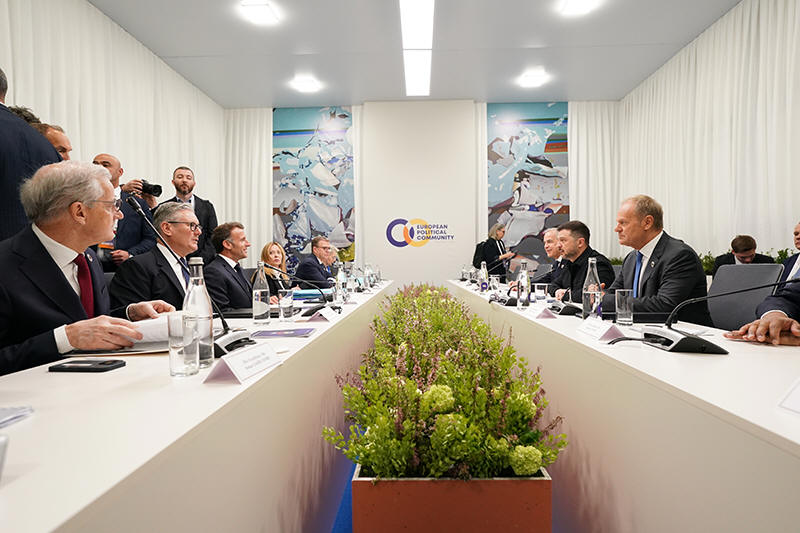
Ukraine's President Volodymyr Zelenskyy, second right, sits opposite
Britain's Prime Minister Keir Starmer, second left, and France's
President Emmanuel Macron, third left, during the Ukraine
multi-lateral meeting, co-chaired by UK and France at the European
Political Community summit in Yerevan, Armenia, Monday May 4, 2026.
(Stefan Rousseau/Pool Photo via AP)

Notably France, Spain and the U.K. have declined to give U.S. forces
free rein to use bases on their territory to attack Iran. Spain has
denied them the use of its airspace and bases there for the war.
But Rutte, who has championed Trump’s leadership at NATO despite the
U.S. president's criticism of the majority of the allies, said: “I
would say the Europeans have heard a message. They are now making
sure that all the bilateral basing agreements are being
implemented.”
Rutte added that European nations “have decided to pre-position
assets, key assets, close to the theater for the next phase.”
He provided no details, but the Europeans have insisted they would
not help police the Strait of Hormuz, a key energy trade route,
until the war is over.
French President Emmanuel Macron said “if the United States is ready
to reopen Hormuz, that’s great. That’s what we’ve been asking for
since the beginning.” But he underlined that the Europeans are not
ready to get involved in any operation “that does not seem clear to
us.”
In another sign of friction with Merz, Trump has accused the EU of
not complying with its U.S. trade deal and announced plans to
increase tariffs next week on cars and trucks produced in the bloc
to 25%, a move that would be particularly damaging to Germany, a
major automobile manufacturer.
Without mentioning Trump or the United States, European Commission
President Ursula von der Leyen listed recent trade deals that the
bloc has sealed with Australia and India, and is now working on with
Mexico.
“With like-minded friends, you have stable, reliable supply chains
and Europe has the biggest network of free trade agreements,” von
der Leyen, who is from Germany, told reporters.
___
Cook reported from Brussels.
All contents © copyright 2026 Associated Press. All rights reserved |